

5 Treatment to Prevent Nutrient Discharges
It is apparent that the most effective measure to control eutrophication would be to
control the nutrient inputs. However, this is not always possible nor practical. It is
nearly impossible to lower the total carbon inputs to a lake, because there is always
some dissolved carbon dioxide present from the atmosphere that can become
available as a carbon source. It is not desirable to limit the oxygen, as that would
encourage anaerobic decomposition with its odors and other undesirable conditions.
Nitrogenous materials can be removed from a wastewater treatment plant effluent,
but certain blue-green algae can utilize nitrogen from the atmosphere. Phosphorus
can also be removed from wastewater effluents. Unless there is a large phosphate
deposit in the watershed or the lake bed, this can result in a permanent removal of the
phosphate so long as the lake maintains aerobic conditions. Thus phosphorus
removal has received much attention in the effort to limit primary productivity.
Furthermore, in his study of lakes around the world, Vollenweider [3] observed that
the nutrient most frequently limiting productivity in lakes was phosphorus.
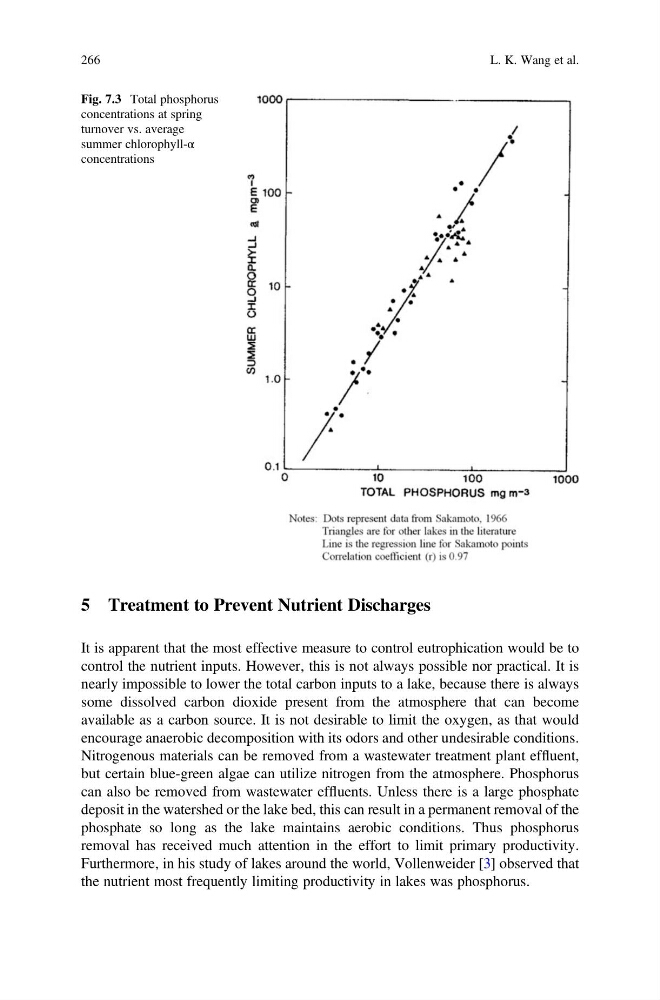
Fig. 7.3 Total phosphorus
concentrations at spring
turnover vs. average
summer chlorophyll-α
concentrations
266
L. K. Wang et al.
It is apparent that the most effective measure to control eutrophication would be to
control the nutrient inputs. However, this is not always possible nor practical. It is
nearly impossible to lower the total carbon inputs to a lake, because there is always
some dissolved carbon dioxide present from the atmosphere that can become
available as a carbon source. It is not desirable to limit the oxygen, as that would
encourage anaerobic decomposition with its odors and other undesirable conditions.
Nitrogenous materials can be removed from a wastewater treatment plant effluent,
but certain blue-green algae can utilize nitrogen from the atmosphere. Phosphorus
can also be removed from wastewater effluents. Unless there is a large phosphate
deposit in the watershed or the lake bed, this can result in a permanent removal of the
phosphate so long as the lake maintains aerobic conditions. Thus phosphorus
removal has received much attention in the effort to limit primary productivity.
Furthermore, in his study of lakes around the world, Vollenweider [3] observed that
the nutrient most frequently limiting productivity in lakes was phosphorus.
Fig. 7.3 Total phosphorus
concentrations at spring
turnover vs. average
summer chlorophyll-α
concentrations
266
L. K. Wang et al.