

• Poor construction workmanship causes the joints between pipes to separate,
resulting in an opening that will widen and pass increasing flows with high
pressures. It was also observed that the backfill materials were not of uniform
sizes. Sometimes large pieces of stone were found in the fill materials causing
splits, particularly in plastic pipes.
2. Leakage rates in the five areas ranged between 10% and 24%, with an overall
weighted average of 16%, for pipe sizes between 19 and 150 mm. According to
Riyadh Region Water and Sanitary Drainage Authority (RRWSDA), the leakage
in water mains greater than 150 mm is negligible. The reason for this is that
failures in large supply mains are easily detected and consequently they are
promptly repaired. Although water losses in Ar-Riyadh are not excessive in
comparison to other cities in the world (see Table 6.1), yet a leakage control
program is essential because of the scarcity and high cost of water in Saudi
Arabia.
3. Desalinated water is imported to Ar-Riyadh from the Arabian Gulf at a relatively
high cost. The unit cost of desalinated water is in the range of SR 3–6 (USD
0.8–1.6) per cubic meter [25]. For a total water supply of about 6.5 million m
3 /
day in 2015, the annual cost of lost water at a leakage rate of 16% is around USD
300 million as a minimum figure. This is a considerable economic loss, notwithstanding problems created by the rising groundwater table in the city. As part of
the preventative solutions adopted to control the rising groundwater table, a
2-year crash program for leak detection and repair was implemented to reduce
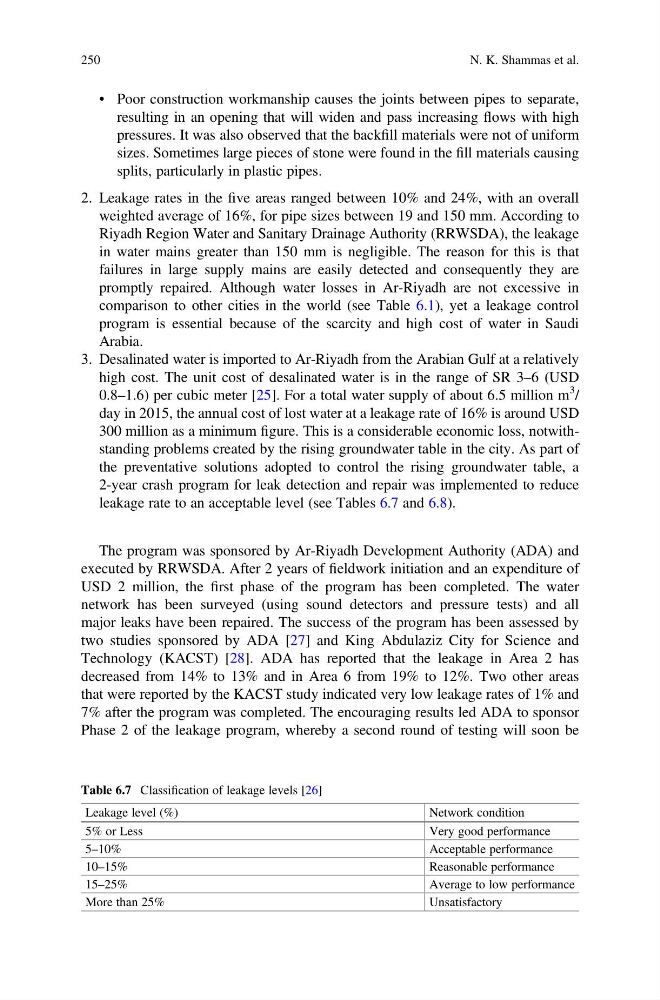
leakage rate to an acceptable level (see Tables 6.7 and 6.8).
The program was sponsored by Ar-Riyadh Development Authority (ADA) and
executed by RRWSDA. After 2 years of fieldwork initiation and an expenditure of
USD 2 million, the first phase of the program has been completed. The water
network has been surveyed (using sound detectors and pressure tests) and all
major leaks have been repaired. The success of the program has been assessed by
two studies sponsored by ADA [27] and King Abdulaziz City for Science and
Technology (KACST) [28]. ADA has reported that the leakage in Area 2 has
decreased from 14% to 13% and in Area 6 from 19% to 12%. Two other areas
that were reported by the KACST study indicated very low leakage rates of 1% and
7% after the program was completed. The encouraging results led ADA to sponsor
Phase 2 of the leakage program, whereby a second round of testing will soon be
Table 6.7 Classification of leakage levels [26]
Leakage level (%)
Network condition
5% or Less
Very good performance
5–10%
Acceptable performance
10–15%
Reasonable performance
15–25%
Average to low performance
More than 25%
Unsatisfactory
250
N. K. Shammas et al.
resulting in an opening that will widen and pass increasing flows with high
pressures. It was also observed that the backfill materials were not of uniform
sizes. Sometimes large pieces of stone were found in the fill materials causing
splits, particularly in plastic pipes.
2. Leakage rates in the five areas ranged between 10% and 24%, with an overall
weighted average of 16%, for pipe sizes between 19 and 150 mm. According to
Riyadh Region Water and Sanitary Drainage Authority (RRWSDA), the leakage
in water mains greater than 150 mm is negligible. The reason for this is that
failures in large supply mains are easily detected and consequently they are
promptly repaired. Although water losses in Ar-Riyadh are not excessive in
comparison to other cities in the world (see Table 6.1), yet a leakage control
program is essential because of the scarcity and high cost of water in Saudi
Arabia.
3. Desalinated water is imported to Ar-Riyadh from the Arabian Gulf at a relatively
high cost. The unit cost of desalinated water is in the range of SR 3–6 (USD
0.8–1.6) per cubic meter [25]. For a total water supply of about 6.5 million m
3 /
day in 2015, the annual cost of lost water at a leakage rate of 16% is around USD
300 million as a minimum figure. This is a considerable economic loss, notwithstanding problems created by the rising groundwater table in the city. As part of
the preventative solutions adopted to control the rising groundwater table, a
2-year crash program for leak detection and repair was implemented to reduce
leakage rate to an acceptable level (see Tables 6.7 and 6.8).
The program was sponsored by Ar-Riyadh Development Authority (ADA) and
executed by RRWSDA. After 2 years of fieldwork initiation and an expenditure of
USD 2 million, the first phase of the program has been completed. The water
network has been surveyed (using sound detectors and pressure tests) and all
major leaks have been repaired. The success of the program has been assessed by
two studies sponsored by ADA [27] and King Abdulaziz City for Science and
Technology (KACST) [28]. ADA has reported that the leakage in Area 2 has
decreased from 14% to 13% and in Area 6 from 19% to 12%. Two other areas
that were reported by the KACST study indicated very low leakage rates of 1% and
7% after the program was completed. The encouraging results led ADA to sponsor
Phase 2 of the leakage program, whereby a second round of testing will soon be
Table 6.7 Classification of leakage levels [26]
Leakage level (%)
Network condition
5% or Less
Very good performance
5–10%
Acceptable performance
10–15%
Reasonable performance
15–25%
Average to low performance
More than 25%
Unsatisfactory
250
N. K. Shammas et al.