

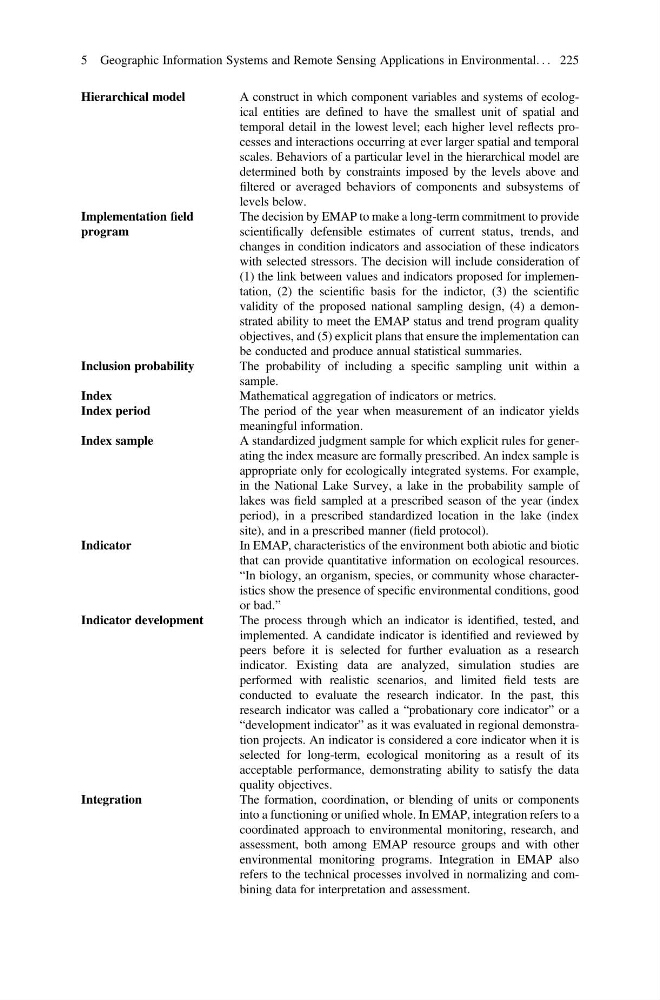
Hierarchical model
A construct in which component variables and systems of ecological entities are defined to have the smallest unit of spatial and
temporal detail in the lowest level; each higher level reflects processes and interactions occurring at ever larger spatial and temporal
scales. Behaviors of a particular level in the hierarchical model are
determined both by constraints imposed by the levels above and
filtered or averaged behaviors of components and subsystems of
levels below.
Implementation field
program
The decision by EMAP to make a long-term commitment to provide
scientifically defensible estimates of current status, trends, and
changes in condition indicators and association of these indicators
with selected stressors. The decision will include consideration of
(1) the link between values and indicators proposed for implementation, (2) the scientific basis for the indictor, (3) the scientific
validity of the proposed national sampling design, (4) a demonstrated ability to meet the EMAP status and trend program quality
objectives, and (5) explicit plans that ensure the implementation can
be conducted and produce annual statistical summaries.
Inclusion probability
The probability of including a specific sampling unit within a
sample.
Index
Mathematical aggregation of indicators or metrics.
Index period
The period of the year when measurement of an indicator yields
meaningful information.
Index sample
A standardized judgment sample for which explicit rules for generating the index measure are formally prescribed. An index sample is
appropriate only for ecologically integrated systems. For example,
in the National Lake Survey, a lake in the probability sample of
lakes was field sampled at a prescribed season of the year (index
period), in a prescribed standardized location in the lake (index
site), and in a prescribed manner (field protocol).
Indicator
In EMAP, characteristics of the environment both abiotic and biotic
that can provide quantitative information on ecological resources.
“In biology, an organism, species, or community whose characteristics show the presence of specific environmental conditions, good
or bad.”
Indicator development
The process through which an indicator is identified, tested, and
implemented. A candidate indicator is identified and reviewed by
peers before it is selected for further evaluation as a research
indicator. Existing data are analyzed, simulation studies are
performed with realistic scenarios, and limited field tests are
conducted to evaluate the research indicator. In the past, this
research indicator was called a “probationary core indicator” or a
“development indicator” as it was evaluated in regional demonstration projects. An indicator is considered a core indicator when it is
selected for long-term, ecological monitoring as a result of its
acceptable performance, demonstrating ability to satisfy the data
quality objectives.
Integration
The formation, coordination, or blending of units or components
into a functioning or unified whole. In EMAP, integration refers to a
coordinated approach to environmental monitoring, research, and
assessment, both among EMAP resource groups and with other
environmental monitoring programs. Integration in EMAP also
refers to the technical processes involved in normalizing and combining data for interpretation and assessment.
5 Geographic Information Systems and Remote Sensing Applications in Environmental. . . 225
A construct in which component variables and systems of ecological entities are defined to have the smallest unit of spatial and
temporal detail in the lowest level; each higher level reflects processes and interactions occurring at ever larger spatial and temporal
scales. Behaviors of a particular level in the hierarchical model are
determined both by constraints imposed by the levels above and
filtered or averaged behaviors of components and subsystems of
levels below.
Implementation field
program
The decision by EMAP to make a long-term commitment to provide
scientifically defensible estimates of current status, trends, and
changes in condition indicators and association of these indicators
with selected stressors. The decision will include consideration of
(1) the link between values and indicators proposed for implementation, (2) the scientific basis for the indictor, (3) the scientific
validity of the proposed national sampling design, (4) a demonstrated ability to meet the EMAP status and trend program quality
objectives, and (5) explicit plans that ensure the implementation can
be conducted and produce annual statistical summaries.
Inclusion probability
The probability of including a specific sampling unit within a
sample.
Index
Mathematical aggregation of indicators or metrics.
Index period
The period of the year when measurement of an indicator yields
meaningful information.
Index sample
A standardized judgment sample for which explicit rules for generating the index measure are formally prescribed. An index sample is
appropriate only for ecologically integrated systems. For example,
in the National Lake Survey, a lake in the probability sample of
lakes was field sampled at a prescribed season of the year (index
period), in a prescribed standardized location in the lake (index
site), and in a prescribed manner (field protocol).
Indicator
In EMAP, characteristics of the environment both abiotic and biotic
that can provide quantitative information on ecological resources.
“In biology, an organism, species, or community whose characteristics show the presence of specific environmental conditions, good
or bad.”
Indicator development
The process through which an indicator is identified, tested, and
implemented. A candidate indicator is identified and reviewed by
peers before it is selected for further evaluation as a research
indicator. Existing data are analyzed, simulation studies are
performed with realistic scenarios, and limited field tests are
conducted to evaluate the research indicator. In the past, this
research indicator was called a “probationary core indicator” or a
“development indicator” as it was evaluated in regional demonstration projects. An indicator is considered a core indicator when it is
selected for long-term, ecological monitoring as a result of its
acceptable performance, demonstrating ability to satisfy the data
quality objectives.
Integration
The formation, coordination, or blending of units or components
into a functioning or unified whole. In EMAP, integration refers to a
coordinated approach to environmental monitoring, research, and
assessment, both among EMAP resource groups and with other
environmental monitoring programs. Integration in EMAP also
refers to the technical processes involved in normalizing and combining data for interpretation and assessment.
5 Geographic Information Systems and Remote Sensing Applications in Environmental. . . 225