

plant. About 60% and 100% reuses of the treated wastewater are recommended for
the television picture tube and aperture mask segments, respectively. Summary of
effectiveness of all these recommended technologies applied to the television picture
tubes is presented in Table 4.24.
2.4.5 Treatment Technology and Cost
The best practicable control treatment (BPT) for this subcategory, particularly for the
television picture tube and aperture mask waste under the step 1 treatment process, is
achievable in three separate treatment systems summarized in Table 4.25.
The BAT treatment level involves all the treatments recommended for BPT and,
in addition, multimedia filtration, to improve the standard of the effluent before
neutralization and discharge into the environment. To maximize the use of water,
particularly reuse, in the manufacturing of television picture tubes and aperture
masks, it is recommended that wastewater resulting from the plants should be treated
to 50% and 100%, respectively, before recycling. The total annual unit cost covering
all the treatment systems involved in all the steps stated above for the electronic tube
subcategory is summarized in Table 4.26.
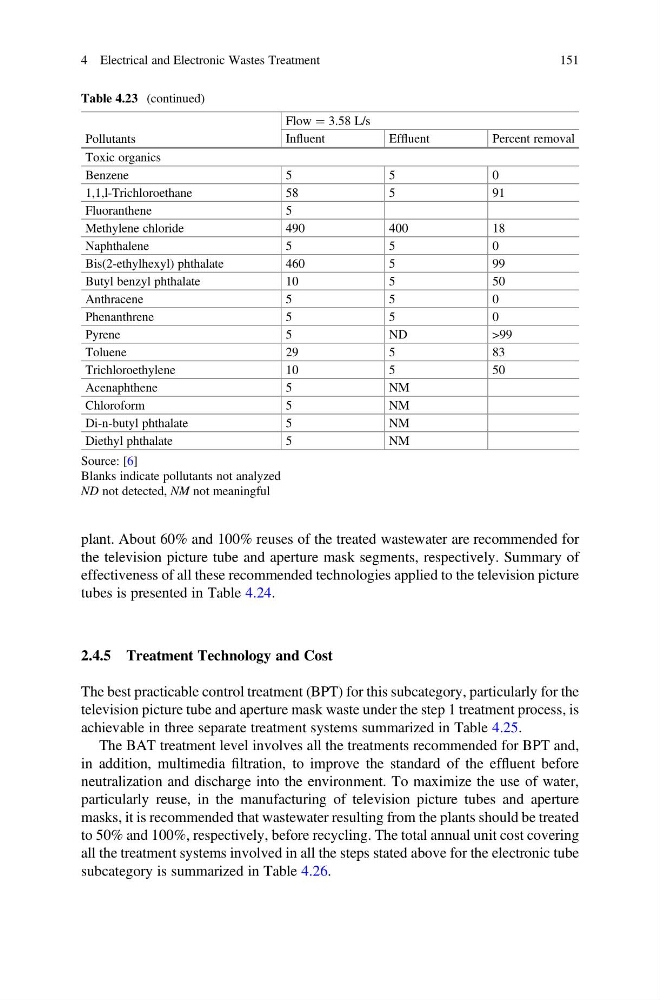
Table 4.23 (continued)
Pollutants
Flow ¼ 3.58 L/s
Influent
Effluent
Percent removal
Toxic organics
Benzene
5
5
0
1,1,l-Trichloroethane
58
5
91
Fluoranthene
5
Methylene chloride
490
400
18
Naphthalene
5
5
0
Bis(2-ethylhexyl) phthalate
460
5
99
Butyl benzyl phthalate
10
5
50
Anthracene
5
5
0
Phenanthrene
5
5
0
Pyrene
5
ND
>99
Toluene
29
5
83
Trichloroethylene
10
5
50
Acenaphthene
5
NM
Chloroform
5
NM
Di-n-butyl phthalate
5
NM
Diethyl phthalate
5
NM
Source: [6]
Blanks indicate pollutants not analyzed
ND not detected, NM not meaningful
4 Electrical and Electronic Wastes Treatment
151
the television picture tube and aperture mask segments, respectively. Summary of
effectiveness of all these recommended technologies applied to the television picture
tubes is presented in Table 4.24.
2.4.5 Treatment Technology and Cost
The best practicable control treatment (BPT) for this subcategory, particularly for the
television picture tube and aperture mask waste under the step 1 treatment process, is
achievable in three separate treatment systems summarized in Table 4.25.
The BAT treatment level involves all the treatments recommended for BPT and,
in addition, multimedia filtration, to improve the standard of the effluent before
neutralization and discharge into the environment. To maximize the use of water,
particularly reuse, in the manufacturing of television picture tubes and aperture
masks, it is recommended that wastewater resulting from the plants should be treated
to 50% and 100%, respectively, before recycling. The total annual unit cost covering
all the treatment systems involved in all the steps stated above for the electronic tube
subcategory is summarized in Table 4.26.
Table 4.23 (continued)
Pollutants
Flow ¼ 3.58 L/s
Influent
Effluent
Percent removal
Toxic organics
Benzene
5
5
0
1,1,l-Trichloroethane
58
5
91
Fluoranthene
5
Methylene chloride
490
400
18
Naphthalene
5
5
0
Bis(2-ethylhexyl) phthalate
460
5
99
Butyl benzyl phthalate
10
5
50
Anthracene
5
5
0
Phenanthrene
5
5
0
Pyrene
5
ND
>99
Toluene
29
5
83
Trichloroethylene
10
5
50
Acenaphthene
5
NM
Chloroform
5
NM
Di-n-butyl phthalate
5
NM
Diethyl phthalate
5
NM
Source: [6]
Blanks indicate pollutants not analyzed
ND not detected, NM not meaningful
4 Electrical and Electronic Wastes Treatment
151