

single phosphor tubes, television sets, and computer displays are produced. Electron
tubes are devices with vacuum or ionized gas-filled tubes made of glass, quartz,
ceramic, or metal, which facilitate the conduction of electrons or ions between the
electrodes. In a given electron tube, electrons are emitted by certain elements or
compounds when the energy of the surface atoms is raised by the addition of heat or
increase in energy of bombarding particles, which excites the screen. The receivingtype electron tubes are important components that are manufactured under this
subcategory and are widely used as low-voltage and low-power appliances such as
radio and television receivers, computers, and sensitive control and measuring
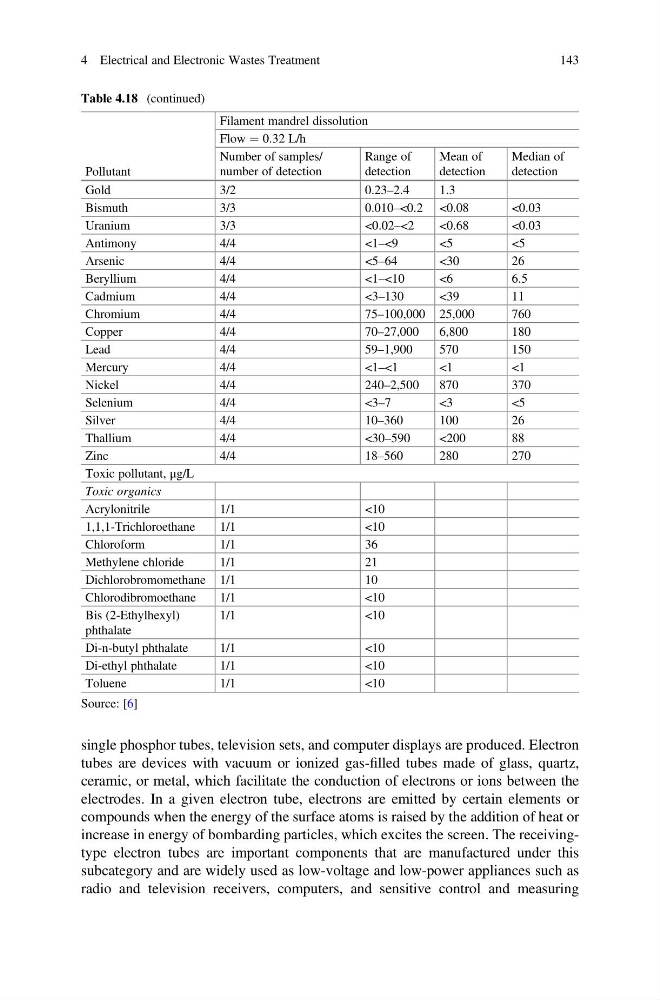
Table 4.18 (continued)
Pollutant
Filament mandrel dissolution
Flow ¼ 0.32 L/h
Number of samples/
number of detection
Range of
detection
Mean of
detection
Median of
detection
Gold
3/2
0.23–2.4
1.3
Bismuth
3/3
0.010–<0.2 <0.08
<0.03
Uranium
3/3
<0.02–<2
<0.68
<0.03
Antimony
4/4
<1–<9
<5
<5
Arsenic
4/4
<5–64
<30
26
Beryllium
4/4
<1–<10
<6
6.5
Cadmium
4/4
<3–130
<39
11
Chromium
4/4
75–100,000 25,000
760
Copper
4/4
70–27,000
6,800
180
Lead
4/4
59–1,900
570
150
Mercury
4/4
<1–<1
<1
<1
Nickel
4/4
240–2,500
870
370
Selenium
4/4
<3–7
< 3
< 5
Silver
4/4
10–360
100
26
Thallium
4/4
<30–590
<200
88
Zinc
4/4
18–560
280
270
Toxic pollutant, μg/L
Toxic organics
Acrylonitrile
1/1
<10
1,1,1-Trichloroethane
1/1
<10
Chloroform
1/1
36
Methylene chloride
1/1
21
Dichlorobromomethane 1/1
10
Chlorodibromoethane
1/1
<10
Bis (2-Ethylhexyl)
phthalate
1/1
<10
Di-n-butyl phthalate
1/1
<10
Di-ethyl phthalate
1/1
<10
Toluene
1/1
<10
Source: [6]
4 Electrical and Electronic Wastes Treatment
143
tubes are devices with vacuum or ionized gas-filled tubes made of glass, quartz,
ceramic, or metal, which facilitate the conduction of electrons or ions between the
electrodes. In a given electron tube, electrons are emitted by certain elements or
compounds when the energy of the surface atoms is raised by the addition of heat or
increase in energy of bombarding particles, which excites the screen. The receivingtype electron tubes are important components that are manufactured under this
subcategory and are widely used as low-voltage and low-power appliances such as
radio and television receivers, computers, and sensitive control and measuring
Table 4.18 (continued)
Pollutant
Filament mandrel dissolution
Flow ¼ 0.32 L/h
Number of samples/
number of detection
Range of
detection
Mean of
detection
Median of
detection
Gold
3/2
0.23–2.4
1.3
Bismuth
3/3
0.010–<0.2 <0.08
<0.03
Uranium
3/3
<0.02–<2
<0.68
<0.03
Antimony
4/4
<1–<9
<5
<5
Arsenic
4/4
<5–64
<30
26
Beryllium
4/4
<1–<10
<6
6.5
Cadmium
4/4
<3–130
<39
11
Chromium
4/4
75–100,000 25,000
760
Copper
4/4
70–27,000
6,800
180
Lead
4/4
59–1,900
570
150
Mercury
4/4
<1–<1
<1
<1
Nickel
4/4
240–2,500
870
370
Selenium
4/4
<3–7
< 3
< 5
Silver
4/4
10–360
100
26
Thallium
4/4
<30–590
<200
88
Zinc
4/4
18–560
280
270
Toxic pollutant, μg/L
Toxic organics
Acrylonitrile
1/1
<10
1,1,1-Trichloroethane
1/1
<10
Chloroform
1/1
36
Methylene chloride
1/1
21
Dichlorobromomethane 1/1
10
Chlorodibromoethane
1/1
<10
Bis (2-Ethylhexyl)
phthalate
1/1
<10
Di-n-butyl phthalate
1/1
<10
Di-ethyl phthalate
1/1
<10
Toluene
1/1
<10
Source: [6]
4 Electrical and Electronic Wastes Treatment
143