

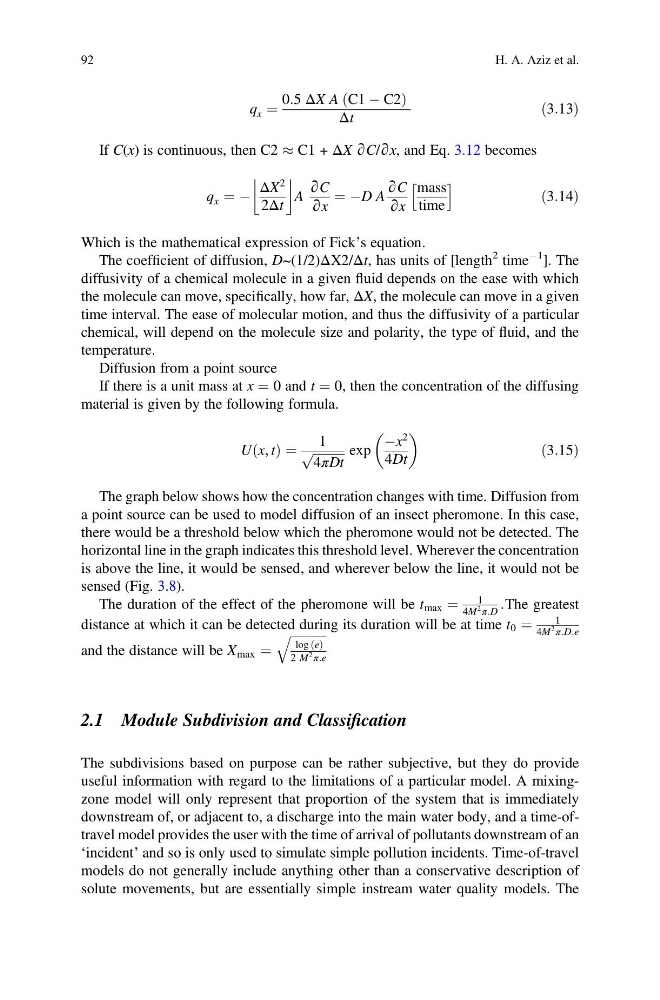
q x ¼
0:5 ΔX A C1 À C2
ð
Þ
Δt
ð3:13Þ
If C(x) is continuous, then C2 % C1 + ΔX ∂C/∂x, and Eq. 3.12 becomes
q x ¼ À
ΔX
2
2Δt
"
#
A
∂C
∂x
¼ ÀD A
∂C
∂x
mass
time
h
i
ð3:14Þ
Which is the mathematical expression of Fick’s equation.
The coefficient of diffusion, D~(1/2)ΔX2/Δt, has units of [length
2 time
À1 ]. The
diffusivity of a chemical molecule in a given fluid depends on the ease with which
the molecule can move, specifically, how far, ΔX, the molecule can move in a given
time interval. The ease of molecular motion, and thus the diffusivity of a particular
chemical, will depend on the molecule size and polarity, the type of fluid, and the
temperature.
Diffusion from a point source
If there is a unit mass at x ¼ 0 and t ¼ 0, then the concentration of the diffusing
material is given by the following formula.
U x, t
ð Þ ¼
1
ffiffiffiffiffiffiffiffiffiffi
4πDt
p
exp
Àx
2
4Dt
ð3:15Þ
The graph below shows how the concentration changes with time. Diffusion from
a point source can be used to model diffusion of an insect pheromone. In this case,
there would be a threshold below which the pheromone would not be detected. The
horizontal line in the graph indicates this threshold level. Wherever the concentration
is above the line, it would be sensed, and wherever below the line, it would not be
sensed (Fig. 3.8).
The duration of the effect of the pheromone will be t max ¼
1
4M
2 π:D
:The greatest
distance at which it can be detected during its duration will be at time t 0 ¼
1
4M
2 π:D:e
and the distance will be X max ¼
ffiffiffiffiffiffiffiffiffiffiffi ffi
log e
ð Þ
2 M
2 π:e
q
2.1 Module Subdivision and Classification
The subdivisions based on purpose can be rather subjective, but they do provide
useful information with regard to the limitations of a particular model. A mixingzone model will only represent that proportion of the system that is immediately
downstream of, or adjacent to, a discharge into the main water body, and a time-oftravel model provides the user with the time of arrival of pollutants downstream of an
‘incident’ and so is only used to simulate simple pollution incidents. Time-of-travel
models do not generally include anything other than a conservative description of
solute movements, but are essentially simple instream water quality models. The
92
H. A. Aziz et al.
0:5 ΔX A C1 À C2
ð
Þ
Δt
ð3:13Þ
If C(x) is continuous, then C2 % C1 + ΔX ∂C/∂x, and Eq. 3.12 becomes
q x ¼ À
ΔX
2
2Δt
"
#
A
∂C
∂x
¼ ÀD A
∂C
∂x
mass
time
h
i
ð3:14Þ
Which is the mathematical expression of Fick’s equation.
The coefficient of diffusion, D~(1/2)ΔX2/Δt, has units of [length
2 time
À1 ]. The
diffusivity of a chemical molecule in a given fluid depends on the ease with which
the molecule can move, specifically, how far, ΔX, the molecule can move in a given
time interval. The ease of molecular motion, and thus the diffusivity of a particular
chemical, will depend on the molecule size and polarity, the type of fluid, and the
temperature.
Diffusion from a point source
If there is a unit mass at x ¼ 0 and t ¼ 0, then the concentration of the diffusing
material is given by the following formula.
U x, t
ð Þ ¼
1
ffiffiffiffiffiffiffiffiffiffi
4πDt
p
exp
Àx
2
4Dt
ð3:15Þ
The graph below shows how the concentration changes with time. Diffusion from
a point source can be used to model diffusion of an insect pheromone. In this case,
there would be a threshold below which the pheromone would not be detected. The
horizontal line in the graph indicates this threshold level. Wherever the concentration
is above the line, it would be sensed, and wherever below the line, it would not be
sensed (Fig. 3.8).
The duration of the effect of the pheromone will be t max ¼
1
4M
2 π:D
:The greatest
distance at which it can be detected during its duration will be at time t 0 ¼
1
4M
2 π:D:e
and the distance will be X max ¼
ffiffiffiffiffiffiffiffiffiffiffi ffi
log e
ð Þ
2 M
2 π:e
q
2.1 Module Subdivision and Classification
The subdivisions based on purpose can be rather subjective, but they do provide
useful information with regard to the limitations of a particular model. A mixingzone model will only represent that proportion of the system that is immediately
downstream of, or adjacent to, a discharge into the main water body, and a time-oftravel model provides the user with the time of arrival of pollutants downstream of an
‘incident’ and so is only used to simulate simple pollution incidents. Time-of-travel
models do not generally include anything other than a conservative description of
solute movements, but are essentially simple instream water quality models. The
92
H. A. Aziz et al.