

model membranes. Results reporting on the application of PM IRRAS with electrochemical control for studies of structural changes in lipid bilayers experiencing
specific interactions with polypeptides and proteins are described below.
Interaction of Lipid Bilayers with Antimicrobial Peptides The surface of biological cell membranes is constantly exposed to interplay between pathogens
(e.g. bacteria) and hosts organisms (eukaryote). Ribosomally synthesized short
cationic polypeptides belong to the innate immune system of eukaryote. They are
called antimicrobial peptides (AMPs). AMPs are usually composed of a 20–80
amino acids long polypeptide chain. Upon interaction with the cell membrane
AMPs adopt either α-helical or β-sheet secondary structure. The insertion of
AMPs into the lipid membrane occurs according to different mechanisms. The
interaction with the cell membrane involves electrostatic interactions and adsorption
of positively charged peptides on the surface of a negatively charged bacterial cell
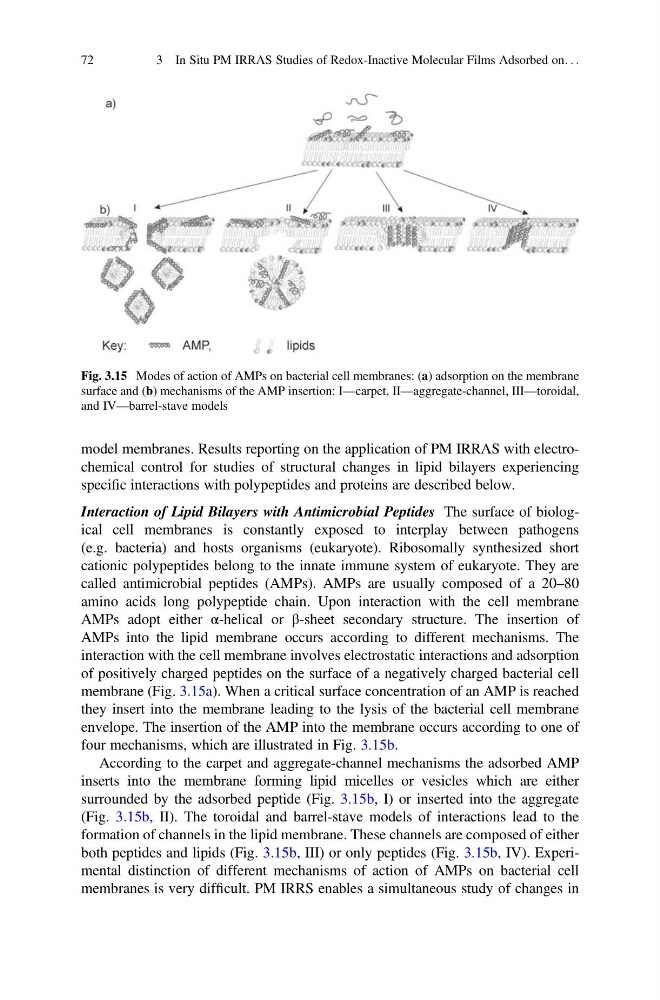
membrane (Fig. 3.15a). When a critical surface concentration of an AMP is reached
they insert into the membrane leading to the lysis of the bacterial cell membrane
envelope. The insertion of the AMP into the membrane occurs according to one of
four mechanisms, which are illustrated in Fig. 3.15b.
According to the carpet and aggregate-channel mechanisms the adsorbed AMP
inserts into the membrane forming lipid micelles or vesicles which are either
surrounded by the adsorbed peptide (Fig. 3.15b, I) or inserted into the aggregate
(Fig. 3.15b, II). The toroidal and barrel-stave models of interactions lead to the
formation of channels in the lipid membrane. These channels are composed of either
both peptides and lipids (Fig. 3.15b, III) or only peptides (Fig. 3.15b, IV). Experimental distinction of different mechanisms of action of AMPs on bacterial cell
membranes is very difficult. PM IRRS enables a simultaneous study of changes in
Fig. 3.15 Modes of action of AMPs on bacterial cell membranes: (a) adsorption on the membrane
surface and (b) mechanisms of the AMP insertion: I—carpet, II—aggregate-channel, III—toroidal,
and IV—barrel-stave models
72
3 In Situ PM IRRAS Studies of Redox-Inactive Molecular Films Adsorbed on. . .
specific interactions with polypeptides and proteins are described below.
Interaction of Lipid Bilayers with Antimicrobial Peptides The surface of biological cell membranes is constantly exposed to interplay between pathogens
(e.g. bacteria) and hosts organisms (eukaryote). Ribosomally synthesized short
cationic polypeptides belong to the innate immune system of eukaryote. They are
called antimicrobial peptides (AMPs). AMPs are usually composed of a 20–80
amino acids long polypeptide chain. Upon interaction with the cell membrane
AMPs adopt either α-helical or β-sheet secondary structure. The insertion of
AMPs into the lipid membrane occurs according to different mechanisms. The
interaction with the cell membrane involves electrostatic interactions and adsorption
of positively charged peptides on the surface of a negatively charged bacterial cell
membrane (Fig. 3.15a). When a critical surface concentration of an AMP is reached
they insert into the membrane leading to the lysis of the bacterial cell membrane
envelope. The insertion of the AMP into the membrane occurs according to one of
four mechanisms, which are illustrated in Fig. 3.15b.
According to the carpet and aggregate-channel mechanisms the adsorbed AMP
inserts into the membrane forming lipid micelles or vesicles which are either
surrounded by the adsorbed peptide (Fig. 3.15b, I) or inserted into the aggregate
(Fig. 3.15b, II). The toroidal and barrel-stave models of interactions lead to the
formation of channels in the lipid membrane. These channels are composed of either
both peptides and lipids (Fig. 3.15b, III) or only peptides (Fig. 3.15b, IV). Experimental distinction of different mechanisms of action of AMPs on bacterial cell
membranes is very difficult. PM IRRS enables a simultaneous study of changes in
Fig. 3.15 Modes of action of AMPs on bacterial cell membranes: (a) adsorption on the membrane
surface and (b) mechanisms of the AMP insertion: I—carpet, II—aggregate-channel, III—toroidal,
and IV—barrel-stave models
72
3 In Situ PM IRRAS Studies of Redox-Inactive Molecular Films Adsorbed on. . .