

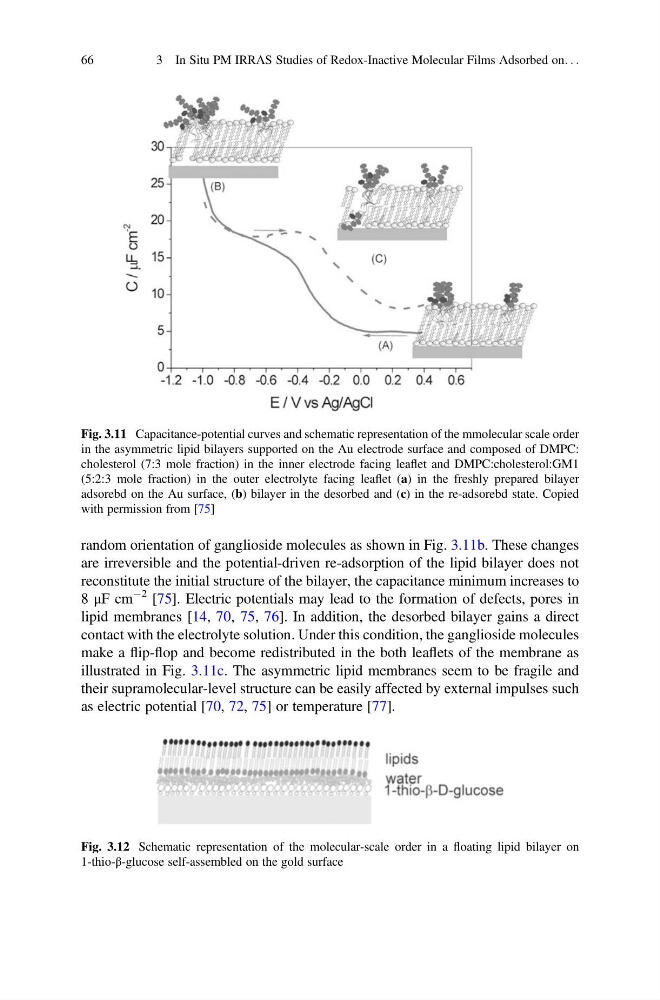
random orientation of ganglioside molecules as shown in Fig. 3.11b. These changes
are irreversible and the potential-driven re-adsorption of the lipid bilayer does not
reconstitute the initial structure of the bilayer, the capacitance minimum increases to
8 μF cm
À2 [75]. Electric potentials may lead to the formation of defects, pores in
lipid membranes [14, 70, 75, 76]. In addition, the desorbed bilayer gains a direct
contact with the electrolyte solution. Under this condition, the ganglioside molecules
make a flip-flop and become redistributed in the both leaflets of the membrane as
illustrated in Fig. 3.11c. The asymmetric lipid membranes seem to be fragile and
their supramolecular-level structure can be easily affected by external impulses such
as electric potential [70, 72, 75] or temperature [77].
Fig. 3.11 Capacitance-potential curves and schematic representation of the mmolecular scale order
in the asymmetric lipid bilayers supported on the Au electrode surface and composed of DMPC:
cholesterol (7:3 mole fraction) in the inner electrode facing leaflet and DMPC:cholesterol:GM1
(5:2:3 mole fraction) in the outer electrolyte facing leaflet (a) in the freshly prepared bilayer
adsorebd on the Au surface, (b) bilayer in the desorbed and (c) in the re-adsorebd state. Copied
with permission from [75]
Fig. 3.12 Schematic representation of the molecular-scale order in a floating lipid bilayer on
1-thio-β-glucose self-assembled on the gold surface
66
3 In Situ PM IRRAS Studies of Redox-Inactive Molecular Films Adsorbed on. . .
are irreversible and the potential-driven re-adsorption of the lipid bilayer does not
reconstitute the initial structure of the bilayer, the capacitance minimum increases to
8 μF cm
À2 [75]. Electric potentials may lead to the formation of defects, pores in
lipid membranes [14, 70, 75, 76]. In addition, the desorbed bilayer gains a direct
contact with the electrolyte solution. Under this condition, the ganglioside molecules
make a flip-flop and become redistributed in the both leaflets of the membrane as
illustrated in Fig. 3.11c. The asymmetric lipid membranes seem to be fragile and
their supramolecular-level structure can be easily affected by external impulses such
as electric potential [70, 72, 75] or temperature [77].
Fig. 3.11 Capacitance-potential curves and schematic representation of the mmolecular scale order
in the asymmetric lipid bilayers supported on the Au electrode surface and composed of DMPC:
cholesterol (7:3 mole fraction) in the inner electrode facing leaflet and DMPC:cholesterol:GM1
(5:2:3 mole fraction) in the outer electrolyte facing leaflet (a) in the freshly prepared bilayer
adsorebd on the Au surface, (b) bilayer in the desorbed and (c) in the re-adsorebd state. Copied
with permission from [75]
Fig. 3.12 Schematic representation of the molecular-scale order in a floating lipid bilayer on
1-thio-β-glucose self-assembled on the gold surface
66
3 In Situ PM IRRAS Studies of Redox-Inactive Molecular Films Adsorbed on. . .