

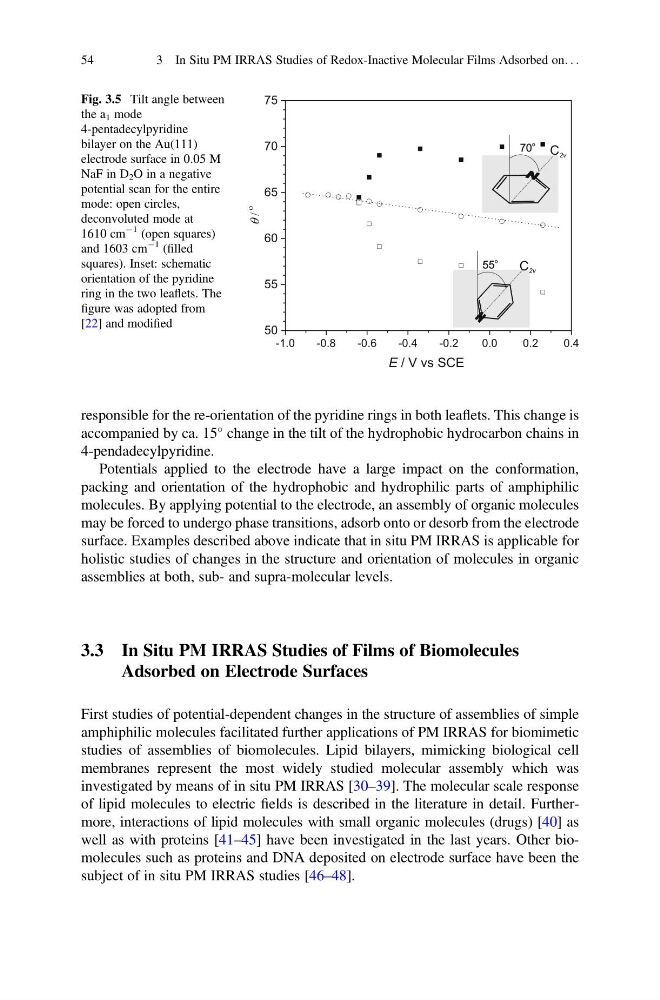
responsible for the re-orientation of the pyridine rings in both leaflets. This change is
accompanied by ca. 15
change in the tilt of the hydrophobic hydrocarbon chains in
4-pendadecylpyridine.
Potentials applied to the electrode have a large impact on the conformation,
packing and orientation of the hydrophobic and hydrophilic parts of amphiphilic
molecules. By applying potential to the electrode, an assembly of organic molecules
may be forced to undergo phase transitions, adsorb onto or desorb from the electrode
surface. Examples described above indicate that in situ PM IRRAS is applicable for
holistic studies of changes in the structure and orientation of molecules in organic
assemblies at both, sub- and supra-molecular levels.
3.3 In Situ PM IRRAS Studies of Films of Biomolecules
Adsorbed on Electrode Surfaces
First studies of potential-dependent changes in the structure of assemblies of simple
amphiphilic molecules facilitated further applications of PM IRRAS for biomimetic
studies of assemblies of biomolecules. Lipid bilayers, mimicking biological cell
membranes represent the most widely studied molecular assembly which was
investigated by means of in situ PM IRRAS [30–39]. The molecular scale response
of lipid molecules to electric fields is described in the literature in detail. Furthermore, interactions of lipid molecules with small organic molecules (drugs) [40] as
well as with proteins [41–45] have been investigated in the last years. Other biomolecules such as proteins and DNA deposited on electrode surface have been the
subject of in situ PM IRRAS studies [46–48].
-1.0
-0.8
-0.6
-0.4
-0.2
0.0
0.2
0.4
50
55
60
65
70
75
E / V vs SCE
C 2v
C 2v
Fig. 3.5 Tilt angle between
the a 1 mode
4-pentadecylpyridine
bilayer on the Au(111)
electrode surface in 0.05 M
NaF in D 2 O in a negative
potential scan for the entire
mode: open circles,
deconvoluted mode at
1610 cm
À1 (open squares)
and 1603 cm
À1 (filled
squares). Inset: schematic
orientation of the pyridine
ring in the two leaflets. The
figure was adopted from
[22] and modified
54
3 In Situ PM IRRAS Studies of Redox-Inactive Molecular Films Adsorbed on. . .
accompanied by ca. 15
change in the tilt of the hydrophobic hydrocarbon chains in
4-pendadecylpyridine.
Potentials applied to the electrode have a large impact on the conformation,
packing and orientation of the hydrophobic and hydrophilic parts of amphiphilic
molecules. By applying potential to the electrode, an assembly of organic molecules
may be forced to undergo phase transitions, adsorb onto or desorb from the electrode
surface. Examples described above indicate that in situ PM IRRAS is applicable for
holistic studies of changes in the structure and orientation of molecules in organic
assemblies at both, sub- and supra-molecular levels.
3.3 In Situ PM IRRAS Studies of Films of Biomolecules
Adsorbed on Electrode Surfaces
First studies of potential-dependent changes in the structure of assemblies of simple
amphiphilic molecules facilitated further applications of PM IRRAS for biomimetic
studies of assemblies of biomolecules. Lipid bilayers, mimicking biological cell
membranes represent the most widely studied molecular assembly which was
investigated by means of in situ PM IRRAS [30–39]. The molecular scale response
of lipid molecules to electric fields is described in the literature in detail. Furthermore, interactions of lipid molecules with small organic molecules (drugs) [40] as
well as with proteins [41–45] have been investigated in the last years. Other biomolecules such as proteins and DNA deposited on electrode surface have been the
subject of in situ PM IRRAS studies [46–48].
-1.0
-0.8
-0.6
-0.4
-0.2
0.0
0.2
0.4
50
55
60
65
70
75
E / V vs SCE
C 2v
C 2v
Fig. 3.5 Tilt angle between
the a 1 mode
4-pentadecylpyridine
bilayer on the Au(111)
electrode surface in 0.05 M
NaF in D 2 O in a negative
potential scan for the entire
mode: open circles,
deconvoluted mode at
1610 cm
À1 (open squares)
and 1603 cm
À1 (filled
squares). Inset: schematic
orientation of the pyridine
ring in the two leaflets. The
figure was adopted from
[22] and modified
54
3 In Situ PM IRRAS Studies of Redox-Inactive Molecular Films Adsorbed on. . .