

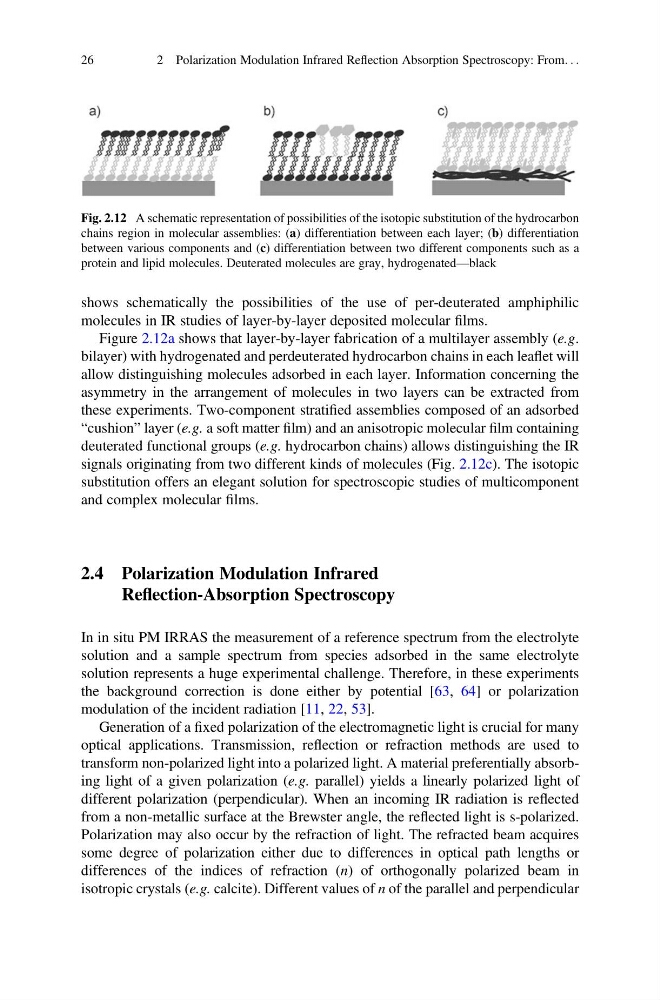
shows schematically the possibilities of the use of per-deuterated amphiphilic
molecules in IR studies of layer-by-layer deposited molecular films.
Figure 2.12a shows that layer-by-layer fabrication of a multilayer assembly (e.g.
bilayer) with hydrogenated and perdeuterated hydrocarbon chains in each leaflet will
allow distinguishing molecules adsorbed in each layer. Information concerning the
asymmetry in the arrangement of molecules in two layers can be extracted from
these experiments. Two-component stratified assemblies composed of an adsorbed
“cushion” layer (e.g. a soft matter film) and an anisotropic molecular film containing
deuterated functional groups (e.g. hydrocarbon chains) allows distinguishing the IR
signals originating from two different kinds of molecules (Fig. 2.12c). The isotopic
substitution offers an elegant solution for spectroscopic studies of multicomponent
and complex molecular films.
2.4 Polarization Modulation Infrared
Reflection-Absorption Spectroscopy
In in situ PM IRRAS the measurement of a reference spectrum from the electrolyte
solution and a sample spectrum from species adsorbed in the same electrolyte
solution represents a huge experimental challenge. Therefore, in these experiments
the background correction is done either by potential [63, 64] or polarization
modulation of the incident radiation [11, 22, 53].
Generation of a fixed polarization of the electromagnetic light is crucial for many
optical applications. Transmission, reflection or refraction methods are used to
transform non-polarized light into a polarized light. A material preferentially absorbing light of a given polarization (e.g. parallel) yields a linearly polarized light of
different polarization (perpendicular). When an incoming IR radiation is reflected
from a non-metallic surface at the Brewster angle, the reflected light is s-polarized.
Polarization may also occur by the refraction of light. The refracted beam acquires
some degree of polarization either due to differences in optical path lengths or
differences of the indices of refraction (n) of orthogonally polarized beam in
isotropic crystals (e.g. calcite). Different values of n of the parallel and perpendicular
Fig. 2.12 A schematic representation of possibilities of the isotopic substitution of the hydrocarbon
chains region in molecular assemblies: (a) differentiation between each layer; (b) differentiation
between various components and (c) differentiation between two different components such as a
protein and lipid molecules. Deuterated molecules are gray, hydrogenated—black
26
2 Polarization Modulation Infrared Reflection Absorption Spectroscopy: From. . .
molecules in IR studies of layer-by-layer deposited molecular films.
Figure 2.12a shows that layer-by-layer fabrication of a multilayer assembly (e.g.
bilayer) with hydrogenated and perdeuterated hydrocarbon chains in each leaflet will
allow distinguishing molecules adsorbed in each layer. Information concerning the
asymmetry in the arrangement of molecules in two layers can be extracted from
these experiments. Two-component stratified assemblies composed of an adsorbed
“cushion” layer (e.g. a soft matter film) and an anisotropic molecular film containing
deuterated functional groups (e.g. hydrocarbon chains) allows distinguishing the IR
signals originating from two different kinds of molecules (Fig. 2.12c). The isotopic
substitution offers an elegant solution for spectroscopic studies of multicomponent
and complex molecular films.
2.4 Polarization Modulation Infrared
Reflection-Absorption Spectroscopy
In in situ PM IRRAS the measurement of a reference spectrum from the electrolyte
solution and a sample spectrum from species adsorbed in the same electrolyte
solution represents a huge experimental challenge. Therefore, in these experiments
the background correction is done either by potential [63, 64] or polarization
modulation of the incident radiation [11, 22, 53].
Generation of a fixed polarization of the electromagnetic light is crucial for many
optical applications. Transmission, reflection or refraction methods are used to
transform non-polarized light into a polarized light. A material preferentially absorbing light of a given polarization (e.g. parallel) yields a linearly polarized light of
different polarization (perpendicular). When an incoming IR radiation is reflected
from a non-metallic surface at the Brewster angle, the reflected light is s-polarized.
Polarization may also occur by the refraction of light. The refracted beam acquires
some degree of polarization either due to differences in optical path lengths or
differences of the indices of refraction (n) of orthogonally polarized beam in
isotropic crystals (e.g. calcite). Different values of n of the parallel and perpendicular
Fig. 2.12 A schematic representation of possibilities of the isotopic substitution of the hydrocarbon
chains region in molecular assemblies: (a) differentiation between each layer; (b) differentiation
between various components and (c) differentiation between two different components such as a
protein and lipid molecules. Deuterated molecules are gray, hydrogenated—black
26
2 Polarization Modulation Infrared Reflection Absorption Spectroscopy: From. . .