

Another approach to modify metallic surfaces aims at the deposition of thin
organic films on their surfaces. For example, collagen is the most abundant protein
in the animal kingdom and forms stable biocompatible films on implant surfaces (e.g.
steel or titanium implants) [46]. Collagen adsorbed on the gold surface forms ca.
6 nm thick films, which have been characterized by means of IRRAS [37, 44]. Such
protein film provides a flexible and hydrophilic “cushion” for the adsorption of
amphiphilic molecules, other proteins, polymers and even biological cells.
Except for metallic surfaces reflecting strongly the IR light, conducting
materials weakly reflecting the IR light [e.g. glassy carbon (GC)] are applicable in
IRRAS [47–49]. GC reflects the IR light and conducts electricity (conductivity
of 200 Ω
À1 cm
À1 at T ¼ 298 K [50]) and therefore it may be used in
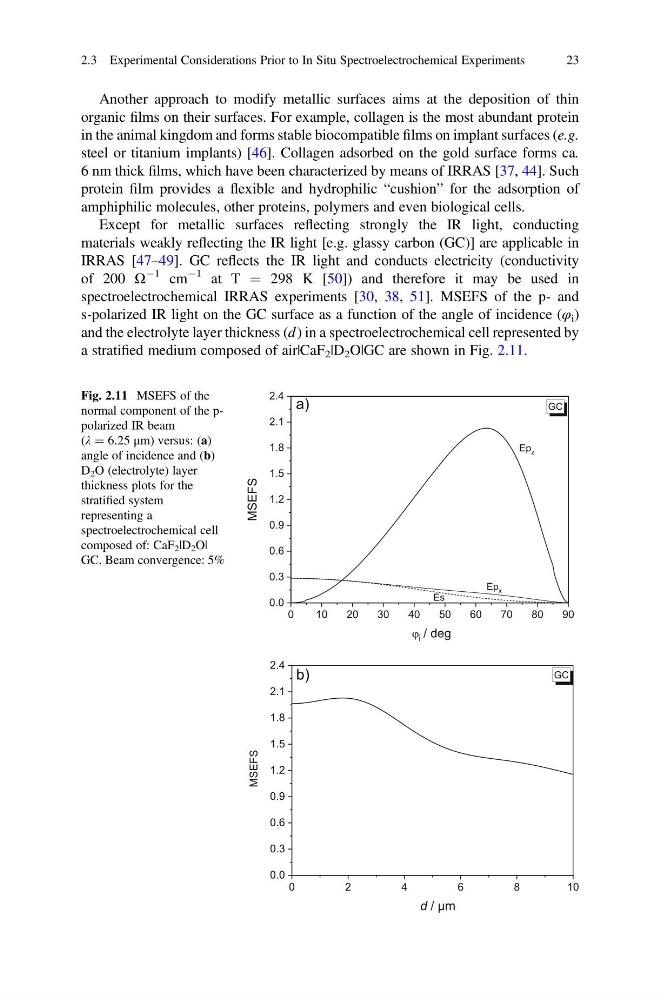
spectroelectrochemical IRRAS experiments [30, 38, 51]. MSEFS of the p- and
s-polarized IR light on the GC surface as a function of the angle of incidence (φ i )
and the electrolyte layer thickness (d) in a spectroelectrochemical cell represented by
a stratified medium composed of air|CaF 2 |D 2 O|GC are shown in Fig. 2.11.
0
10
20
30
40
50
60
70
80
90
0.0
0.3
0.6
0.9
1.2
1.5
1.8
2.1
2.4
Es
Ep x
MSEFS
i / deg
a)
Ep z
GC
0
2
4
6
8
1 0
0.0
0.3
0.6
0.9
1.2
1.5
1.8
2.1
2.4
MSEFS
d / µm
b)
GC
Fig. 2.11 MSEFS of the
normal component of the ppolarized IR beam
(λ ¼ 6.25 μm) versus: (a)
angle of incidence and (b)
D 2 O (electrolyte) layer
thickness plots for the
stratified system
representing a
spectroelectrochemical cell
composed of: CaF 2 |D 2 O|
GC. Beam convergence: 5%
2.3 Experimental Considerations Prior to In Situ Spectroelectrochemical Experiments
23
organic films on their surfaces. For example, collagen is the most abundant protein
in the animal kingdom and forms stable biocompatible films on implant surfaces (e.g.
steel or titanium implants) [46]. Collagen adsorbed on the gold surface forms ca.
6 nm thick films, which have been characterized by means of IRRAS [37, 44]. Such
protein film provides a flexible and hydrophilic “cushion” for the adsorption of
amphiphilic molecules, other proteins, polymers and even biological cells.
Except for metallic surfaces reflecting strongly the IR light, conducting
materials weakly reflecting the IR light [e.g. glassy carbon (GC)] are applicable in
IRRAS [47–49]. GC reflects the IR light and conducts electricity (conductivity
of 200 Ω
À1 cm
À1 at T ¼ 298 K [50]) and therefore it may be used in
spectroelectrochemical IRRAS experiments [30, 38, 51]. MSEFS of the p- and
s-polarized IR light on the GC surface as a function of the angle of incidence (φ i )
and the electrolyte layer thickness (d) in a spectroelectrochemical cell represented by
a stratified medium composed of air|CaF 2 |D 2 O|GC are shown in Fig. 2.11.
0
10
20
30
40
50
60
70
80
90
0.0
0.3
0.6
0.9
1.2
1.5
1.8
2.1
2.4
Es
Ep x
MSEFS
i / deg
a)
Ep z
GC
0
2
4
6
8
1 0
0.0
0.3
0.6
0.9
1.2
1.5
1.8
2.1
2.4
MSEFS
d / µm
b)
GC
Fig. 2.11 MSEFS of the
normal component of the ppolarized IR beam
(λ ¼ 6.25 μm) versus: (a)
angle of incidence and (b)
D 2 O (electrolyte) layer
thickness plots for the
stratified system
representing a
spectroelectrochemical cell
composed of: CaF 2 |D 2 O|
GC. Beam convergence: 5%
2.3 Experimental Considerations Prior to In Situ Spectroelectrochemical Experiments
23