

were done to improve the performance of the cell [4, 21–24]. The body of contemporary produced spectroelectrochemical cells is made either of glass [3, 13, 20, 25,
26], metal or polymers (e.g. Kel-F, Teflon) [22, 27]. Main constructional challenges
arise from the requirement of a parallel positioning of the prism and the metal mirror
(WE) and the maintenance of a constant thickness of the electrolyte layer during
measurement (which may last for 24 hours). Use of a large and heavy piece of
polished metal (disk or a thick metal foil) as the mirror (WE) which is pressed against
the optical window facilitates a parallel orientation of the mirror with respect to the
optical window.
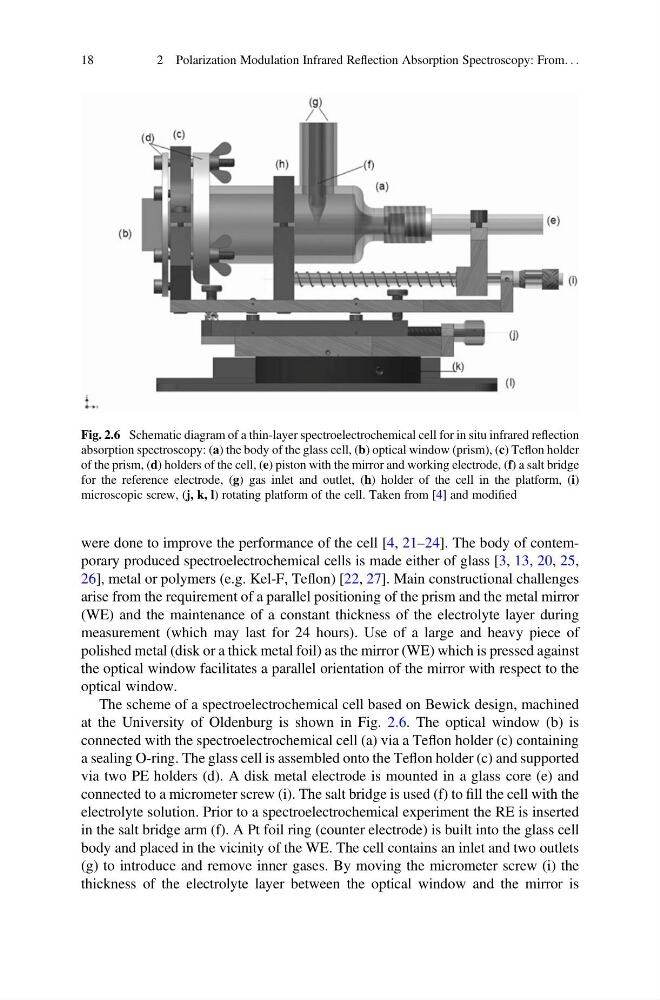
The scheme of a spectroelectrochemical cell based on Bewick design, machined
at the University of Oldenburg is shown in Fig. 2.6. The optical window (b) is
connected with the spectroelectrochemical cell (a) via a Teflon holder (c) containing
a sealing O-ring. The glass cell is assembled onto the Teflon holder (c) and supported
via two PE holders (d). A disk metal electrode is mounted in a glass core (e) and
connected to a micrometer screw (i). The salt bridge is used (f) to fill the cell with the
electrolyte solution. Prior to a spectroelectrochemical experiment the RE is inserted
in the salt bridge arm (f). A Pt foil ring (counter electrode) is built into the glass cell
body and placed in the vicinity of the WE. The cell contains an inlet and two outlets
(g) to introduce and remove inner gases. By moving the micrometer screw (i) the
thickness of the electrolyte layer between the optical window and the mirror is
Fig. 2.6 Schematic diagram of a thin-layer spectroelectrochemical cell for in situ infrared reflection
absorption spectroscopy: (a) the body of the glass cell, (b) optical window (prism), (c) Teflon holder
of the prism, (d) holders of the cell, (e) piston with the mirror and working electrode, (f) a salt bridge
for the reference electrode, (g) gas inlet and outlet, (h) holder of the cell in the platform, (i)
microscopic screw, (j, k, l) rotating platform of the cell. Taken from [4] and modified
18
2 Polarization Modulation Infrared Reflection Absorption Spectroscopy: From. . .
26], metal or polymers (e.g. Kel-F, Teflon) [22, 27]. Main constructional challenges
arise from the requirement of a parallel positioning of the prism and the metal mirror
(WE) and the maintenance of a constant thickness of the electrolyte layer during
measurement (which may last for 24 hours). Use of a large and heavy piece of
polished metal (disk or a thick metal foil) as the mirror (WE) which is pressed against
the optical window facilitates a parallel orientation of the mirror with respect to the
optical window.
The scheme of a spectroelectrochemical cell based on Bewick design, machined
at the University of Oldenburg is shown in Fig. 2.6. The optical window (b) is
connected with the spectroelectrochemical cell (a) via a Teflon holder (c) containing
a sealing O-ring. The glass cell is assembled onto the Teflon holder (c) and supported
via two PE holders (d). A disk metal electrode is mounted in a glass core (e) and
connected to a micrometer screw (i). The salt bridge is used (f) to fill the cell with the
electrolyte solution. Prior to a spectroelectrochemical experiment the RE is inserted
in the salt bridge arm (f). A Pt foil ring (counter electrode) is built into the glass cell
body and placed in the vicinity of the WE. The cell contains an inlet and two outlets
(g) to introduce and remove inner gases. By moving the micrometer screw (i) the
thickness of the electrolyte layer between the optical window and the mirror is
Fig. 2.6 Schematic diagram of a thin-layer spectroelectrochemical cell for in situ infrared reflection
absorption spectroscopy: (a) the body of the glass cell, (b) optical window (prism), (c) Teflon holder
of the prism, (d) holders of the cell, (e) piston with the mirror and working electrode, (f) a salt bridge
for the reference electrode, (g) gas inlet and outlet, (h) holder of the cell in the platform, (i)
microscopic screw, (j, k, l) rotating platform of the cell. Taken from [4] and modified
18
2 Polarization Modulation Infrared Reflection Absorption Spectroscopy: From. . .