

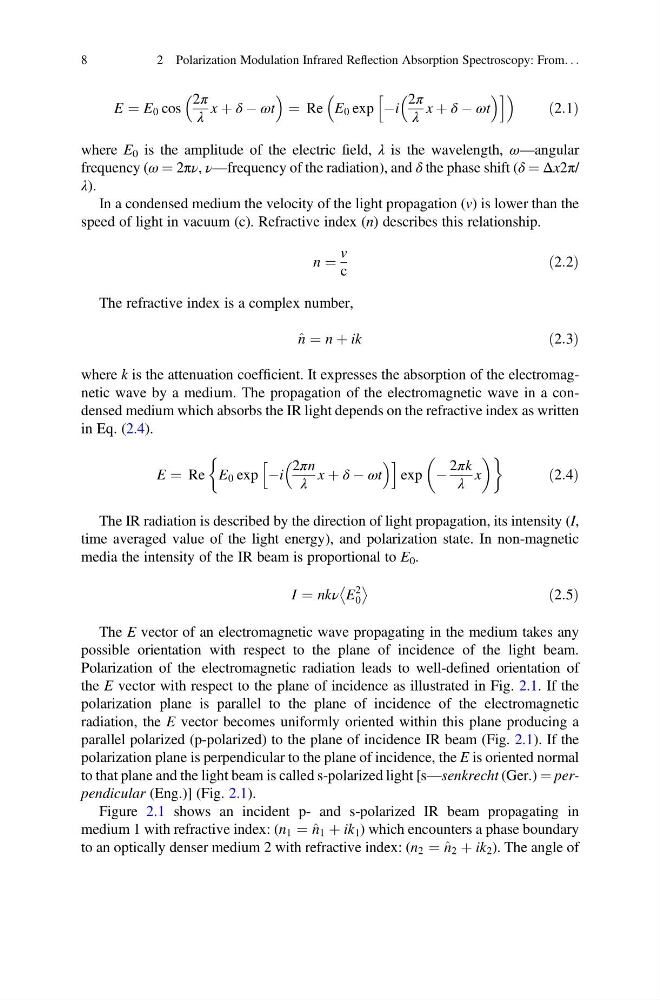
E ¼ E 0 cos
2π
λ
x þ δ À ωt
¼ Re E 0 exp Ài
2π
λ
x þ δ À ωt
h
i
ð2:1Þ
where E 0 is the amplitude of the electric field, λ is the wavelength, ω—angular
frequency (ω ¼ 2πν, ν—frequency of the radiation), and δ the phase shift (δ ¼ Δx2π/
λ).
In a condensed medium the velocity of the light propagation (v) is lower than the
speed of light in vacuum (c). Refractive index (n) describes this relationship.
n ¼
v
c
ð2:2Þ
The refractive index is a complex number,
^ n ¼ n þ ik
ð2:3Þ
where k is the attenuation coefficient. It expresses the absorption of the electromagnetic wave by a medium. The propagation of the electromagnetic wave in a condensed medium which absorbs the IR light depends on the refractive index as written
in Eq. (2.4).
E ¼ Re E 0 exp Ài
2πn
λ
x þ δ À ωt
h
i
exp À
2πk
λ
x
&
'
ð2:4Þ
The IR radiation is described by the direction of light propagation, its intensity (I,
time averaged value of the light energy), and polarization state. In non-magnetic
media the intensity of the IR beam is proportional to E 0 .
I ¼ nkν E
2
0
ð2:5Þ
The E vector of an electromagnetic wave propagating in the medium takes any
possible orientation with respect to the plane of incidence of the light beam.
Polarization of the electromagnetic radiation leads to well-defined orientation of
the E vector with respect to the plane of incidence as illustrated in Fig. 2.1. If the
polarization plane is parallel to the plane of incidence of the electromagnetic
radiation, the E vector becomes uniformly oriented within this plane producing a
parallel polarized (p-polarized) to the plane of incidence IR beam (Fig. 2.1). If the
polarization plane is perpendicular to the plane of incidence, the E is oriented normal
to that plane and the light beam is called s-polarized light [s—senkrecht (Ger.) ¼ perpendicular (Eng.)] (Fig. 2.1).
Figure 2.1 shows an incident p- and s-polarized IR beam propagating in
medium 1 with refractive index: (n 1 ¼ ^ n 1 þ ik 1 ) which encounters a phase boundary
to an optically denser medium 2 with refractive index: (n 2 ¼ ^ n 2 þ ik 2 ). The angle of
8
2 Polarization Modulation Infrared Reflection Absorption Spectroscopy: From. . .
2π
λ
x þ δ À ωt
¼ Re E 0 exp Ài
2π
λ
x þ δ À ωt
h
i
ð2:1Þ
where E 0 is the amplitude of the electric field, λ is the wavelength, ω—angular
frequency (ω ¼ 2πν, ν—frequency of the radiation), and δ the phase shift (δ ¼ Δx2π/
λ).
In a condensed medium the velocity of the light propagation (v) is lower than the
speed of light in vacuum (c). Refractive index (n) describes this relationship.
n ¼
v
c
ð2:2Þ
The refractive index is a complex number,
^ n ¼ n þ ik
ð2:3Þ
where k is the attenuation coefficient. It expresses the absorption of the electromagnetic wave by a medium. The propagation of the electromagnetic wave in a condensed medium which absorbs the IR light depends on the refractive index as written
in Eq. (2.4).
E ¼ Re E 0 exp Ài
2πn
λ
x þ δ À ωt
h
i
exp À
2πk
λ
x
&
'
ð2:4Þ
The IR radiation is described by the direction of light propagation, its intensity (I,
time averaged value of the light energy), and polarization state. In non-magnetic
media the intensity of the IR beam is proportional to E 0 .
I ¼ nkν E
2
0
ð2:5Þ
The E vector of an electromagnetic wave propagating in the medium takes any
possible orientation with respect to the plane of incidence of the light beam.
Polarization of the electromagnetic radiation leads to well-defined orientation of
the E vector with respect to the plane of incidence as illustrated in Fig. 2.1. If the
polarization plane is parallel to the plane of incidence of the electromagnetic
radiation, the E vector becomes uniformly oriented within this plane producing a
parallel polarized (p-polarized) to the plane of incidence IR beam (Fig. 2.1). If the
polarization plane is perpendicular to the plane of incidence, the E is oriented normal
to that plane and the light beam is called s-polarized light [s—senkrecht (Ger.) ¼ perpendicular (Eng.)] (Fig. 2.1).
Figure 2.1 shows an incident p- and s-polarized IR beam propagating in
medium 1 with refractive index: (n 1 ¼ ^ n 1 þ ik 1 ) which encounters a phase boundary
to an optically denser medium 2 with refractive index: (n 2 ¼ ^ n 2 þ ik 2 ). The angle of
8
2 Polarization Modulation Infrared Reflection Absorption Spectroscopy: From. . .