

44
3 Dietary Intakes of Polyphenols in Selected Vegetables and Fruits
10.62
72.35
8.18
1.1
3.43
0.22
14.5
0.210.04
1.69
0.02
6
33.1
1.01 2.1 0.77 0.21
12.5
0.5 1.43
10.82
68.08
0.25 0.5 1.5 0.04
2.8
0.1
9
22.55
65.93
72.02
81.82
14.42
0
10
20
30
40
50
60
70
80
90
Luteonin (FL)
Cyanidin 3-O-glucoside (AC)
Cyanidin 3-O-runoside (AC)
Apigenin 7-O-glucoside
Isorhoifolin (FL)
Luteolin (FL)
Luteolin 6-C-glucoside (FL)
Luteolin 7-O-glucoside (FL)
2,4-Dihydroxybenzoic acid (PA)
2,6-Dihydroxybenzoic acid (PA)
4-Hydroxybenzoic acid (PA)
Gallic acid (PA)
Protocatechuic acid (PA)
Syringic acid (PA)
Vanillic acid (PA)
Caffeic acid (HA)
Cinnamic acid (HA)
Ferulic acid (HA)
m-Coumaric acid (HPA)
o-Coumaric acid HPA)
p-Coumaric acid (HPA)
Sinapic acid (HPA)
Verbascoside (HPA)
3,4-Dihydroxyphenylacec acid
4-Hydroxyphenylacec acid
Homovanillicacid
Homoveratricacid
Dihydro-p-coumaricacid
Vanillin
3,4-DHPEA-EA
Demethyloleuropein
Hydroxytyrosol
Oleuropein
Oleuropein-aglycone
Tyrosol
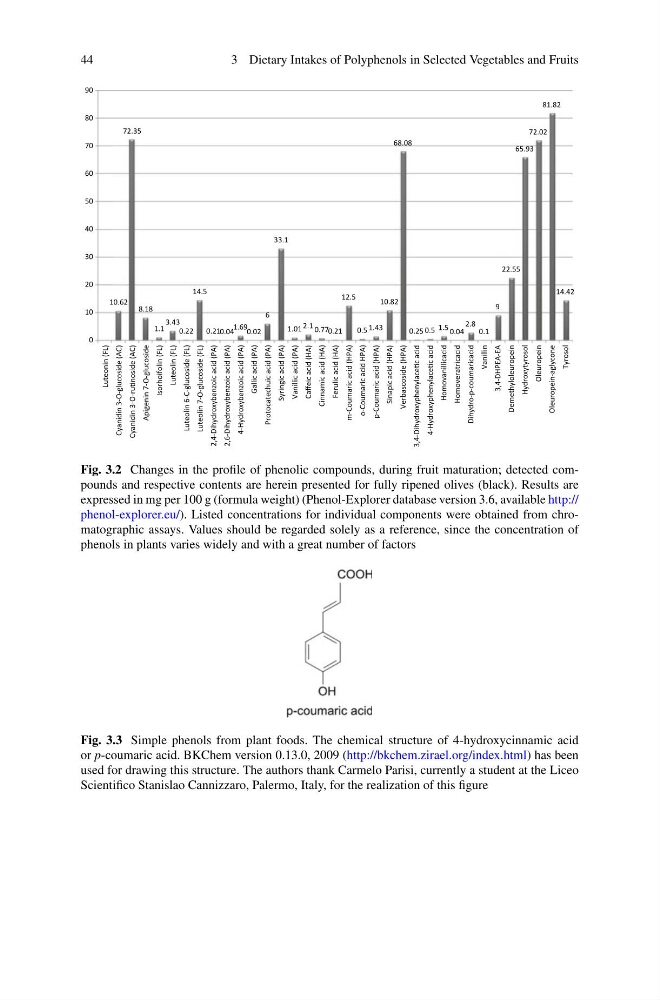
Fig. 3.2 Changes in the profile of phenolic compounds, during fruit maturation; detected compounds and respective contents are herein presented for fully ripened olives (black). Results are
expressed in mg per 100 g (formula weight) (Phenol-Explorer database version 3.6, available http://
phenol-explorer.eu/). Listed concentrations for individual components were obtained from chromatographic assays. Values should be regarded solely as a reference, since the concentration of
phenols in plants varies widely and with a great number of factors
Fig. 3.3 Simple phenols from plant foods. The chemical structure of 4-hydroxycinnamic acid
or p-coumaric acid. BKChem version 0.13.0, 2009 (http://bkchem.zirael.org/index.html) has been
used for drawing this structure. The authors thank Carmelo Parisi, currently a student at the Liceo
Scientifico Stanislao Cannizzaro, Palermo, Italy, for the realization of this figure
3 Dietary Intakes of Polyphenols in Selected Vegetables and Fruits
10.62
72.35
8.18
1.1
3.43
0.22
14.5
0.210.04
1.69
0.02
6
33.1
1.01 2.1 0.77 0.21
12.5
0.5 1.43
10.82
68.08
0.25 0.5 1.5 0.04
2.8
0.1
9
22.55
65.93
72.02
81.82
14.42
0
10
20
30
40
50
60
70
80
90
Luteonin (FL)
Cyanidin 3-O-glucoside (AC)
Cyanidin 3-O-runoside (AC)
Apigenin 7-O-glucoside
Isorhoifolin (FL)
Luteolin (FL)
Luteolin 6-C-glucoside (FL)
Luteolin 7-O-glucoside (FL)
2,4-Dihydroxybenzoic acid (PA)
2,6-Dihydroxybenzoic acid (PA)
4-Hydroxybenzoic acid (PA)
Gallic acid (PA)
Protocatechuic acid (PA)
Syringic acid (PA)
Vanillic acid (PA)
Caffeic acid (HA)
Cinnamic acid (HA)
Ferulic acid (HA)
m-Coumaric acid (HPA)
o-Coumaric acid HPA)
p-Coumaric acid (HPA)
Sinapic acid (HPA)
Verbascoside (HPA)
3,4-Dihydroxyphenylacec acid
4-Hydroxyphenylacec acid
Homovanillicacid
Homoveratricacid
Dihydro-p-coumaricacid
Vanillin
3,4-DHPEA-EA
Demethyloleuropein
Hydroxytyrosol
Oleuropein
Oleuropein-aglycone
Tyrosol
Fig. 3.2 Changes in the profile of phenolic compounds, during fruit maturation; detected compounds and respective contents are herein presented for fully ripened olives (black). Results are
expressed in mg per 100 g (formula weight) (Phenol-Explorer database version 3.6, available http://
phenol-explorer.eu/). Listed concentrations for individual components were obtained from chromatographic assays. Values should be regarded solely as a reference, since the concentration of
phenols in plants varies widely and with a great number of factors
Fig. 3.3 Simple phenols from plant foods. The chemical structure of 4-hydroxycinnamic acid
or p-coumaric acid. BKChem version 0.13.0, 2009 (http://bkchem.zirael.org/index.html) has been
used for drawing this structure. The authors thank Carmelo Parisi, currently a student at the Liceo
Scientifico Stanislao Cannizzaro, Palermo, Italy, for the realization of this figure