

3.1 Nutritional Importance of Polyphenols
43
0.56
4.97
0.67
6
2.2 1.33
14.33
3.01
8
10
5.9
44
17.2
3.33
6
2
6
17.5
13
55.57
1.62
55.58
58.5
7.46
1.82
0
10
20
30
40
50
60
70
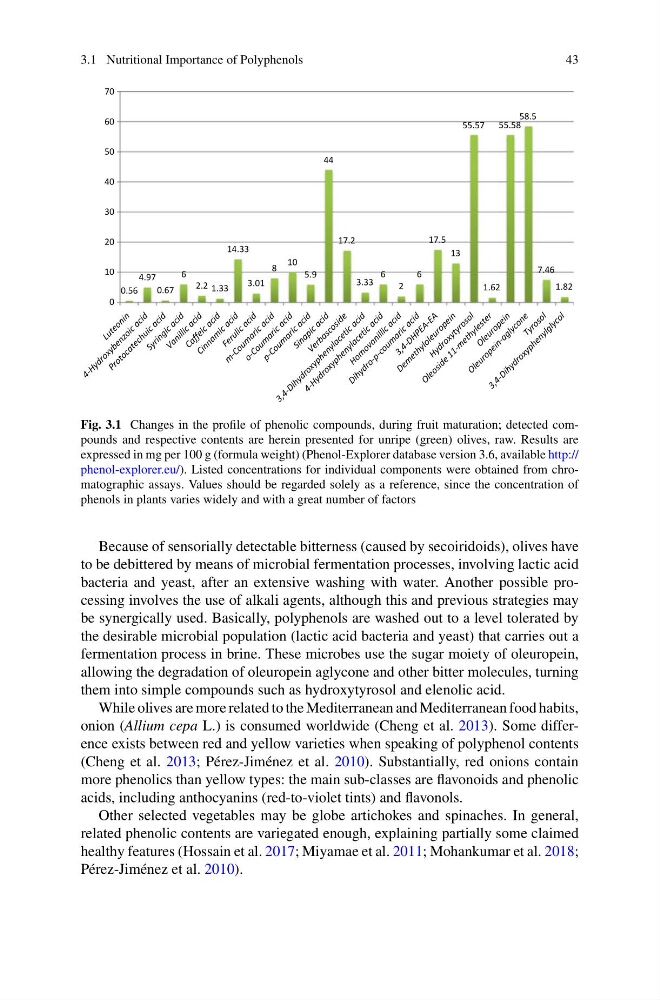
Fig. 3.1 Changes in the profile of phenolic compounds, during fruit maturation; detected compounds and respective contents are herein presented for unripe (green) olives, raw. Results are
expressed in mg per 100 g (formula weight) (Phenol-Explorer database version 3.6, available http://
phenol-explorer.eu/). Listed concentrations for individual components were obtained from chromatographic assays. Values should be regarded solely as a reference, since the concentration of
phenols in plants varies widely and with a great number of factors
Because of sensorially detectable bitterness (caused by secoiridoids), olives have
to be debittered by means of microbial fermentation processes, involving lactic acid
bacteria and yeast, after an extensive washing with water. Another possible processing involves the use of alkali agents, although this and previous strategies may
be synergically used. Basically, polyphenols are washed out to a level tolerated by
the desirable microbial population (lactic acid bacteria and yeast) that carries out a
fermentation process in brine. These microbes use the sugar moiety of oleuropein,
allowing the degradation of oleuropein aglycone and other bitter molecules, turning
them into simple compounds such as hydroxytyrosol and elenolic acid.
While olives are more related to the Mediterranean and Mediterranean food habits,
onion (Allium cepa L.) is consumed worldwide (Cheng et al. 2013). Some difference exists between red and yellow varieties when speaking of polyphenol contents
(Cheng et al. 2013; Pérez-Jiménez et al. 2010). Substantially, red onions contain
more phenolics than yellow types: the main sub-classes are flavonoids and phenolic
acids, including anthocyanins (red-to-violet tints) and flavonols.
Other selected vegetables may be globe artichokes and spinaches. In general,
related phenolic contents are variegated enough, explaining partially some claimed
healthy features (Hossain et al. 2017; Miyamae et al. 2011; Mohankumar et al. 2018;
Pérez-Jiménez et al. 2010).
43
0.56
4.97
0.67
6
2.2 1.33
14.33
3.01
8
10
5.9
44
17.2
3.33
6
2
6
17.5
13
55.57
1.62
55.58
58.5
7.46
1.82
0
10
20
30
40
50
60
70
Fig. 3.1 Changes in the profile of phenolic compounds, during fruit maturation; detected compounds and respective contents are herein presented for unripe (green) olives, raw. Results are
expressed in mg per 100 g (formula weight) (Phenol-Explorer database version 3.6, available http://
phenol-explorer.eu/). Listed concentrations for individual components were obtained from chromatographic assays. Values should be regarded solely as a reference, since the concentration of
phenols in plants varies widely and with a great number of factors
Because of sensorially detectable bitterness (caused by secoiridoids), olives have
to be debittered by means of microbial fermentation processes, involving lactic acid
bacteria and yeast, after an extensive washing with water. Another possible processing involves the use of alkali agents, although this and previous strategies may
be synergically used. Basically, polyphenols are washed out to a level tolerated by
the desirable microbial population (lactic acid bacteria and yeast) that carries out a
fermentation process in brine. These microbes use the sugar moiety of oleuropein,
allowing the degradation of oleuropein aglycone and other bitter molecules, turning
them into simple compounds such as hydroxytyrosol and elenolic acid.
While olives are more related to the Mediterranean and Mediterranean food habits,
onion (Allium cepa L.) is consumed worldwide (Cheng et al. 2013). Some difference exists between red and yellow varieties when speaking of polyphenol contents
(Cheng et al. 2013; Pérez-Jiménez et al. 2010). Substantially, red onions contain
more phenolics than yellow types: the main sub-classes are flavonoids and phenolic
acids, including anthocyanins (red-to-violet tints) and flavonols.
Other selected vegetables may be globe artichokes and spinaches. In general,
related phenolic contents are variegated enough, explaining partially some claimed
healthy features (Hossain et al. 2017; Miyamae et al. 2011; Mohankumar et al. 2018;
Pérez-Jiménez et al. 2010).