

80
N. Akhtar and P. N. Kuriakose
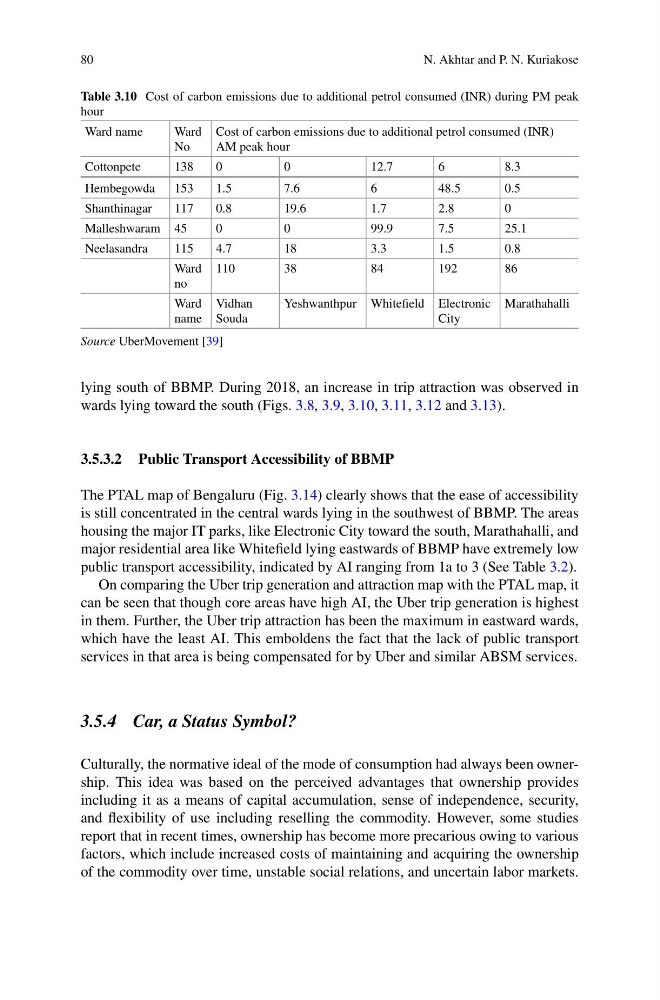
Table 3.10 Cost of carbon emissions due to additional petrol consumed (INR) during PM peak
hour
Ward name
Ward
No
Cost of carbon emissions due to additional petrol consumed (INR)
AM peak hour
Cottonpete
138
0
0
12.7
6
8.3
Hembegowda
153
1.5
7.6
6
48.5
0.5
Shanthinagar
117
0.8
19.6
1.7
2.8
0
Malleshwaram 45
0
0
99.9
7.5
25.1
Neelasandra
115
4.7
18
3.3
1.5
0.8
Ward
no
110
38
84
192
86
Ward
name
Vidhan
Souda
Yeshwanthpur Whitefield Electronic
City
Marathahalli
Source UberMovement [39]
lying south of BBMP. During 2018, an increase in trip attraction was observed in
wards lying toward the south (Figs. 3.8, 3.9, 3.10, 3.11, 3.12 and 3.13).
3.5.3.2 Public Transport Accessibility of BBMP
The PTAL map of Bengaluru (Fig. 3.14) clearly shows that the ease of accessibility
is still concentrated in the central wards lying in the southwest of BBMP. The areas
housing the major IT parks, like Electronic City toward the south, Marathahalli, and
major residential area like Whitefield lying eastwards of BBMP have extremely low
public transport accessibility, indicated by AI ranging from 1a to 3 (See Table 3.2).
On comparing the Uber trip generation and attraction map with the PTAL map, it
can be seen that though core areas have high AI, the Uber trip generation is highest
in them. Further, the Uber trip attraction has been the maximum in eastward wards,
which have the least AI. This emboldens the fact that the lack of public transport
services in that area is being compensated for by Uber and similar ABSM services.
3.5.4 Car, a Status Symbol?
Culturally, the normative ideal of the mode of consumption had always been ownership. This idea was based on the perceived advantages that ownership provides
including it as a means of capital accumulation, sense of independence, security,
and flexibility of use including reselling the commodity. However, some studies
report that in recent times, ownership has become more precarious owing to various
factors, which include increased costs of maintaining and acquiring the ownership
of the commodity over time, unstable social relations, and uncertain labor markets.
N. Akhtar and P. N. Kuriakose
Table 3.10 Cost of carbon emissions due to additional petrol consumed (INR) during PM peak
hour
Ward name
Ward
No
Cost of carbon emissions due to additional petrol consumed (INR)
AM peak hour
Cottonpete
138
0
0
12.7
6
8.3
Hembegowda
153
1.5
7.6
6
48.5
0.5
Shanthinagar
117
0.8
19.6
1.7
2.8
0
Malleshwaram 45
0
0
99.9
7.5
25.1
Neelasandra
115
4.7
18
3.3
1.5
0.8
Ward
no
110
38
84
192
86
Ward
name
Vidhan
Souda
Yeshwanthpur Whitefield Electronic
City
Marathahalli
Source UberMovement [39]
lying south of BBMP. During 2018, an increase in trip attraction was observed in
wards lying toward the south (Figs. 3.8, 3.9, 3.10, 3.11, 3.12 and 3.13).
3.5.3.2 Public Transport Accessibility of BBMP
The PTAL map of Bengaluru (Fig. 3.14) clearly shows that the ease of accessibility
is still concentrated in the central wards lying in the southwest of BBMP. The areas
housing the major IT parks, like Electronic City toward the south, Marathahalli, and
major residential area like Whitefield lying eastwards of BBMP have extremely low
public transport accessibility, indicated by AI ranging from 1a to 3 (See Table 3.2).
On comparing the Uber trip generation and attraction map with the PTAL map, it
can be seen that though core areas have high AI, the Uber trip generation is highest
in them. Further, the Uber trip attraction has been the maximum in eastward wards,
which have the least AI. This emboldens the fact that the lack of public transport
services in that area is being compensated for by Uber and similar ABSM services.
3.5.4 Car, a Status Symbol?
Culturally, the normative ideal of the mode of consumption had always been ownership. This idea was based on the perceived advantages that ownership provides
including it as a means of capital accumulation, sense of independence, security,
and flexibility of use including reselling the commodity. However, some studies
report that in recent times, ownership has become more precarious owing to various
factors, which include increased costs of maintaining and acquiring the ownership
of the commodity over time, unstable social relations, and uncertain labor markets.