

3 Disruptive Mobility in Pre- and Post-COVID Times …
75
two-wheelers (29%) was observed to be the highest. It was followed by cycle (11%),
IPT (4%), and walk (4%).
During the revealed preference survey, residents were inquired about their daily
travel mode preference. The metropolis has various travel options to choose from
and hence the respondents were asked regarding their mode preference for daily
work/education purpose trips and recreational trips separately.
Maximum of the respondents (37%) said they prefer to travel to their workplace/
education centers via two-wheeler vehicles. The vehicle registration data also shows
that two-wheelers form the major part of the vehicle fleet of Bengaluru (See Table
3.4). The second most popular mode of travel was found to be BMTC buses followed
by ABSM services. Though metro services are pretty efficient in Bengaluru, only
7% prefer it as their daily travel mode since it presently covers very few areas of
BBMP and is under construction.
The survey respondents usually prefer two-wheelers (34%) for their recreational
trips, followed by ABSM services (27%) and BMTC buses (10%). Two-wheelers
being a flexible and readily available mode of travel is popular among the users.
ABSM services prove to be comfortable and free the users of the responsibility of
driving and finding parking places and hence is the second most preferred mode for
recreational trips.
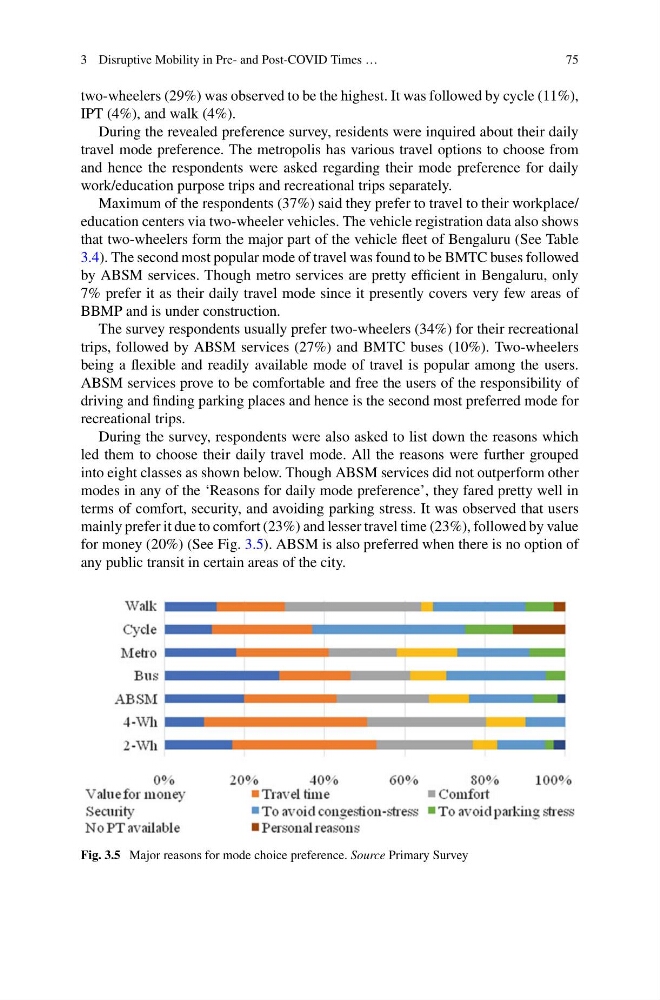
During the survey, respondents were also asked to list down the reasons which
led them to choose their daily travel mode. All the reasons were further grouped
into eight classes as shown below. Though ABSM services did not outperform other
modes in any of the ‘Reasons for daily mode preference’, they fared pretty well in
terms of comfort, security, and avoiding parking stress. It was observed that users
mainly prefer it due to comfort (23%) and lesser travel time (23%), followed by value
for money (20%) (See Fig. 3.5). ABSM is also preferred when there is no option of
any public transit in certain areas of the city.
Fig. 3.5 Major reasons for mode choice preference. Source Primary Survey
75
two-wheelers (29%) was observed to be the highest. It was followed by cycle (11%),
IPT (4%), and walk (4%).
During the revealed preference survey, residents were inquired about their daily
travel mode preference. The metropolis has various travel options to choose from
and hence the respondents were asked regarding their mode preference for daily
work/education purpose trips and recreational trips separately.
Maximum of the respondents (37%) said they prefer to travel to their workplace/
education centers via two-wheeler vehicles. The vehicle registration data also shows
that two-wheelers form the major part of the vehicle fleet of Bengaluru (See Table
3.4). The second most popular mode of travel was found to be BMTC buses followed
by ABSM services. Though metro services are pretty efficient in Bengaluru, only
7% prefer it as their daily travel mode since it presently covers very few areas of
BBMP and is under construction.
The survey respondents usually prefer two-wheelers (34%) for their recreational
trips, followed by ABSM services (27%) and BMTC buses (10%). Two-wheelers
being a flexible and readily available mode of travel is popular among the users.
ABSM services prove to be comfortable and free the users of the responsibility of
driving and finding parking places and hence is the second most preferred mode for
recreational trips.
During the survey, respondents were also asked to list down the reasons which
led them to choose their daily travel mode. All the reasons were further grouped
into eight classes as shown below. Though ABSM services did not outperform other
modes in any of the ‘Reasons for daily mode preference’, they fared pretty well in
terms of comfort, security, and avoiding parking stress. It was observed that users
mainly prefer it due to comfort (23%) and lesser travel time (23%), followed by value
for money (20%) (See Fig. 3.5). ABSM is also preferred when there is no option of
any public transit in certain areas of the city.
Fig. 3.5 Major reasons for mode choice preference. Source Primary Survey