

338
U. Abiha et al.
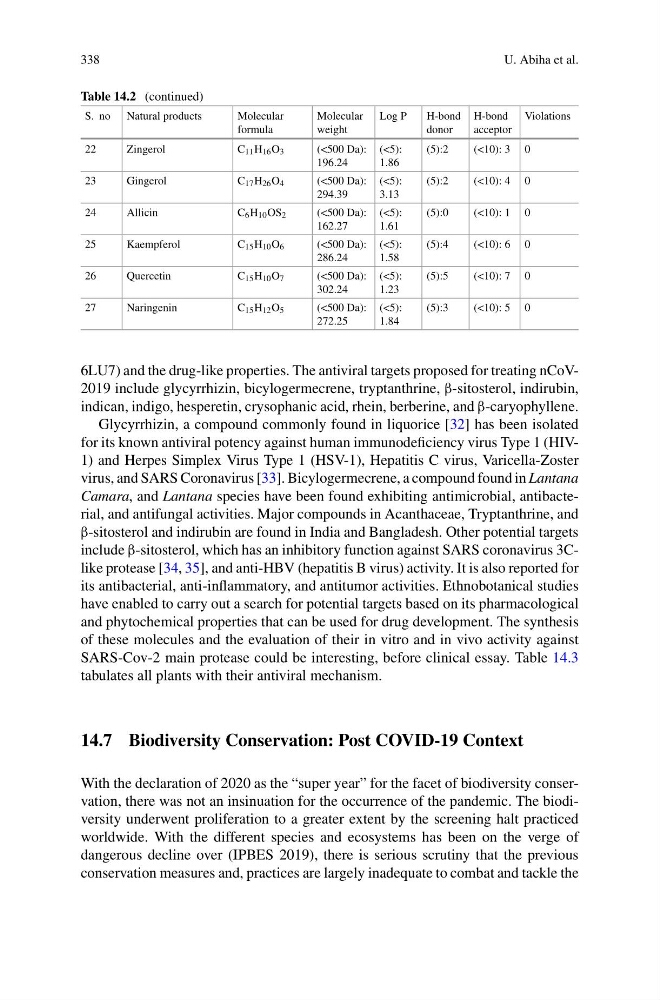
Table 14.2 (continued)
S. no Natural products
Molecular
formula
Molecular
weight
Log P
H-bond
donor
H-bond
acceptor
Violations
22
Zingerol
C 11 H 16 O 3
(<500 Da):
196.24
(<5):
1.86
(5):2
(<10): 3 0
23
Gingerol
C 17 H 26 O 4
(<500 Da):
294.39
(<5):
3.13
(5):2
(<10): 4 0
24
Allicin
C 6 H 10 OS 2
(<500 Da):
162.27
(<5):
1.61
(5):0
(<10): 1 0
25
Kaempferol
C 15 H 10 O 6
(<500 Da):
286.24
(<5):
1.58
(5):4
(<10): 6 0
26
Quercetin
C 15 H 10 O 7
(<500 Da):
302.24
(<5):
1.23
(5):5
(<10): 7 0
27
Naringenin
C 15 H 12 O 5
(<500 Da):
272.25
(<5):
1.84
(5):3
(<10): 5 0
6LU7) and the drug-like properties. The antiviral targets proposed for treating nCoV2019 include glycyrrhizin, bicylogermecrene, tryptanthrine, β-sitosterol, indirubin,
indican, indigo, hesperetin, crysophanic acid, rhein, berberine, and β-caryophyllene.
Glycyrrhizin, a compound commonly found in liquorice [32] has been isolated
for its known antiviral potency against human immunodeficiency virus Type 1 (HIV1) and Herpes Simplex Virus Type 1 (HSV-1), Hepatitis C virus, Varicella-Zoster
virus, and SARS Coronavirus [33]. Bicylogermecrene, a compound found in Lantana
Camara, and Lantana species have been found exhibiting antimicrobial, antibacterial, and antifungal activities. Major compounds in Acanthaceae, Tryptanthrine, and
β-sitosterol and indirubin are found in India and Bangladesh. Other potential targets
include β-sitosterol, which has an inhibitory function against SARS coronavirus 3Clike protease [34, 35], and anti-HBV (hepatitis B virus) activity. It is also reported for
its antibacterial, anti-inflammatory, and antitumor activities. Ethnobotanical studies
have enabled to carry out a search for potential targets based on its pharmacological
and phytochemical properties that can be used for drug development. The synthesis
of these molecules and the evaluation of their in vitro and in vivo activity against
SARS-Cov-2 main protease could be interesting, before clinical essay. Table 14.3
tabulates all plants with their antiviral mechanism.
14.7 Biodiversity Conservation: Post COVID-19 Context
With the declaration of 2020 as the “super year” for the facet of biodiversity conservation, there was not an insinuation for the occurrence of the pandemic. The biodiversity underwent proliferation to a greater extent by the screening halt practiced
worldwide. With the different species and ecosystems has been on the verge of
dangerous decline over (IPBES 2019), there is serious scrutiny that the previous
conservation measures and, practices are largely inadequate to combat and tackle the
U. Abiha et al.
Table 14.2 (continued)
S. no Natural products
Molecular
formula
Molecular
weight
Log P
H-bond
donor
H-bond
acceptor
Violations
22
Zingerol
C 11 H 16 O 3
(<500 Da):
196.24
(<5):
1.86
(5):2
(<10): 3 0
23
Gingerol
C 17 H 26 O 4
(<500 Da):
294.39
(<5):
3.13
(5):2
(<10): 4 0
24
Allicin
C 6 H 10 OS 2
(<500 Da):
162.27
(<5):
1.61
(5):0
(<10): 1 0
25
Kaempferol
C 15 H 10 O 6
(<500 Da):
286.24
(<5):
1.58
(5):4
(<10): 6 0
26
Quercetin
C 15 H 10 O 7
(<500 Da):
302.24
(<5):
1.23
(5):5
(<10): 7 0
27
Naringenin
C 15 H 12 O 5
(<500 Da):
272.25
(<5):
1.84
(5):3
(<10): 5 0
6LU7) and the drug-like properties. The antiviral targets proposed for treating nCoV2019 include glycyrrhizin, bicylogermecrene, tryptanthrine, β-sitosterol, indirubin,
indican, indigo, hesperetin, crysophanic acid, rhein, berberine, and β-caryophyllene.
Glycyrrhizin, a compound commonly found in liquorice [32] has been isolated
for its known antiviral potency against human immunodeficiency virus Type 1 (HIV1) and Herpes Simplex Virus Type 1 (HSV-1), Hepatitis C virus, Varicella-Zoster
virus, and SARS Coronavirus [33]. Bicylogermecrene, a compound found in Lantana
Camara, and Lantana species have been found exhibiting antimicrobial, antibacterial, and antifungal activities. Major compounds in Acanthaceae, Tryptanthrine, and
β-sitosterol and indirubin are found in India and Bangladesh. Other potential targets
include β-sitosterol, which has an inhibitory function against SARS coronavirus 3Clike protease [34, 35], and anti-HBV (hepatitis B virus) activity. It is also reported for
its antibacterial, anti-inflammatory, and antitumor activities. Ethnobotanical studies
have enabled to carry out a search for potential targets based on its pharmacological
and phytochemical properties that can be used for drug development. The synthesis
of these molecules and the evaluation of their in vitro and in vivo activity against
SARS-Cov-2 main protease could be interesting, before clinical essay. Table 14.3
tabulates all plants with their antiviral mechanism.
14.7 Biodiversity Conservation: Post COVID-19 Context
With the declaration of 2020 as the “super year” for the facet of biodiversity conservation, there was not an insinuation for the occurrence of the pandemic. The biodiversity underwent proliferation to a greater extent by the screening halt practiced
worldwide. With the different species and ecosystems has been on the verge of
dangerous decline over (IPBES 2019), there is serious scrutiny that the previous
conservation measures and, practices are largely inadequate to combat and tackle the