

12 Trends and Innovations in Biosensors for COVID-19 …
297
term, more participation in scientific research will speed up their development. As
of now the work is not completely faded out: first the virus started to develop in
China and then globally even before the COVID-19, at the beginning of January
2020, the usage of this sensor is not advisable and so to improve the process of the
device/sensor in a more effective to find a particular virus accurately [57, 58]. The
main ultimate motto of this sensor is not replacing the already available laboratory
methods, but it can work as other test methods for medical purpose and assist in the
diagnosis process, and more conspicuous to calculate the virus aggregation in the
environment/air in day to day life: For instance, in busy places like bus stations or
colleges, public gatherings [59]. New test methods are in urge for the finding of the
coronavirus to normal and the pandemic under control as earlier as possible with fast
test results and accuracy.
Some of the latest technology growth for coronavirus fast detection and their
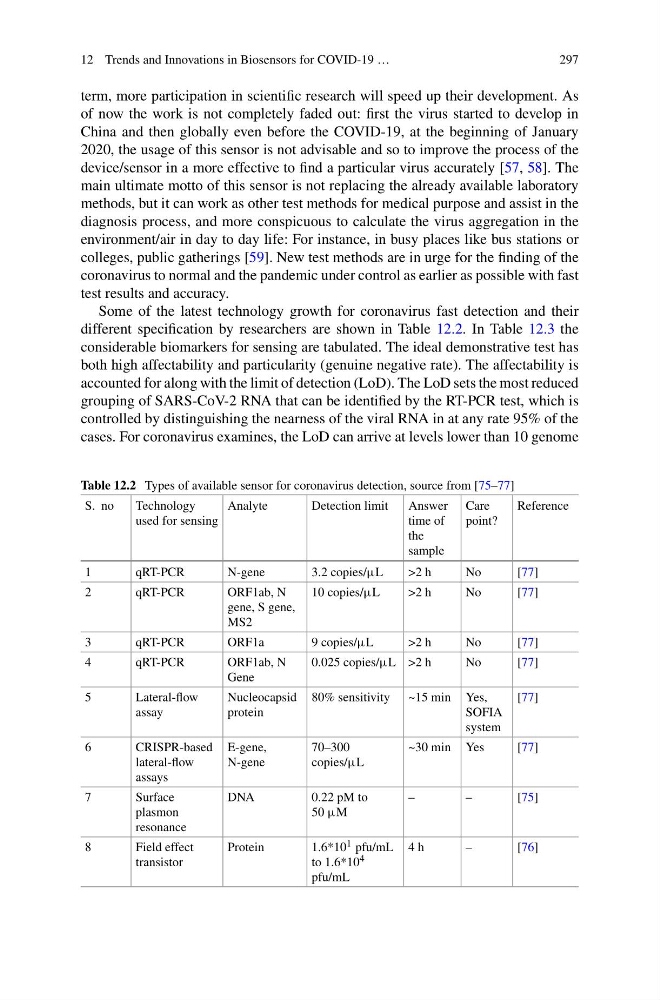
different specification by researchers are shown in Table 12.2. In Table 12.3 the
considerable biomarkers for sensing are tabulated. The ideal demonstrative test has
both high affectability and particularity (genuine negative rate). The affectability is
accounted for along with the limit of detection (LoD). The LoD sets the most reduced
grouping of SARS-CoV-2 RNA that can be identified by the RT-PCR test, which is
controlled by distinguishing the nearness of the viral RNA in at any rate 95% of the
cases. For coronavirus examines, the LoD can arrive at levels lower than 10 genome
Table 12.2 Types of available sensor for coronavirus detection, source from [75–77]
S. no
Technology
used for sensing
Analyte
Detection limit
Answer
time of
the
sample
Care
point?
Reference
1
qRT-PCR
N-gene
3.2 copies/μL
>2 h
No
[77]
2
qRT-PCR
ORF1ab, N
gene, S gene,
MS2
10 copies/μL
>2 h
No
[77]
3
qRT-PCR
ORF1a
9 copies/μL
>2 h
No
[77]
4
qRT-PCR
ORF1ab, N
Gene
0.025 copies/μL >2 h
No
[77]
5
Lateral-flow
assay
Nucleocapsid
protein
80% sensitivity ~15 min Yes,
SOFIA
system
[77]
6
CRISPR-based
lateral-flow
assays
E-gene,
N-gene
70–300
copies/μL
~30 min Yes
[77]
7
Surface
plasmon
resonance
DNA
0.22 pM to
50 μM
–
–
[75]
8
Field effect
transistor
Protein
1.6*10 1 pfu/mL
to 1.6*10 4
pfu/mL
4 h
–
[76]
297
term, more participation in scientific research will speed up their development. As
of now the work is not completely faded out: first the virus started to develop in
China and then globally even before the COVID-19, at the beginning of January
2020, the usage of this sensor is not advisable and so to improve the process of the
device/sensor in a more effective to find a particular virus accurately [57, 58]. The
main ultimate motto of this sensor is not replacing the already available laboratory
methods, but it can work as other test methods for medical purpose and assist in the
diagnosis process, and more conspicuous to calculate the virus aggregation in the
environment/air in day to day life: For instance, in busy places like bus stations or
colleges, public gatherings [59]. New test methods are in urge for the finding of the
coronavirus to normal and the pandemic under control as earlier as possible with fast
test results and accuracy.
Some of the latest technology growth for coronavirus fast detection and their
different specification by researchers are shown in Table 12.2. In Table 12.3 the
considerable biomarkers for sensing are tabulated. The ideal demonstrative test has
both high affectability and particularity (genuine negative rate). The affectability is
accounted for along with the limit of detection (LoD). The LoD sets the most reduced
grouping of SARS-CoV-2 RNA that can be identified by the RT-PCR test, which is
controlled by distinguishing the nearness of the viral RNA in at any rate 95% of the
cases. For coronavirus examines, the LoD can arrive at levels lower than 10 genome
Table 12.2 Types of available sensor for coronavirus detection, source from [75–77]
S. no
Technology
used for sensing
Analyte
Detection limit
Answer
time of
the
sample
Care
point?
Reference
1
qRT-PCR
N-gene
3.2 copies/μL
>2 h
No
[77]
2
qRT-PCR
ORF1ab, N
gene, S gene,
MS2
10 copies/μL
>2 h
No
[77]
3
qRT-PCR
ORF1a
9 copies/μL
>2 h
No
[77]
4
qRT-PCR
ORF1ab, N
Gene
0.025 copies/μL >2 h
No
[77]
5
Lateral-flow
assay
Nucleocapsid
protein
80% sensitivity ~15 min Yes,
SOFIA
system
[77]
6
CRISPR-based
lateral-flow
assays
E-gene,
N-gene
70–300
copies/μL
~30 min Yes
[77]
7
Surface
plasmon
resonance
DNA
0.22 pM to
50 μM
–
–
[75]
8
Field effect
transistor
Protein
1.6*10 1 pfu/mL
to 1.6*10 4
pfu/mL
4 h
–
[76]