

238
J. R. S. Selvan Christyraj et al.
yellow, white, red and blue. A detailed discussion about segregation was given in
Sect. 10.4.2.
Handling and Storage of waste The coded colour plastic bags should be properly
labelled with the cytotoxic symbols, date of entry, types of materials and exact quantity of BMW as well as the sender’s and collector’s information to which waste was
transported to disposal points. Used bags, containers and bins should be labelled with
Bio-Hazard and Cytotoxic-Hazard symbols in order to have effective BMW management. Untreated BMW should not be stored beyond 48 h in any case if necessary prior
permission should be acquired from the authorized person to store even after 48 h.
The BMW must be stored in a separate common room or place facility which is situated very far from the patient and visitor paths in accordance with BMW guideline,
2018.
Transportation
BMW has to be transported within limits of same hospital or only across the nearby
district level with secured packaging and means of transport [4] without any leakage
of bio-wastes. Separate wheeled trolleys are used within the hospital premises and
they should be frequently disinfected after usage to avoid infections due to spillage of
wastes. BMW has to be transported only in authorized vehicles by skilled authority
as stated by the government to the common disposal point for the treatment process.
Treatment and Disposal of Waste (General and biomedical)
As 80–90% of waste produced in the hospital is covered under general waste category, this waste has to be collected separately in black coloured polyethylene plastic
bags and has to be hand-over to the local municipal authorities for proper disposal
procedures. Biomedical wastes are segregated as per BMWM rules, 2016 and are
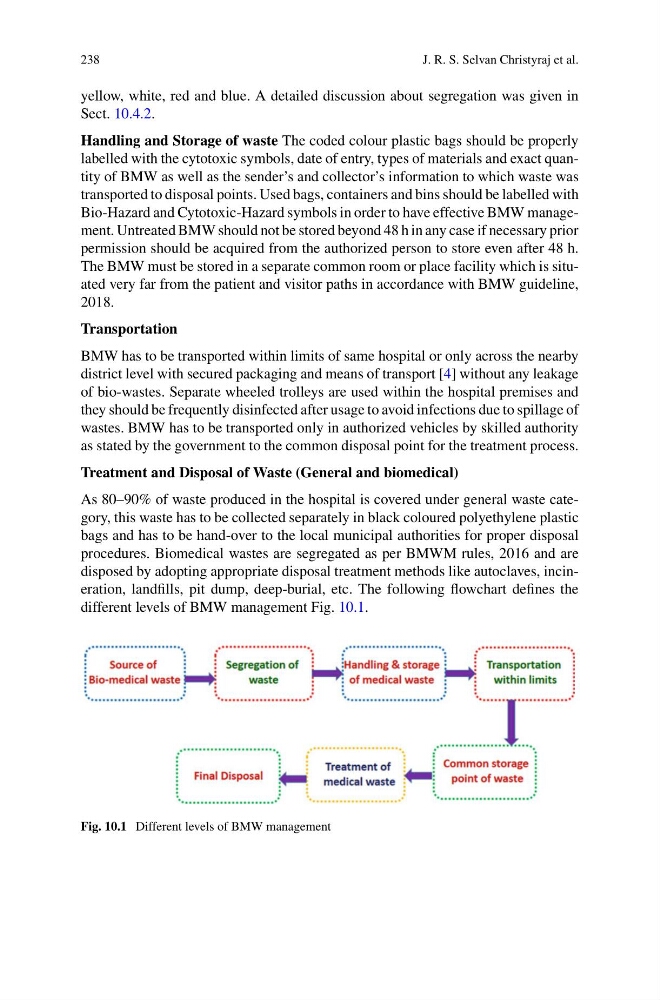
disposed by adopting appropriate disposal treatment methods like autoclaves, incineration, landfills, pit dump, deep-burial, etc. The following flowchart defines the
different levels of BMW management Fig. 10.1.
Fig. 10.1 Different levels of BMW management
J. R. S. Selvan Christyraj et al.
yellow, white, red and blue. A detailed discussion about segregation was given in
Sect. 10.4.2.
Handling and Storage of waste The coded colour plastic bags should be properly
labelled with the cytotoxic symbols, date of entry, types of materials and exact quantity of BMW as well as the sender’s and collector’s information to which waste was
transported to disposal points. Used bags, containers and bins should be labelled with
Bio-Hazard and Cytotoxic-Hazard symbols in order to have effective BMW management. Untreated BMW should not be stored beyond 48 h in any case if necessary prior
permission should be acquired from the authorized person to store even after 48 h.
The BMW must be stored in a separate common room or place facility which is situated very far from the patient and visitor paths in accordance with BMW guideline,
2018.
Transportation
BMW has to be transported within limits of same hospital or only across the nearby
district level with secured packaging and means of transport [4] without any leakage
of bio-wastes. Separate wheeled trolleys are used within the hospital premises and
they should be frequently disinfected after usage to avoid infections due to spillage of
wastes. BMW has to be transported only in authorized vehicles by skilled authority
as stated by the government to the common disposal point for the treatment process.
Treatment and Disposal of Waste (General and biomedical)
As 80–90% of waste produced in the hospital is covered under general waste category, this waste has to be collected separately in black coloured polyethylene plastic
bags and has to be hand-over to the local municipal authorities for proper disposal
procedures. Biomedical wastes are segregated as per BMWM rules, 2016 and are
disposed by adopting appropriate disposal treatment methods like autoclaves, incineration, landfills, pit dump, deep-burial, etc. The following flowchart defines the
different levels of BMW management Fig. 10.1.
Fig. 10.1 Different levels of BMW management