

10 Impact of Biomedical Waste Management System …
237
Table 10.1 Primary sources
of BioMedical waste
Primary sources
Hospitals
Mortuaries
Nursing homes
Research and training centres (Medical)
Clinics
Biotechnology Institution/Manufacturing
units
Medical laboratories Animal houses
Blood banks
Home healthcare unit
Whereas, according to Bio-medical Waste (Management & Handling) Rules, 1998
[1], wastes were classified into ten categories as Human Anatomical Waste, Microbiology & Biotechnology Waste, Animal Waste, Waste Sharps, Liquid Waste, Soiled
Waste, Unwanted Medicines & Cytotoxic drugs, Incineration Ash, Solid Waste,
and Chemical Waste. Bio Medical Waste Management Rules, 2016 categorizes the
biomedical wastes into four categories and the medical wastes are segregated based
on four colour code as yellow, blue, red and white category.
Sources of biomedical waste Biomedical wastes generated during analysis,
handling/treatment or vaccination of human beings or animals are considered to be
more infectious than the municipal solid waste. Hence, management of biomedical
waste is an essential part of controlling infections and conducting healthcare training
programs. The sources of biomedical waste [2] can be classified into two types as
primary and secondary sources based on the amount of waste produced. Based on
training component of the Project “Environmentally Sound Management of Medical
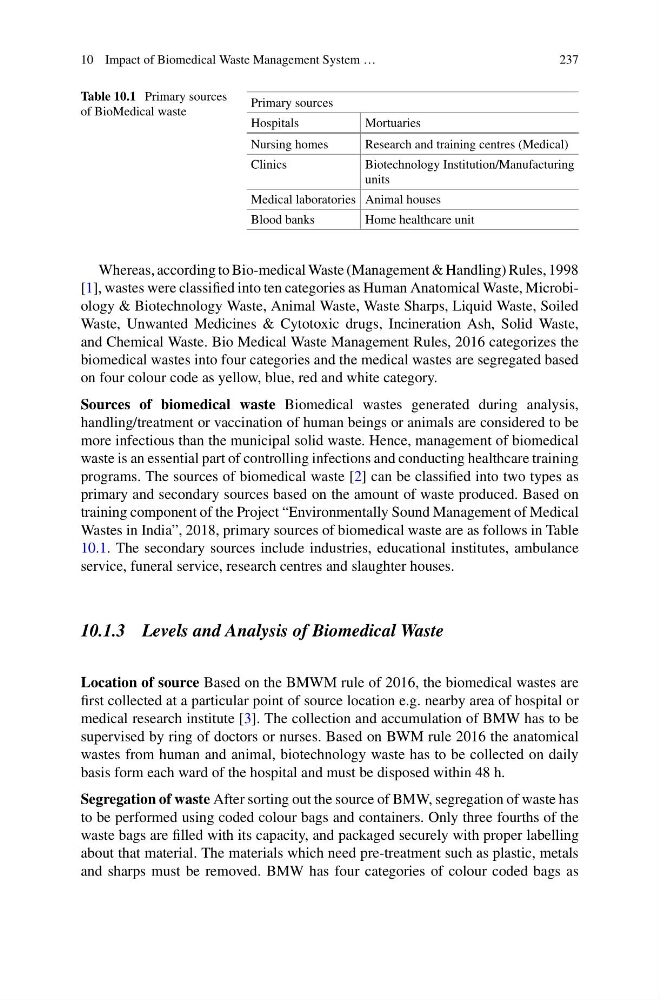
Wastes in India”, 2018, primary sources of biomedical waste are as follows in Table
10.1. The secondary sources include industries, educational institutes, ambulance
service, funeral service, research centres and slaughter houses.
10.1.3 Levels and Analysis of Biomedical Waste
Location of source Based on the BMWM rule of 2016, the biomedical wastes are
first collected at a particular point of source location e.g. nearby area of hospital or
medical research institute [3]. The collection and accumulation of BMW has to be
supervised by ring of doctors or nurses. Based on BWM rule 2016 the anatomical
wastes from human and animal, biotechnology waste has to be collected on daily
basis form each ward of the hospital and must be disposed within 48 h.
Segregation of waste After sorting out the source of BMW, segregation of waste has
to be performed using coded colour bags and containers. Only three fourths of the
waste bags are filled with its capacity, and packaged securely with proper labelling
about that material. The materials which need pre-treatment such as plastic, metals
and sharps must be removed. BMW has four categories of colour coded bags as
237
Table 10.1 Primary sources
of BioMedical waste
Primary sources
Hospitals
Mortuaries
Nursing homes
Research and training centres (Medical)
Clinics
Biotechnology Institution/Manufacturing
units
Medical laboratories Animal houses
Blood banks
Home healthcare unit
Whereas, according to Bio-medical Waste (Management & Handling) Rules, 1998
[1], wastes were classified into ten categories as Human Anatomical Waste, Microbiology & Biotechnology Waste, Animal Waste, Waste Sharps, Liquid Waste, Soiled
Waste, Unwanted Medicines & Cytotoxic drugs, Incineration Ash, Solid Waste,
and Chemical Waste. Bio Medical Waste Management Rules, 2016 categorizes the
biomedical wastes into four categories and the medical wastes are segregated based
on four colour code as yellow, blue, red and white category.
Sources of biomedical waste Biomedical wastes generated during analysis,
handling/treatment or vaccination of human beings or animals are considered to be
more infectious than the municipal solid waste. Hence, management of biomedical
waste is an essential part of controlling infections and conducting healthcare training
programs. The sources of biomedical waste [2] can be classified into two types as
primary and secondary sources based on the amount of waste produced. Based on
training component of the Project “Environmentally Sound Management of Medical
Wastes in India”, 2018, primary sources of biomedical waste are as follows in Table
10.1. The secondary sources include industries, educational institutes, ambulance
service, funeral service, research centres and slaughter houses.
10.1.3 Levels and Analysis of Biomedical Waste
Location of source Based on the BMWM rule of 2016, the biomedical wastes are
first collected at a particular point of source location e.g. nearby area of hospital or
medical research institute [3]. The collection and accumulation of BMW has to be
supervised by ring of doctors or nurses. Based on BWM rule 2016 the anatomical
wastes from human and animal, biotechnology waste has to be collected on daily
basis form each ward of the hospital and must be disposed within 48 h.
Segregation of waste After sorting out the source of BMW, segregation of waste has
to be performed using coded colour bags and containers. Only three fourths of the
waste bags are filled with its capacity, and packaged securely with proper labelling
about that material. The materials which need pre-treatment such as plastic, metals
and sharps must be removed. BMW has four categories of colour coded bags as