

6. Annexes
6.1. La méthode des moindres carrés
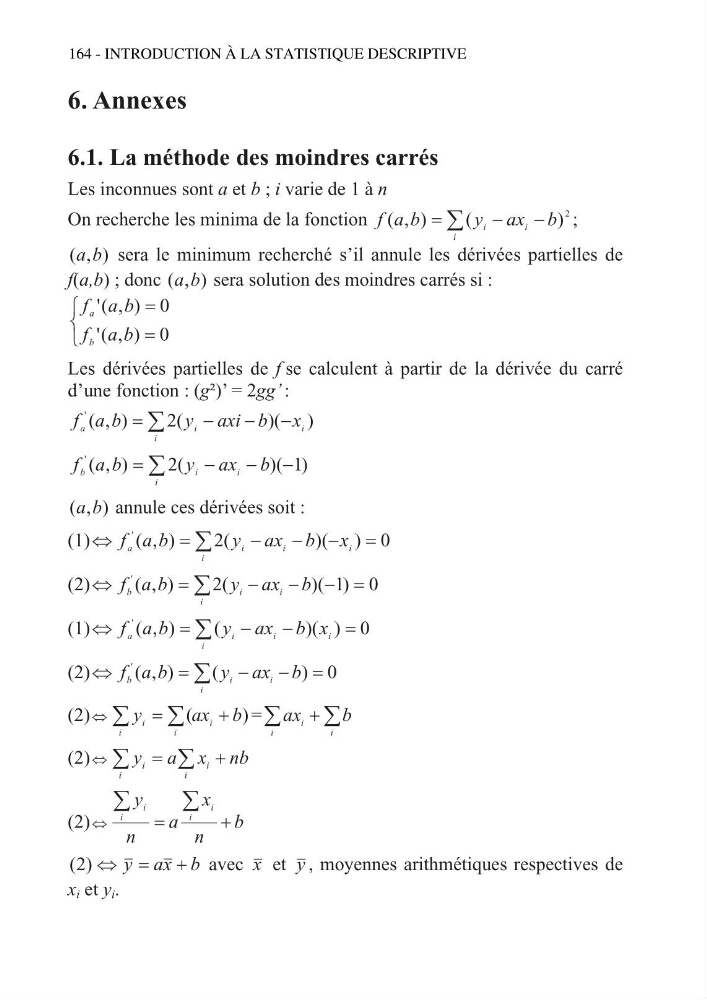
Les inconnues sont a et b ; i varie de 1 à n
On recherche les minima de la fonction
2
)
(
)
,
(
b
ax
y
b
a
f
i
i
i
¦
;
)
,
( b
a
sera le minimum recherché s’il annule les dérivées partielles de
f(a,b) ; donc
)
,
( b
a
sera solution des moindres carrés si :
¯
®
0
)
,
(
'
0
)
,
(
'
b
a
f
b
a
f
b
a
Les dérivées partielles de f se calculent à partir de la dérivée du carré
d’une fonction : (g²)’ = 2gg’ :
)
)(
(
2
)
,
(
'
i
i
i
a
x
b
axi
y
b
a
f
¦
)
1
)(
(
2
)
,
(
'
¦
b
ax
y
b
a
f
i
i
i
b
)
,
( b
a
annule ces dérivées soit :
(1)
0
)
)(
(
2
)
,
(
'
¦
i
i
i
i
a
x
b
ax
y
b
a
f
(2)
0
)
1
)(
(
2
)
,
(
'
¦
b
ax
y
b
a
f
i
i
i
b
(1)
0
)
)(
(
)
,
(
'
¦
i
i
i
i
a
x
b
ax
y
b
a
f
(2)
0
)
(
)
,
(
'
¦
b
ax
y
b
a
f
i
i
i
b
(2)
)
(
b
ax
y
i
i
i
i
¦
¦
= ¦
¦
i
i
i
b
ax
(2)
nb
x
a
y
i
i
i
i
¦
¦
(2)
b
n
x
a
n
y
i
i
i
i
¦
¦
b
x
a
y
)
2
(
avec x et y , moyennes arithmétiques respectives de
x i et y i .
164 - INTRODUCTION À LA STATISTIQUE DESCRIPTIVE
6.1. La méthode des moindres carrés
Les inconnues sont a et b ; i varie de 1 à n
On recherche les minima de la fonction
2
)
(
)
,
(
b
ax
y
b
a
f
i
i
i
¦
;
)
,
( b
a
sera le minimum recherché s’il annule les dérivées partielles de
f(a,b) ; donc
)
,
( b
a
sera solution des moindres carrés si :
¯
®
0
)
,
(
'
0
)
,
(
'
b
a
f
b
a
f
b
a
Les dérivées partielles de f se calculent à partir de la dérivée du carré
d’une fonction : (g²)’ = 2gg’ :
)
)(
(
2
)
,
(
'
i
i
i
a
x
b
axi
y
b
a
f
¦
)
1
)(
(
2
)
,
(
'
¦
b
ax
y
b
a
f
i
i
i
b
)
,
( b
a
annule ces dérivées soit :
(1)
0
)
)(
(
2
)
,
(
'
¦
i
i
i
i
a
x
b
ax
y
b
a
f
(2)
0
)
1
)(
(
2
)
,
(
'
¦
b
ax
y
b
a
f
i
i
i
b
(1)
0
)
)(
(
)
,
(
'
¦
i
i
i
i
a
x
b
ax
y
b
a
f
(2)
0
)
(
)
,
(
'
¦
b
ax
y
b
a
f
i
i
i
b
(2)
)
(
b
ax
y
i
i
i
i
¦
¦
= ¦
¦
i
i
i
b
ax
(2)
nb
x
a
y
i
i
i
i
¦
¦
(2)
b
n
x
a
n
y
i
i
i
i
¦
¦
b
x
a
y
)
2
(
avec x et y , moyennes arithmétiques respectives de
x i et y i .
164 - INTRODUCTION À LA STATISTIQUE DESCRIPTIVE