

3.1 Marine
Biorefinery System
Boundary
The biorefinery system includes the physical, financial, and environmental components. The physical boundaries for the analyzed
energy systems are the boundaries of the physical territory (allocated ocean area and required onshore facilities) where the system is
constructed and operated. The capital boundaries include the capital invested in the system construction, maintenance, and deconstruction. The environmental boundaries include the ecosystems
that are located in the area that is occupied by the cultivation site
and processing facility or that is affected by the facility construction.
The system also includes the produced products, wastes, jobs, and
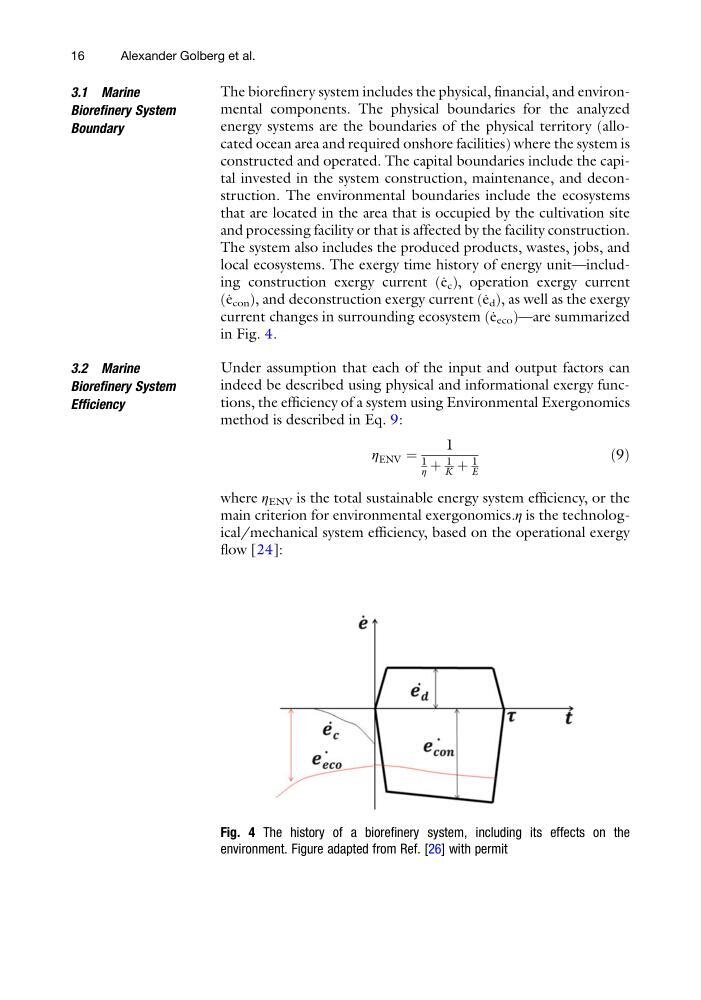
local ecosystems. The exergy time history of energy unit—including construction exergy current (e ˙ c ), operation exergy current
(e ˙ con ), and deconstruction exergy current (e ˙ d ), as well as the exergy
current changes in surrounding ecosystem (e ˙ eco )—are summarized
in Fig. 4.
3.2 Marine
Biorefinery System
Efficiency
Under assumption that each of the input and output factors can
indeed be described using physical and informational exergy functions, the efficiency of a system using Environmental Exergonomics
method is described in Eq. 9:
η ENV ¼
1
1
η þ
1
K þ
1
E
ð9Þ
where η ENV is the total sustainable energy system efficiency, or the
main criterion for environmental exergonomics.η is the technological/mechanical system efficiency, based on the operational exergy
flow [24]:
Fig. 4 The history of a biorefinery system, including its effects on the
environment. Figure adapted from Ref. [26] with permit
16
Alexander Golberg et al.
Biorefinery System
Boundary
The biorefinery system includes the physical, financial, and environmental components. The physical boundaries for the analyzed
energy systems are the boundaries of the physical territory (allocated ocean area and required onshore facilities) where the system is
constructed and operated. The capital boundaries include the capital invested in the system construction, maintenance, and deconstruction. The environmental boundaries include the ecosystems
that are located in the area that is occupied by the cultivation site
and processing facility or that is affected by the facility construction.
The system also includes the produced products, wastes, jobs, and
local ecosystems. The exergy time history of energy unit—including construction exergy current (e ˙ c ), operation exergy current
(e ˙ con ), and deconstruction exergy current (e ˙ d ), as well as the exergy
current changes in surrounding ecosystem (e ˙ eco )—are summarized
in Fig. 4.
3.2 Marine
Biorefinery System
Efficiency
Under assumption that each of the input and output factors can
indeed be described using physical and informational exergy functions, the efficiency of a system using Environmental Exergonomics
method is described in Eq. 9:
η ENV ¼
1
1
η þ
1
K þ
1
E
ð9Þ
where η ENV is the total sustainable energy system efficiency, or the
main criterion for environmental exergonomics.η is the technological/mechanical system efficiency, based on the operational exergy
flow [24]:
Fig. 4 The history of a biorefinery system, including its effects on the
environment. Figure adapted from Ref. [26] with permit
16
Alexander Golberg et al.