

3 Environmental Exergonomics for Marine Biorefineries
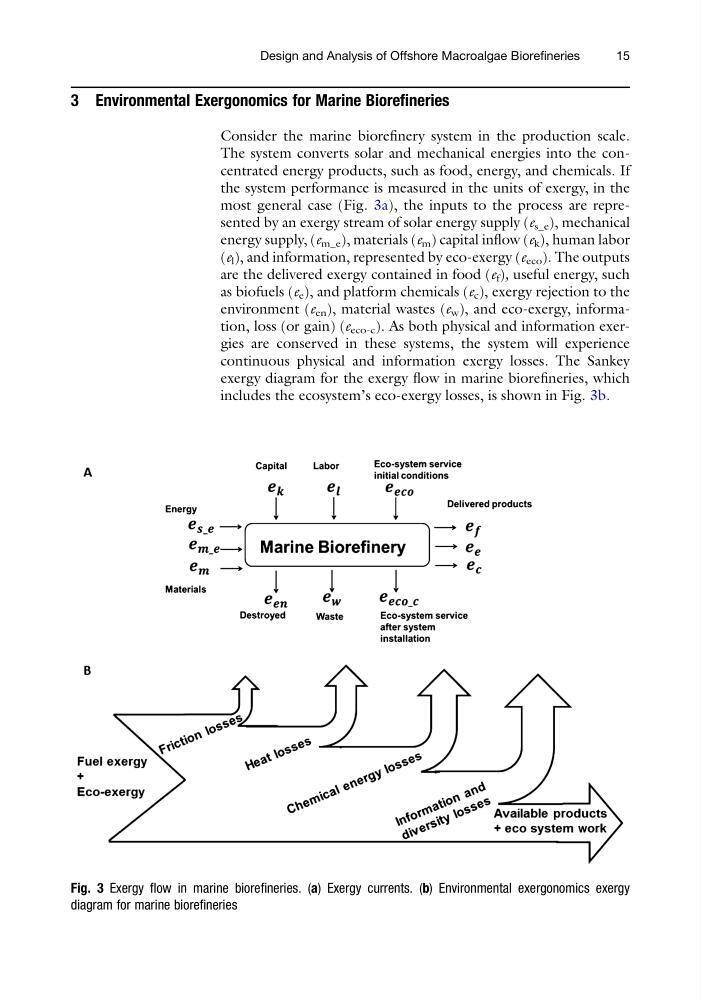
Consider the marine biorefinery system in the production scale.
The system converts solar and mechanical energies into the concentrated energy products, such as food, energy, and chemicals. If
the system performance is measured in the units of exergy, in the
most general case (Fig. 3a), the inputs to the process are represented by an exergy stream of solar energy supply (e s_e ), mechanical
energy supply, (e m_e ), materials (e m ) capital inflow (e k ), human labor
(e l ), and information, represented by eco-exergy (e eco ). The outputs
are the delivered exergy contained in food (e f ), useful energy, such
as biofuels (e e ), and platform chemicals (e c ), exergy rejection to the
environment (e en ), material wastes (e w ), and eco-exergy, information, loss (or gain) (e eco-c ). As both physical and information exergies are conserved in these systems, the system will experience
continuous physical and information exergy losses. The Sankey
exergy diagram for the exergy flow in marine biorefineries, which
includes the ecosystem’s eco-exergy losses, is shown in Fig. 3b.
Fig. 3 Exergy flow in marine biorefineries. (a) Exergy currents. (b) Environmental exergonomics exergy
diagram for marine biorefineries
Design and Analysis of Offshore Macroalgae Biorefineries
15
Consider the marine biorefinery system in the production scale.
The system converts solar and mechanical energies into the concentrated energy products, such as food, energy, and chemicals. If
the system performance is measured in the units of exergy, in the
most general case (Fig. 3a), the inputs to the process are represented by an exergy stream of solar energy supply (e s_e ), mechanical
energy supply, (e m_e ), materials (e m ) capital inflow (e k ), human labor
(e l ), and information, represented by eco-exergy (e eco ). The outputs
are the delivered exergy contained in food (e f ), useful energy, such
as biofuels (e e ), and platform chemicals (e c ), exergy rejection to the
environment (e en ), material wastes (e w ), and eco-exergy, information, loss (or gain) (e eco-c ). As both physical and information exergies are conserved in these systems, the system will experience
continuous physical and information exergy losses. The Sankey
exergy diagram for the exergy flow in marine biorefineries, which
includes the ecosystem’s eco-exergy losses, is shown in Fig. 3b.
Fig. 3 Exergy flow in marine biorefineries. (a) Exergy currents. (b) Environmental exergonomics exergy
diagram for marine biorefineries
Design and Analysis of Offshore Macroalgae Biorefineries
15