

(approximately 0.02–20 μg/ml) with two to four replicates are
used. Internal standards containing other than C17:0 as acyl
groups could be selected for marine samples.
2. Tetrahydrofuran should be distilled to obtain a more stable
baseline.
3. Different variations exist for solvent mixture C. The ratio of
2-propanol and water 85:15 (v/v) containing, e.g., 0.05%
(v/v) acetic acid and ethanolamine has been used to improve
the column performance [14, 16, 17].
4. Heating time during transesterification is very important since
FAME can decompose to FFA if the sample is heated too long
or the petroleum ether layer is totally evaporated.
5. The gradient program used for this UPLC-ELSD method has
been applied and optimized from an earlier HPLC-ELSD method
[15]. Running the solvent cycle continuously helps to obtain more
stable retention times for the analytes.
12.0
200000
400000
600000
800000
16:4n-3
IS
FAME
IS
FFA
Ph
1000000
Abundance
14.0
16.0
18.0
Time (min)
20.0
AOG-16:0
14:0/14:0
WE
16:0/16:0
WE
16:0/14:0
14:0/16:0
WE
22.0
24.0
Sterols
α-Toc
26.0
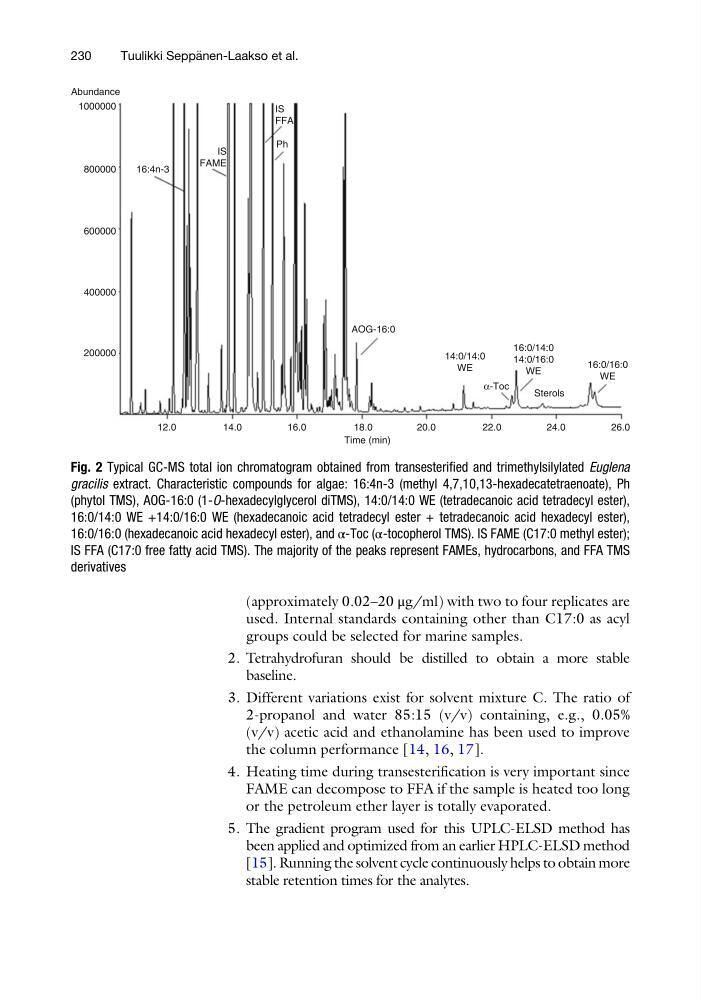
Fig. 2 Typical GC-MS total ion chromatogram obtained from transesterified and trimethylsilylated Euglena
gracilis extract. Characteristic compounds for algae: 16:4n-3 (methyl 4,7,10,13-hexadecatetraenoate), Ph
(phytol TMS), AOG-16:0 (1-O-hexadecylglycerol diTMS), 14:0/14:0 WE (tetradecanoic acid tetradecyl ester),
16:0/14:0 WE +14:0/16:0 WE (hexadecanoic acid tetradecyl ester + tetradecanoic acid hexadecyl ester),
16:0/16:0 (hexadecanoic acid hexadecyl ester), and α-Toc (α-tocopherol TMS). IS FAME (C17:0 methyl ester);
IS FFA (C17:0 free fatty acid TMS). The majority of the peaks represent FAMEs, hydrocarbons, and FFA TMS
derivatives
230
Tuulikki Sepp€ anen-Laakso et al.
used. Internal standards containing other than C17:0 as acyl
groups could be selected for marine samples.
2. Tetrahydrofuran should be distilled to obtain a more stable
baseline.
3. Different variations exist for solvent mixture C. The ratio of
2-propanol and water 85:15 (v/v) containing, e.g., 0.05%
(v/v) acetic acid and ethanolamine has been used to improve
the column performance [14, 16, 17].
4. Heating time during transesterification is very important since
FAME can decompose to FFA if the sample is heated too long
or the petroleum ether layer is totally evaporated.
5. The gradient program used for this UPLC-ELSD method has
been applied and optimized from an earlier HPLC-ELSD method
[15]. Running the solvent cycle continuously helps to obtain more
stable retention times for the analytes.
12.0
200000
400000
600000
800000
16:4n-3
IS
FAME
IS
FFA
Ph
1000000
Abundance
14.0
16.0
18.0
Time (min)
20.0
AOG-16:0
14:0/14:0
WE
16:0/16:0
WE
16:0/14:0
14:0/16:0
WE
22.0
24.0
Sterols
α-Toc
26.0
Fig. 2 Typical GC-MS total ion chromatogram obtained from transesterified and trimethylsilylated Euglena
gracilis extract. Characteristic compounds for algae: 16:4n-3 (methyl 4,7,10,13-hexadecatetraenoate), Ph
(phytol TMS), AOG-16:0 (1-O-hexadecylglycerol diTMS), 14:0/14:0 WE (tetradecanoic acid tetradecyl ester),
16:0/14:0 WE +14:0/16:0 WE (hexadecanoic acid tetradecyl ester + tetradecanoic acid hexadecyl ester),
16:0/16:0 (hexadecanoic acid hexadecyl ester), and α-Toc (α-tocopherol TMS). IS FAME (C17:0 methyl ester);
IS FFA (C17:0 free fatty acid TMS). The majority of the peaks represent FAMEs, hydrocarbons, and FFA TMS
derivatives
230
Tuulikki Sepp€ anen-Laakso et al.