

3.1.3 Derivatization of
Sterols, Free Fatty Acids,
and Other Polar
Compounds
After GC-MS run for FAME and other easily evaporated compounds, the same sample is trimethylsilylated (TMS) for free fatty
acids and other hydroxyl group-containing compounds, e.g., sterols and alkoxyglycerols.
1. Transfer the sample from the vial insert to a GC vial, rinse the
insert with 100 μl of hexane, combine the hexane aliquots, and
evaporate to dryness.
2. Dissolve the sample in 50 μl of DCM, and add 25 μl of a
mixture of MSTFA and TMCS (1%). Close the cap well.
3. Heat at 80
C for 20 min.
4. Take the cooled sample to a new vial insert (250 μl), and close
the cap well. The sample is ready for GC-MS analysis on a
semipolar or nonpolar column.
3.2 Lipid Class and
Fatty Acid Analyses
3.2.1 Lipid Class
Analysis by UPLC-ELSD
The UPLC-ELSD system is controlled by Empower 3 software.
1. Open the nebulizer gas (nitrogen, 50 psi), set the temperature
of the nebulizer, and drift tube to 40 and 40
C, respectively.
2. Set the temperature of the sample manager to 10
C.
3. Set the column temperature to 40
C.
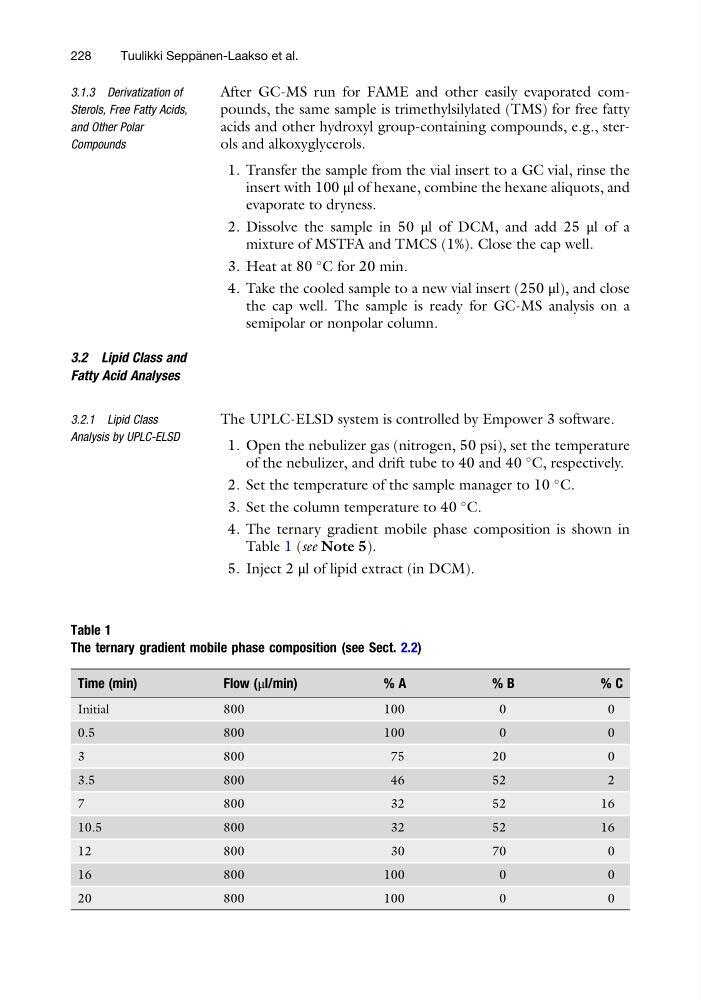
4. The ternary gradient mobile phase composition is shown in
Table 1 (see Note 5).
5. Inject 2 μl of lipid extract (in DCM).
Table 1
The ternary gradient mobile phase composition (see Sect. 2.2)
Time (min)
Flow (μl/min)
% A
% B
% C
Initial
800
100
0
0
0.5
800
100
0
0
3
800
75
20
0
3.5
800
46
52
2
7
800
32
52
16
10.5
800
32
52
16
12
800
30
70
0
16
800
100
0
0
20
800
100
0
0
228
Tuulikki Sepp€ anen-Laakso et al.
Sterols, Free Fatty Acids,
and Other Polar
Compounds
After GC-MS run for FAME and other easily evaporated compounds, the same sample is trimethylsilylated (TMS) for free fatty
acids and other hydroxyl group-containing compounds, e.g., sterols and alkoxyglycerols.
1. Transfer the sample from the vial insert to a GC vial, rinse the
insert with 100 μl of hexane, combine the hexane aliquots, and
evaporate to dryness.
2. Dissolve the sample in 50 μl of DCM, and add 25 μl of a
mixture of MSTFA and TMCS (1%). Close the cap well.
3. Heat at 80
C for 20 min.
4. Take the cooled sample to a new vial insert (250 μl), and close
the cap well. The sample is ready for GC-MS analysis on a
semipolar or nonpolar column.
3.2 Lipid Class and
Fatty Acid Analyses
3.2.1 Lipid Class
Analysis by UPLC-ELSD
The UPLC-ELSD system is controlled by Empower 3 software.
1. Open the nebulizer gas (nitrogen, 50 psi), set the temperature
of the nebulizer, and drift tube to 40 and 40
C, respectively.
2. Set the temperature of the sample manager to 10
C.
3. Set the column temperature to 40
C.
4. The ternary gradient mobile phase composition is shown in
Table 1 (see Note 5).
5. Inject 2 μl of lipid extract (in DCM).
Table 1
The ternary gradient mobile phase composition (see Sect. 2.2)
Time (min)
Flow (μl/min)
% A
% B
% C
Initial
800
100
0
0
0.5
800
100
0
0
3
800
75
20
0
3.5
800
46
52
2
7
800
32
52
16
10.5
800
32
52
16
12
800
30
70
0
16
800
100
0
0
20
800
100
0
0
228
Tuulikki Sepp€ anen-Laakso et al.