

3. For stage 1 of the assay, place all reaction vessels in a test-tube
rack, and place the rack in a 37
C water bath (or incubator) for
1 h (see note 4).
4. Upon completion of the 1 h incubation period at 37
C, remove
the test-tube rack, and add the required aliquot of RO water (see
note 5) to achieve dilution of the acid concentration to 1 M.
5. For stage 2 of the assay, carefully return the reaction vessel caps,
return the vessels to the test-tube rack, and then place the rack
in 100
C water bath (or incubator) for 2 h.
6. After 2 h incubation at 100
C, remove the test-tube rack and
place it into an ice-cold water bath (or similarly suitable tray) to
cool, and allow any particulates or suspended biomass to settle.
7. After cooling unscrew the reaction vessel caps and carefully
remove an aliquot (ca. 2 mL) of the liquid phase using a
disposable plastic Luer-Lok-type syringe (2–5 mL capacity typically) while attempting to minimize uptake of solid particles.
8. Syringe filter each sample into a clean glass test tube, using a
Luer-Lok-type syringe filter of <0.45 μm retention size.
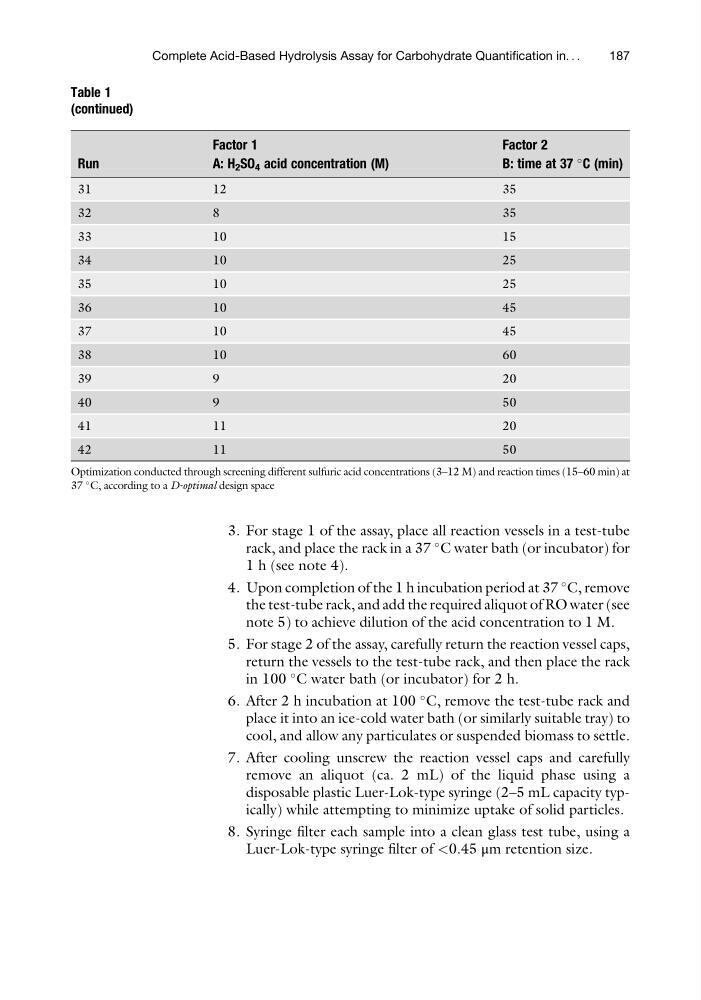
Table 1
(continued)
Run
Factor 1
Factor 2
A: H 2 SO 4 acid concentration (M)
B: time at 37
C (min)
31
12
35
32
8
35
33
10
15
34
10
25
35
10
25
36
10
45
37
10
45
38
10
60
39
9
20
40
9
50
41
11
20
42
11
50
Optimization conducted through screening different sulfuric acid concentrations (3–12 M) and reaction times (15–60 min) at
37
C, according to a D-optimal design space
Complete Acid-Based Hydrolysis Assay for Carbohydrate Quantification in. . .
187
rack, and place the rack in a 37
C water bath (or incubator) for
1 h (see note 4).
4. Upon completion of the 1 h incubation period at 37
C, remove
the test-tube rack, and add the required aliquot of RO water (see
note 5) to achieve dilution of the acid concentration to 1 M.
5. For stage 2 of the assay, carefully return the reaction vessel caps,
return the vessels to the test-tube rack, and then place the rack
in 100
C water bath (or incubator) for 2 h.
6. After 2 h incubation at 100
C, remove the test-tube rack and
place it into an ice-cold water bath (or similarly suitable tray) to
cool, and allow any particulates or suspended biomass to settle.
7. After cooling unscrew the reaction vessel caps and carefully
remove an aliquot (ca. 2 mL) of the liquid phase using a
disposable plastic Luer-Lok-type syringe (2–5 mL capacity typically) while attempting to minimize uptake of solid particles.
8. Syringe filter each sample into a clean glass test tube, using a
Luer-Lok-type syringe filter of <0.45 μm retention size.
Table 1
(continued)
Run
Factor 1
Factor 2
A: H 2 SO 4 acid concentration (M)
B: time at 37
C (min)
31
12
35
32
8
35
33
10
15
34
10
25
35
10
25
36
10
45
37
10
45
38
10
60
39
9
20
40
9
50
41
11
20
42
11
50
Optimization conducted through screening different sulfuric acid concentrations (3–12 M) and reaction times (15–60 min) at
37
C, according to a D-optimal design space
Complete Acid-Based Hydrolysis Assay for Carbohydrate Quantification in. . .
187