

3 Metabolic Engineering for Biohydrogen Production by Microalgae
Biohydrogen is a carbon-free fuel whose combustion results in the
generation of water. Hydrogen is also the main fuel for electricity
production by fuel cells. Microalgae produces hydrogen through at
least three known pathways which have been well-reviewed in our
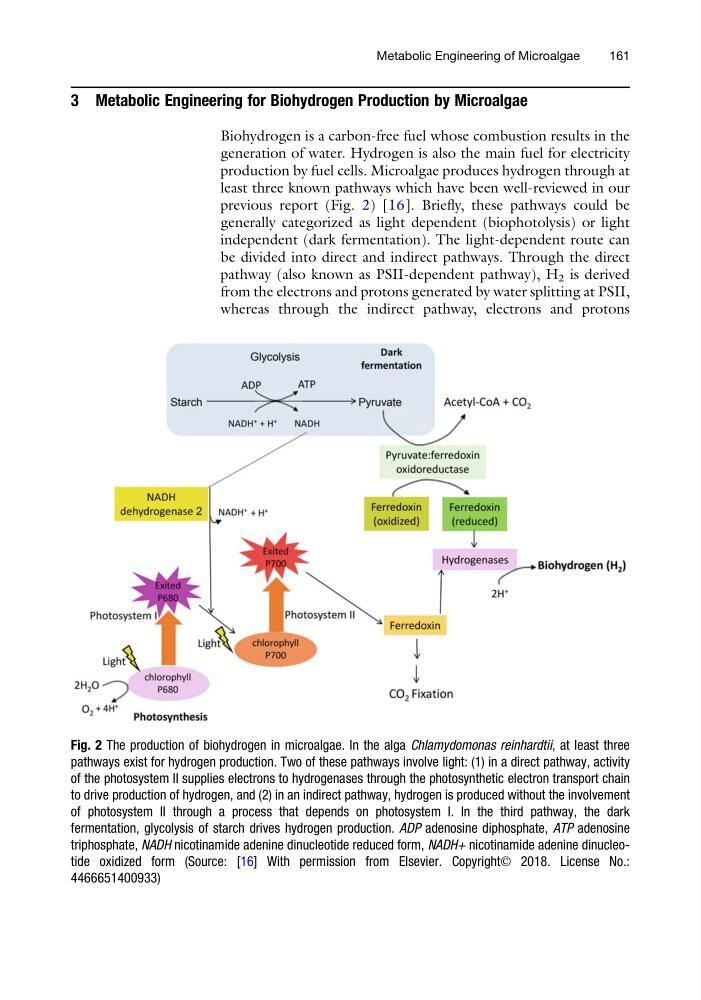
previous report (Fig. 2) [16]. Briefly, these pathways could be
generally categorized as light dependent (biophotolysis) or light
independent (dark fermentation). The light-dependent route can
be divided into direct and indirect pathways. Through the direct
pathway (also known as PSII-dependent pathway), H 2 is derived
from the electrons and protons generated by water splitting at PSII,
whereas through the indirect pathway, electrons and protons
Fig. 2 The production of biohydrogen in microalgae. In the alga Chlamydomonas reinhardtii, at least three
pathways exist for hydrogen production. Two of these pathways involve light: (1) in a direct pathway, activity
of the photosystem II supplies electrons to hydrogenases through the photosynthetic electron transport chain
to drive production of hydrogen, and (2) in an indirect pathway, hydrogen is produced without the involvement
of photosystem II through a process that depends on photosystem I. In the third pathway, the dark
fermentation, glycolysis of starch drives hydrogen production. ADP adenosine diphosphate, ATP adenosine
triphosphate, NADH nicotinamide adenine dinucleotide reduced form, NADH+ nicotinamide adenine dinucleotide oxidized form (Source: [16] With permission from Elsevier. Copyright© 2018. License No.:
4466651400933)
Metabolic Engineering of Microalgae
161
Biohydrogen is a carbon-free fuel whose combustion results in the
generation of water. Hydrogen is also the main fuel for electricity
production by fuel cells. Microalgae produces hydrogen through at
least three known pathways which have been well-reviewed in our
previous report (Fig. 2) [16]. Briefly, these pathways could be
generally categorized as light dependent (biophotolysis) or light
independent (dark fermentation). The light-dependent route can
be divided into direct and indirect pathways. Through the direct
pathway (also known as PSII-dependent pathway), H 2 is derived
from the electrons and protons generated by water splitting at PSII,
whereas through the indirect pathway, electrons and protons
Fig. 2 The production of biohydrogen in microalgae. In the alga Chlamydomonas reinhardtii, at least three
pathways exist for hydrogen production. Two of these pathways involve light: (1) in a direct pathway, activity
of the photosystem II supplies electrons to hydrogenases through the photosynthetic electron transport chain
to drive production of hydrogen, and (2) in an indirect pathway, hydrogen is produced without the involvement
of photosystem II through a process that depends on photosystem I. In the third pathway, the dark
fermentation, glycolysis of starch drives hydrogen production. ADP adenosine diphosphate, ATP adenosine
triphosphate, NADH nicotinamide adenine dinucleotide reduced form, NADH+ nicotinamide adenine dinucleotide oxidized form (Source: [16] With permission from Elsevier. Copyright© 2018. License No.:
4466651400933)
Metabolic Engineering of Microalgae
161