

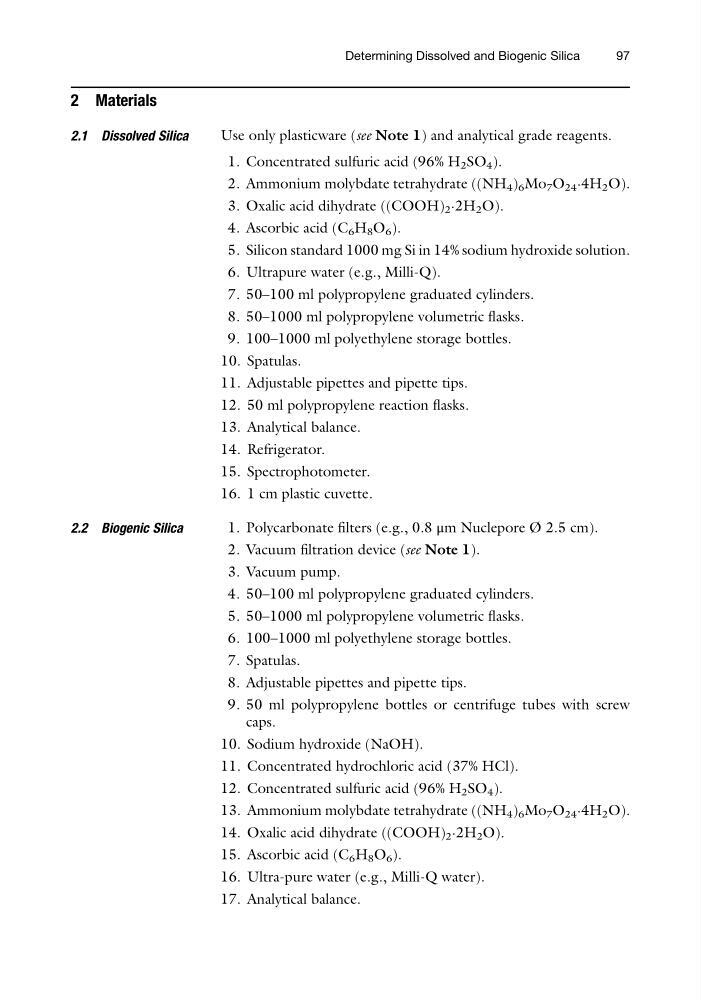
2 Materials
2.1 Dissolved Silica
Use only plasticware (see Note 1) and analytical grade reagents.
1. Concentrated sulfuric acid (96% H 2 SO 4 ).
2. Ammonium molybdate tetrahydrate ((NH 4 ) 6 Mo 7 O 24 ·4H 2 O).
3. Oxalic acid dihydrate ((COOH) 2 ·2H 2 O).
4. Ascorbic acid (C 6 H 8 O 6 ).
5. Silicon standard 1000 mg Si in 14% sodium hydroxide solution.
6. Ultrapure water (e.g., Milli-Q).
7. 50–100 ml polypropylene graduated cylinders.
8. 50–1000 ml polypropylene volumetric flasks.
9. 100–1000 ml polyethylene storage bottles.
10. Spatulas.
11. Adjustable pipettes and pipette tips.
12. 50 ml polypropylene reaction flasks.
13. Analytical balance.
14. Refrigerator.
15. Spectrophotometer.
16. 1 cm plastic cuvette.
2.2 Biogenic Silica
1. Polycarbonate filters (e.g., 0.8 μm Nuclepore Ø 2.5 cm).
2. Vacuum filtration device (see Note 1).
3. Vacuum pump.
4. 50–100 ml polypropylene graduated cylinders.
5. 50–1000 ml polypropylene volumetric flasks.
6. 100–1000 ml polyethylene storage bottles.
7. Spatulas.
8. Adjustable pipettes and pipette tips.
9. 50 ml polypropylene bottles or centrifuge tubes with screw
caps.
10. Sodium hydroxide (NaOH).
11. Concentrated hydrochloric acid (37% HCl).
12. Concentrated sulfuric acid (96% H 2 SO 4 ).
13. Ammonium molybdate tetrahydrate ((NH 4 ) 6 Mo 7 O 24 ·4H 2 O).
14. Oxalic acid dihydrate ((COOH) 2 ·2H 2 O).
15. Ascorbic acid (C 6 H 8 O 6 ).
16. Ultra-pure water (e.g., Milli-Q water).
17. Analytical balance.
Determining Dissolved and Biogenic Silica
97
2.1 Dissolved Silica
Use only plasticware (see Note 1) and analytical grade reagents.
1. Concentrated sulfuric acid (96% H 2 SO 4 ).
2. Ammonium molybdate tetrahydrate ((NH 4 ) 6 Mo 7 O 24 ·4H 2 O).
3. Oxalic acid dihydrate ((COOH) 2 ·2H 2 O).
4. Ascorbic acid (C 6 H 8 O 6 ).
5. Silicon standard 1000 mg Si in 14% sodium hydroxide solution.
6. Ultrapure water (e.g., Milli-Q).
7. 50–100 ml polypropylene graduated cylinders.
8. 50–1000 ml polypropylene volumetric flasks.
9. 100–1000 ml polyethylene storage bottles.
10. Spatulas.
11. Adjustable pipettes and pipette tips.
12. 50 ml polypropylene reaction flasks.
13. Analytical balance.
14. Refrigerator.
15. Spectrophotometer.
16. 1 cm plastic cuvette.
2.2 Biogenic Silica
1. Polycarbonate filters (e.g., 0.8 μm Nuclepore Ø 2.5 cm).
2. Vacuum filtration device (see Note 1).
3. Vacuum pump.
4. 50–100 ml polypropylene graduated cylinders.
5. 50–1000 ml polypropylene volumetric flasks.
6. 100–1000 ml polyethylene storage bottles.
7. Spatulas.
8. Adjustable pipettes and pipette tips.
9. 50 ml polypropylene bottles or centrifuge tubes with screw
caps.
10. Sodium hydroxide (NaOH).
11. Concentrated hydrochloric acid (37% HCl).
12. Concentrated sulfuric acid (96% H 2 SO 4 ).
13. Ammonium molybdate tetrahydrate ((NH 4 ) 6 Mo 7 O 24 ·4H 2 O).
14. Oxalic acid dihydrate ((COOH) 2 ·2H 2 O).
15. Ascorbic acid (C 6 H 8 O 6 ).
16. Ultra-pure water (e.g., Milli-Q water).
17. Analytical balance.
Determining Dissolved and Biogenic Silica
97