

30
2 Environmental Risk Management Applications …
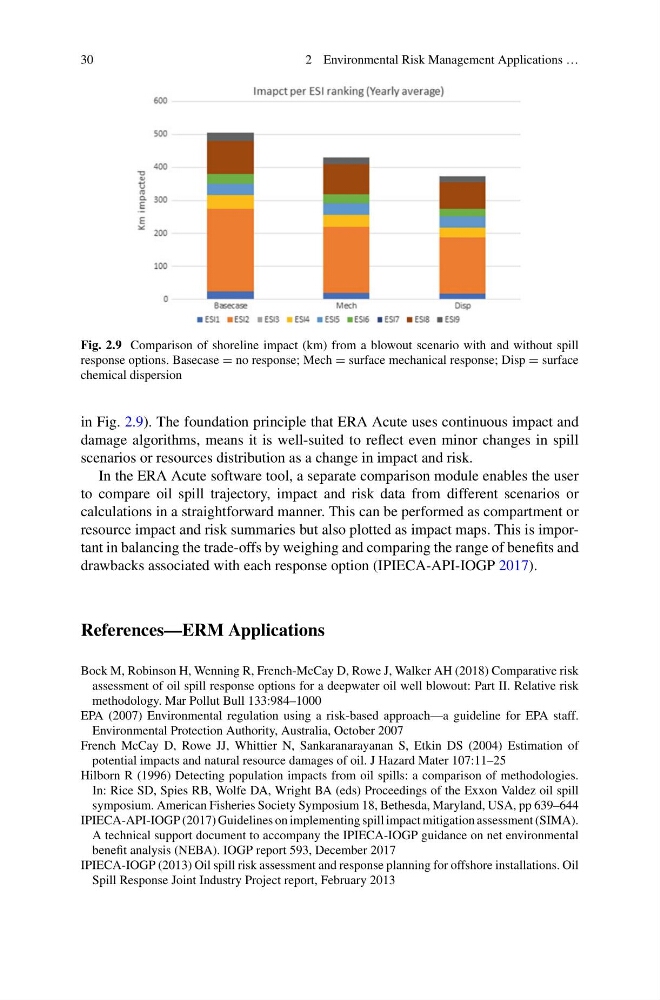
Fig. 2.9 Comparison of shoreline impact (km) from a blowout scenario with and without spill
response options. Basecase = no response; Mech = surface mechanical response; Disp = surface
chemical dispersion
in Fig. 2.9). The foundation principle that ERA Acute uses continuous impact and
damage algorithms, means it is well-suited to reflect even minor changes in spill
scenarios or resources distribution as a change in impact and risk.
In the ERA Acute software tool, a separate comparison module enables the user
to compare oil spill trajectory, impact and risk data from different scenarios or
calculations in a straightforward manner. This can be performed as compartment or
resource impact and risk summaries but also plotted as impact maps. This is important in balancing the trade-offs by weighing and comparing the range of benefits and
drawbacks associated with each response option (IPIECA-API-IOGP 2017).
References—ERM Applications
Bock M, Robinson H, Wenning R, French-McCay D, Rowe J, Walker AH (2018) Comparative risk
assessment of oil spill response options for a deepwater oil well blowout: Part II. Relative risk
methodology. Mar Pollut Bull 133:984–1000
EPA (2007) Environmental regulation using a risk-based approach—a guideline for EPA staff.
Environmental Protection Authority, Australia, October 2007
French McCay D, Rowe JJ, Whittier N, Sankaranarayanan S, Etkin DS (2004) Estimation of
potential impacts and natural resource damages of oil. J Hazard Mater 107:11–25
Hilborn R (1996) Detecting population impacts from oil spills: a comparison of methodologies.
In: Rice SD, Spies RB, Wolfe DA, Wright BA (eds) Proceedings of the Exxon Valdez oil spill
symposium. American Fisheries Society Symposium 18, Bethesda, Maryland, USA, pp 639–644
IPIECA-API-IOGP (2017) Guidelines on implementing spill impact mitigation assessment (SIMA).
A technical support document to accompany the IPIECA-IOGP guidance on net environmental
benefit analysis (NEBA). IOGP report 593, December 2017
IPIECA-IOGP (2013) Oil spill risk assessment and response planning for offshore installations. Oil
Spill Response Joint Industry Project report, February 2013
2 Environmental Risk Management Applications …
Fig. 2.9 Comparison of shoreline impact (km) from a blowout scenario with and without spill
response options. Basecase = no response; Mech = surface mechanical response; Disp = surface
chemical dispersion
in Fig. 2.9). The foundation principle that ERA Acute uses continuous impact and
damage algorithms, means it is well-suited to reflect even minor changes in spill
scenarios or resources distribution as a change in impact and risk.
In the ERA Acute software tool, a separate comparison module enables the user
to compare oil spill trajectory, impact and risk data from different scenarios or
calculations in a straightforward manner. This can be performed as compartment or
resource impact and risk summaries but also plotted as impact maps. This is important in balancing the trade-offs by weighing and comparing the range of benefits and
drawbacks associated with each response option (IPIECA-API-IOGP 2017).
References—ERM Applications
Bock M, Robinson H, Wenning R, French-McCay D, Rowe J, Walker AH (2018) Comparative risk
assessment of oil spill response options for a deepwater oil well blowout: Part II. Relative risk
methodology. Mar Pollut Bull 133:984–1000
EPA (2007) Environmental regulation using a risk-based approach—a guideline for EPA staff.
Environmental Protection Authority, Australia, October 2007
French McCay D, Rowe JJ, Whittier N, Sankaranarayanan S, Etkin DS (2004) Estimation of
potential impacts and natural resource damages of oil. J Hazard Mater 107:11–25
Hilborn R (1996) Detecting population impacts from oil spills: a comparison of methodologies.
In: Rice SD, Spies RB, Wolfe DA, Wright BA (eds) Proceedings of the Exxon Valdez oil spill
symposium. American Fisheries Society Symposium 18, Bethesda, Maryland, USA, pp 639–644
IPIECA-API-IOGP (2017) Guidelines on implementing spill impact mitigation assessment (SIMA).
A technical support document to accompany the IPIECA-IOGP guidance on net environmental
benefit analysis (NEBA). IOGP report 593, December 2017
IPIECA-IOGP (2013) Oil spill risk assessment and response planning for offshore installations. Oil
Spill Response Joint Industry Project report, February 2013