

5.4 Recommended Uncertainty Handling at This Point in Model Development
105
Table 5.8 (continued)
Main parameter
A: Strength of knowledge (function where it is used)
B: Belief that the value may deviate from the average assumption (Natural
variation of parameter)
C: Sensitivity of function to parameter (sensitivity index)
t res (Hard)
A Fixed value
B High
C High
Comments/recommendations:
Very little research available after oil spills affecting deep sea corals.
Comparable incident DHOS not yet restored
Within a region, e.g. a country for which assessments should be used for applications to the authorities, this means that the industry should work together to test new
values, gain common knowledge and understanding of the sensitivities as well as use
common data sets. Calibration of the parameter values should be carried out after
testing and documentation of the effects, and results discussed between scientists
from both industry, consultancies, authorities and research institutions. The goal is
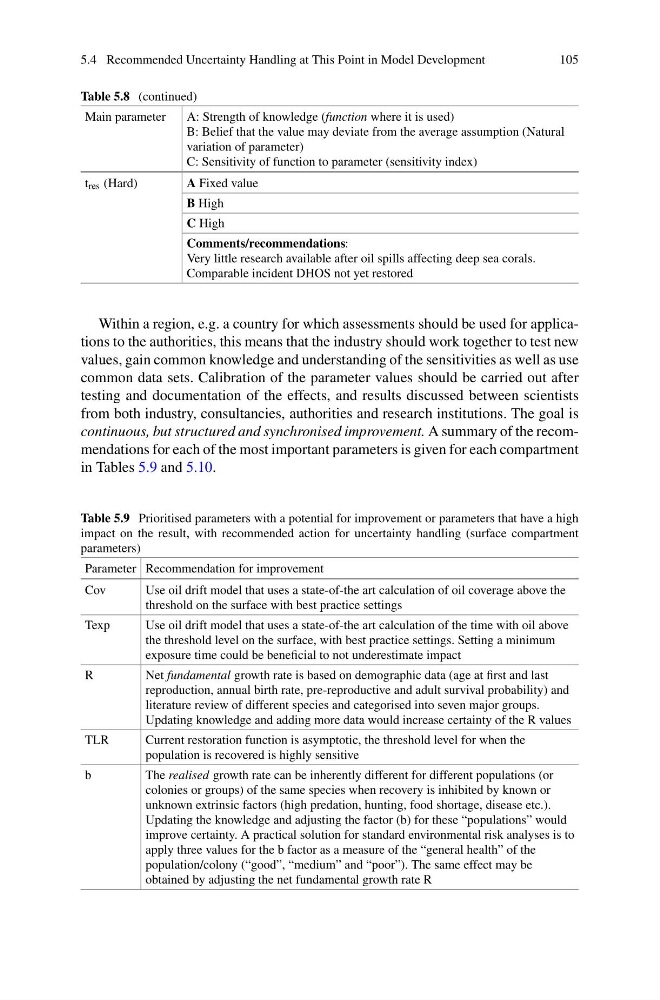
continuous, but structured and synchronised improvement. A summary of the recommendations for each of the most important parameters is given for each compartment
in Tables 5.9 and 5.10.
Table 5.9 Prioritised parameters with a potential for improvement or parameters that have a high
impact on the result, with recommended action for uncertainty handling (surface compartment
parameters)
Parameter Recommendation for improvement
Cov
Use oil drift model that uses a state-of-the art calculation of oil coverage above the
threshold on the surface with best practice settings
Texp
Use oil drift model that uses a state-of-the art calculation of the time with oil above
the threshold level on the surface, with best practice settings. Setting a minimum
exposure time could be beneficial to not underestimate impact
R
Net fundamental growth rate is based on demographic data (age at first and last
reproduction, annual birth rate, pre-reproductive and adult survival probability) and
literature review of different species and categorised into seven major groups.
Updating knowledge and adding more data would increase certainty of the R values
TLR
Current restoration function is asymptotic, the threshold level for when the
population is recovered is highly sensitive
b
The realised growth rate can be inherently different for different populations (or
colonies or groups) of the same species when recovery is inhibited by known or
unknown extrinsic factors (high predation, hunting, food shortage, disease etc.).
Updating the knowledge and adjusting the factor (b) for these “populations” would
improve certainty. A practical solution for standard environmental risk analyses is to
apply three values for the b factor as a measure of the “general health” of the
population/colony (“good”, “medium” and “poor”). The same effect may be
obtained by adjusting the net fundamental growth rate R
105
Table 5.8 (continued)
Main parameter
A: Strength of knowledge (function where it is used)
B: Belief that the value may deviate from the average assumption (Natural
variation of parameter)
C: Sensitivity of function to parameter (sensitivity index)
t res (Hard)
A Fixed value
B High
C High
Comments/recommendations:
Very little research available after oil spills affecting deep sea corals.
Comparable incident DHOS not yet restored
Within a region, e.g. a country for which assessments should be used for applications to the authorities, this means that the industry should work together to test new
values, gain common knowledge and understanding of the sensitivities as well as use
common data sets. Calibration of the parameter values should be carried out after
testing and documentation of the effects, and results discussed between scientists
from both industry, consultancies, authorities and research institutions. The goal is
continuous, but structured and synchronised improvement. A summary of the recommendations for each of the most important parameters is given for each compartment
in Tables 5.9 and 5.10.
Table 5.9 Prioritised parameters with a potential for improvement or parameters that have a high
impact on the result, with recommended action for uncertainty handling (surface compartment
parameters)
Parameter Recommendation for improvement
Cov
Use oil drift model that uses a state-of-the art calculation of oil coverage above the
threshold on the surface with best practice settings
Texp
Use oil drift model that uses a state-of-the art calculation of the time with oil above
the threshold level on the surface, with best practice settings. Setting a minimum
exposure time could be beneficial to not underestimate impact
R
Net fundamental growth rate is based on demographic data (age at first and last
reproduction, annual birth rate, pre-reproductive and adult survival probability) and
literature review of different species and categorised into seven major groups.
Updating knowledge and adding more data would increase certainty of the R values
TLR
Current restoration function is asymptotic, the threshold level for when the
population is recovered is highly sensitive
b
The realised growth rate can be inherently different for different populations (or
colonies or groups) of the same species when recovery is inhibited by known or
unknown extrinsic factors (high predation, hunting, food shortage, disease etc.).
Updating the knowledge and adjusting the factor (b) for these “populations” would
improve certainty. A practical solution for standard environmental risk analyses is to
apply three values for the b factor as a measure of the “general health” of the
population/colony (“good”, “medium” and “poor”). The same effect may be
obtained by adjusting the net fundamental growth rate R