

2.8 Molecular Design
87
Table 2.23 Count of spin quantum numbers for several non-Kekulé molecules with numbers of
starred and unstarred carbon atoms (n*and n)
n*
n
Spin quantum number S (=[n* − n]/2)
Multiplicity: 2S+1
TMM
3
1
1
3; triplet
MQDM
5
3
1
3; triplet
TME
3
3
0
1; singlet
TMB
5
5
0
1; singlet
levels guarantees Hund’s rule resulting in parallel spin alignment (Ito et al. 1997). For
instance, a benzene ring equipped with two radical centers at its meta position could
have triplet-ground state or, in other words, the triplet state becomes energetically
most stable as expressed by positive ST value defined by
ST = E S −E T
(2.54)
where E S and E T represent the energies of a molecule in the singlet and triplet states,
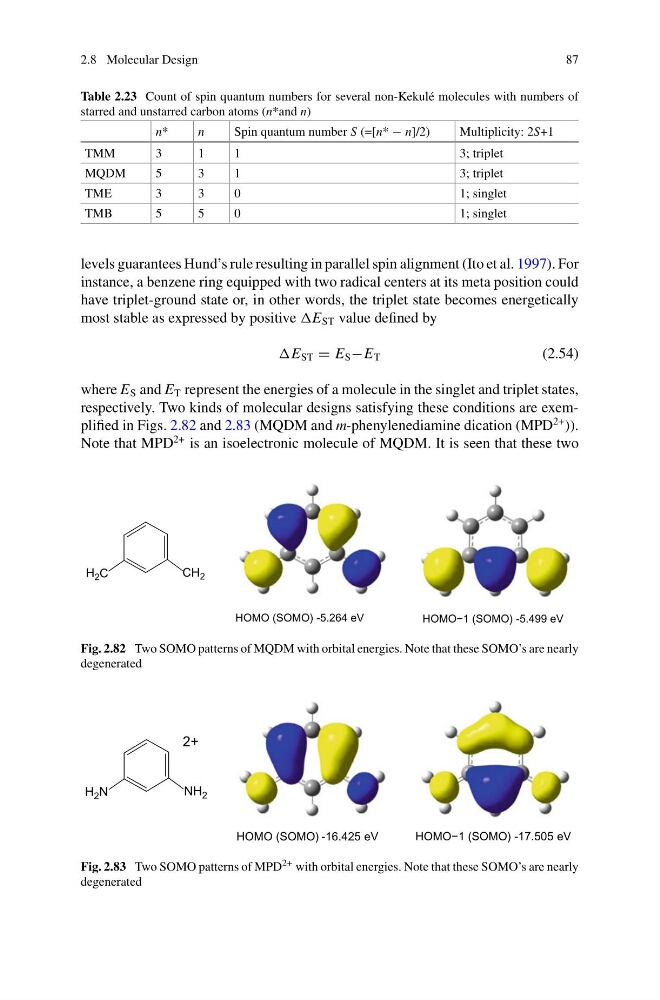
respectively. Two kinds of molecular designs satisfying these conditions are exemplified in Figs. 2.82 and 2.83 (MQDM and m-phenylenediamine dication (MPD
2+ )).
Note that MPD
2+ is an isoelectronic molecule of MQDM. It is seen that these two
H 2 C
CH 2
HOMO−1 (SOMO) -5.499 eV
HOMO (SOMO) -5.264 eV
Fig. 2.82 Two SOMO patterns of MQDM with orbital energies. Note that these SOMO’s are nearly
degenerated
H 2 N
NH 2
2+
HOMO−1 (SOMO) -17.505 eV
HOMO (SOMO) -16.425 eV
Fig. 2.83 Two SOMO patterns of MPD 2+ with orbital energies. Note that these SOMO’s are nearly
degenerated
87
Table 2.23 Count of spin quantum numbers for several non-Kekulé molecules with numbers of
starred and unstarred carbon atoms (n*and n)
n*
n
Spin quantum number S (=[n* − n]/2)
Multiplicity: 2S+1
TMM
3
1
1
3; triplet
MQDM
5
3
1
3; triplet
TME
3
3
0
1; singlet
TMB
5
5
0
1; singlet
levels guarantees Hund’s rule resulting in parallel spin alignment (Ito et al. 1997). For
instance, a benzene ring equipped with two radical centers at its meta position could
have triplet-ground state or, in other words, the triplet state becomes energetically
most stable as expressed by positive ST value defined by
ST = E S −E T
(2.54)
where E S and E T represent the energies of a molecule in the singlet and triplet states,
respectively. Two kinds of molecular designs satisfying these conditions are exemplified in Figs. 2.82 and 2.83 (MQDM and m-phenylenediamine dication (MPD
2+ )).
Note that MPD
2+ is an isoelectronic molecule of MQDM. It is seen that these two
H 2 C
CH 2
HOMO−1 (SOMO) -5.499 eV
HOMO (SOMO) -5.264 eV
Fig. 2.82 Two SOMO patterns of MQDM with orbital energies. Note that these SOMO’s are nearly
degenerated
H 2 N
NH 2
2+
HOMO−1 (SOMO) -17.505 eV
HOMO (SOMO) -16.425 eV
Fig. 2.83 Two SOMO patterns of MPD 2+ with orbital energies. Note that these SOMO’s are nearly
degenerated