

86
2 Actual Potentials of Theoretical Chemistry: What Can Be Obtained
(a)
(c)
(d)
(b)
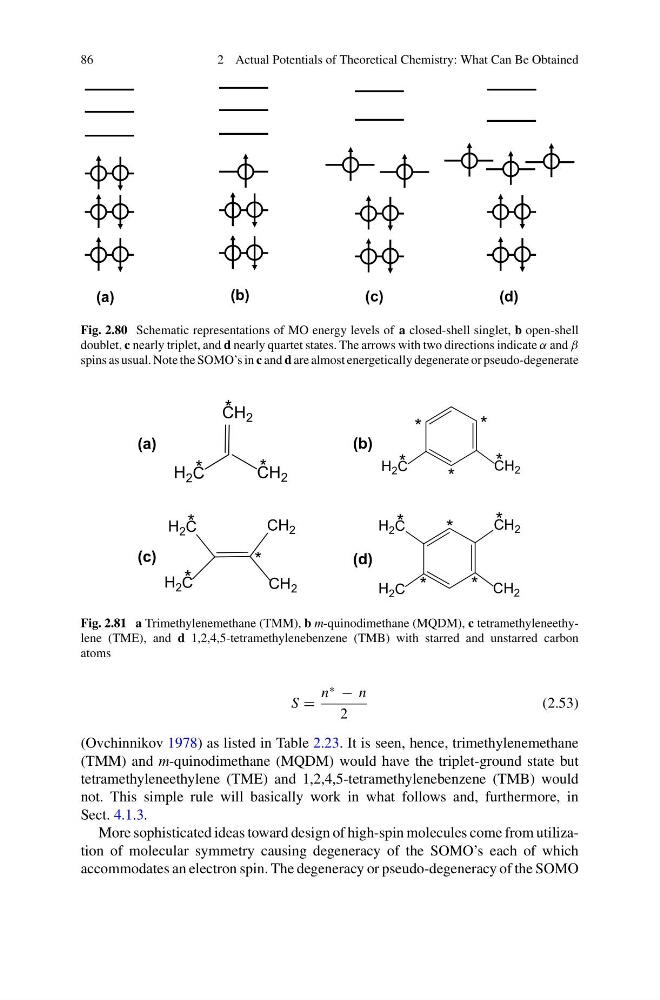
Fig. 2.80 Schematic representations of MO energy levels of a closed-shell singlet, b open-shell
doublet, c nearly triplet, and d nearly quartet states. The arrows with two directions indicate α and β
spins as usual. Note the SOMO’s in c and d are almost energetically degenerate or pseudo-degenerate
H 2 C
CH 2
CH 2
CH 2
H 2 C
CH 2
CH 2
H 2 C
H 2 C
H 2 C
CH 2
H 2 C
CH 2
*
*
*
*
*
*
*
*
*
*
*
*
*
*
*
*
(a)
(b)
(c)
(d)
Fig. 2.81 a Trimethylenemethane (TMM), b m-quinodimethane (MQDM), c tetramethyleneethylene (TME), and d 1,2,4,5-tetramethylenebenzene (TMB) with starred and unstarred carbon
atoms
S =
n
∗
− n
2
(2.53)
(Ovchinnikov 1978) as listed in Table 2.23. It is seen, hence, trimethylenemethane
(TMM) and m-quinodimethane (MQDM) would have the triplet-ground state but
tetramethyleneethylene (TME) and 1,2,4,5-tetramethylenebenzene (TMB) would
not. This simple rule will basically work in what follows and, furthermore, in
Sect. 4.1.3.
More sophisticated ideas toward design of high-spin molecules come from utilization of molecular symmetry causing degeneracy of the SOMO’s each of which
accommodates an electron spin. The degeneracy or pseudo-degeneracy of the SOMO
2 Actual Potentials of Theoretical Chemistry: What Can Be Obtained
(a)
(c)
(d)
(b)
Fig. 2.80 Schematic representations of MO energy levels of a closed-shell singlet, b open-shell
doublet, c nearly triplet, and d nearly quartet states. The arrows with two directions indicate α and β
spins as usual. Note the SOMO’s in c and d are almost energetically degenerate or pseudo-degenerate
H 2 C
CH 2
CH 2
CH 2
H 2 C
CH 2
CH 2
H 2 C
H 2 C
H 2 C
CH 2
H 2 C
CH 2
*
*
*
*
*
*
*
*
*
*
*
*
*
*
*
*
(a)
(b)
(c)
(d)
Fig. 2.81 a Trimethylenemethane (TMM), b m-quinodimethane (MQDM), c tetramethyleneethylene (TME), and d 1,2,4,5-tetramethylenebenzene (TMB) with starred and unstarred carbon
atoms
S =
n
∗
− n
2
(2.53)
(Ovchinnikov 1978) as listed in Table 2.23. It is seen, hence, trimethylenemethane
(TMM) and m-quinodimethane (MQDM) would have the triplet-ground state but
tetramethyleneethylene (TME) and 1,2,4,5-tetramethylenebenzene (TMB) would
not. This simple rule will basically work in what follows and, furthermore, in
Sect. 4.1.3.
More sophisticated ideas toward design of high-spin molecules come from utilization of molecular symmetry causing degeneracy of the SOMO’s each of which
accommodates an electron spin. The degeneracy or pseudo-degeneracy of the SOMO