

2.7 Chemical Reactions
81
CH 3 Br
LUMO
OH -
HOMO
(a)
(b)
L
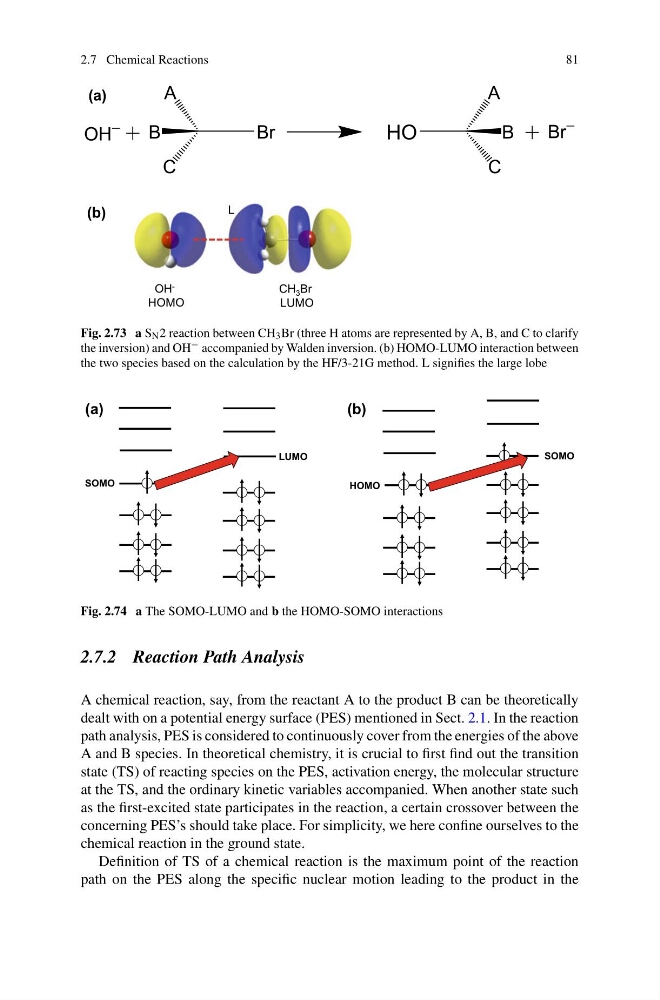
Fig. 2.73 a S N 2 reaction between CH 3 Br (three H atoms are represented by A, B, and C to clarify
the inversion) and OH − accompanied by Walden inversion. (b) HOMO-LUMO interaction between
the two species based on the calculation by the HF/3-21G method. L signifies the large lobe
HOMO
LUMO
(a)
SOMO
SOMO
(b)
Fig. 2.74 a The SOMO-LUMO and b the HOMO-SOMO interactions
2.7.2 Reaction Path Analysis
A chemical reaction, say, from the reactant A to the product B can be theoretically
dealt with on a potential energy surface (PES) mentioned in Sect. 2.1. In the reaction
path analysis, PES is considered to continuously cover from the energies of the above
A and B species. In theoretical chemistry, it is crucial to first find out the transition
state (TS) of reacting species on the PES, activation energy, the molecular structure
at the TS, and the ordinary kinetic variables accompanied. When another state such
as the first-excited state participates in the reaction, a certain crossover between the
concerning PES’s should take place. For simplicity, we here confine ourselves to the
chemical reaction in the ground state.
Definition of TS of a chemical reaction is the maximum point of the reaction
path on the PES along the specific nuclear motion leading to the product in the
81
CH 3 Br
LUMO
OH -
HOMO
(a)
(b)
L
Fig. 2.73 a S N 2 reaction between CH 3 Br (three H atoms are represented by A, B, and C to clarify
the inversion) and OH − accompanied by Walden inversion. (b) HOMO-LUMO interaction between
the two species based on the calculation by the HF/3-21G method. L signifies the large lobe
HOMO
LUMO
(a)
SOMO
SOMO
(b)
Fig. 2.74 a The SOMO-LUMO and b the HOMO-SOMO interactions
2.7.2 Reaction Path Analysis
A chemical reaction, say, from the reactant A to the product B can be theoretically
dealt with on a potential energy surface (PES) mentioned in Sect. 2.1. In the reaction
path analysis, PES is considered to continuously cover from the energies of the above
A and B species. In theoretical chemistry, it is crucial to first find out the transition
state (TS) of reacting species on the PES, activation energy, the molecular structure
at the TS, and the ordinary kinetic variables accompanied. When another state such
as the first-excited state participates in the reaction, a certain crossover between the
concerning PES’s should take place. For simplicity, we here confine ourselves to the
chemical reaction in the ground state.
Definition of TS of a chemical reaction is the maximum point of the reaction
path on the PES along the specific nuclear motion leading to the product in the