

2.7 Chemical Reactions
73
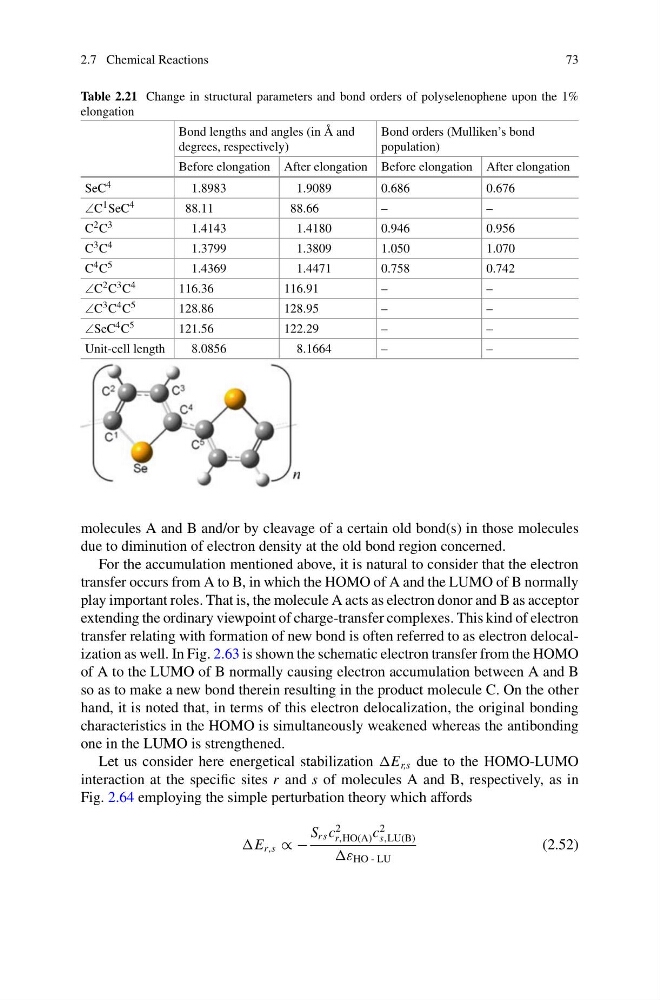
Table 2.21 Change in structural parameters and bond orders of polyselenophene upon the 1%
elongation
Bond lengths and angles (in Å and
degrees, respectively)
Bond orders (Mulliken’s bond
population)
Before elongation After elongation Before elongation After elongation
SeC 4
1.8983
1.9089
0.686
0.676
∠C 1 SeC 4
88.11
88.66
–
–
C 2 C 3
1.4143
1.4180
0.946
0.956
C 3 C 4
1.3799
1.3809
1.050
1.070
C 4 C 5
1.4369
1.4471
0.758
0.742
∠C 2 C 3 C 4
116.36
116.91
–
–
∠C 3 C 4 C 5
128.86
128.95
–
–
∠SeC 4 C 5
121.56
122.29
–
–
Unit-cell length
8.0856
8.1664
–
–
molecules A and B and/or by cleavage of a certain old bond(s) in those molecules
due to diminution of electron density at the old bond region concerned.
For the accumulation mentioned above, it is natural to consider that the electron
transfer occurs from A to B, in which the HOMO of A and the LUMO of B normally
play important roles. That is, the molecule A acts as electron donor and B as acceptor
extending the ordinary viewpoint of charge-transfer complexes. This kind of electron
transfer relating with formation of new bond is often referred to as electron delocalization as well. In Fig. 2.63 is shown the schematic electron transfer from the HOMO
of A to the LUMO of B normally causing electron accumulation between A and B
so as to make a new bond therein resulting in the product molecule C. On the other
hand, it is noted that, in terms of this electron delocalization, the original bonding
characteristics in the HOMO is simultaneously weakened whereas the antibonding
one in the LUMO is strengthened.
Let us consider here energetical stabilization E r,s due to the HOMO-LUMO
interaction at the specific sites r and s of molecules A and B, respectively, as in
Fig. 2.64 employing the simple perturbation theory which affords
E r,s ∝ −
S rs c
2
r,HO(A) c
2
s,LU(B)
ε HO - LU
(2.52)
73
Table 2.21 Change in structural parameters and bond orders of polyselenophene upon the 1%
elongation
Bond lengths and angles (in Å and
degrees, respectively)
Bond orders (Mulliken’s bond
population)
Before elongation After elongation Before elongation After elongation
SeC 4
1.8983
1.9089
0.686
0.676
∠C 1 SeC 4
88.11
88.66
–
–
C 2 C 3
1.4143
1.4180
0.946
0.956
C 3 C 4
1.3799
1.3809
1.050
1.070
C 4 C 5
1.4369
1.4471
0.758
0.742
∠C 2 C 3 C 4
116.36
116.91
–
–
∠C 3 C 4 C 5
128.86
128.95
–
–
∠SeC 4 C 5
121.56
122.29
–
–
Unit-cell length
8.0856
8.1664
–
–
molecules A and B and/or by cleavage of a certain old bond(s) in those molecules
due to diminution of electron density at the old bond region concerned.
For the accumulation mentioned above, it is natural to consider that the electron
transfer occurs from A to B, in which the HOMO of A and the LUMO of B normally
play important roles. That is, the molecule A acts as electron donor and B as acceptor
extending the ordinary viewpoint of charge-transfer complexes. This kind of electron
transfer relating with formation of new bond is often referred to as electron delocalization as well. In Fig. 2.63 is shown the schematic electron transfer from the HOMO
of A to the LUMO of B normally causing electron accumulation between A and B
so as to make a new bond therein resulting in the product molecule C. On the other
hand, it is noted that, in terms of this electron delocalization, the original bonding
characteristics in the HOMO is simultaneously weakened whereas the antibonding
one in the LUMO is strengthened.
Let us consider here energetical stabilization E r,s due to the HOMO-LUMO
interaction at the specific sites r and s of molecules A and B, respectively, as in
Fig. 2.64 employing the simple perturbation theory which affords
E r,s ∝ −
S rs c
2
r,HO(A) c
2
s,LU(B)
ε HO - LU
(2.52)