

72
2 Actual Potentials of Theoretical Chemistry: What Can Be Obtained
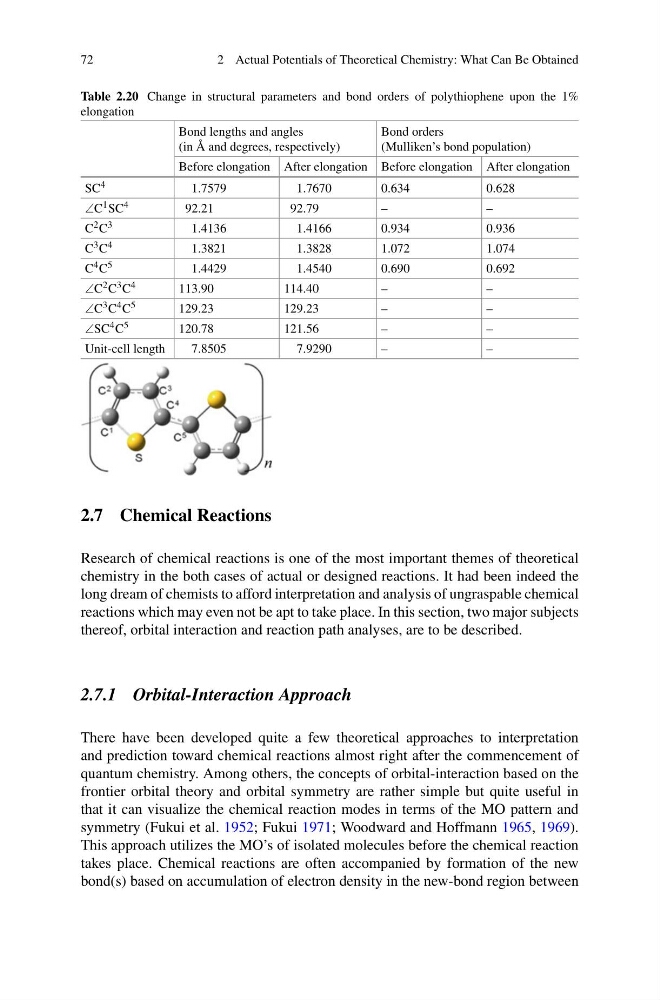
Table 2.20 Change in structural parameters and bond orders of polythiophene upon the 1%
elongation
Bond lengths and angles
(in Å and degrees, respectively)
Bond orders
(Mulliken’s bond population)
Before elongation After elongation Before elongation After elongation
SC 4
1.7579
1.7670
0.634
0.628
∠C 1 SC 4
92.21
92.79
–
–
C 2 C 3
1.4136
1.4166
0.934
0.936
C 3 C 4
1.3821
1.3828
1.072
1.074
C 4 C 5
1.4429
1.4540
0.690
0.692
∠C 2 C 3 C 4
113.90
114.40
–
–
∠C 3 C 4 C 5
129.23
129.23
–
–
∠SC 4 C 5
120.78
121.56
–
–
Unit-cell length
7.8505
7.9290
–
–
2.7 Chemical Reactions
Research of chemical reactions is one of the most important themes of theoretical
chemistry in the both cases of actual or designed reactions. It had been indeed the
long dream of chemists to afford interpretation and analysis of ungraspable chemical
reactions which may even not be apt to take place. In this section, two major subjects
thereof, orbital interaction and reaction path analyses, are to be described.
2.7.1 Orbital-Interaction Approach
There have been developed quite a few theoretical approaches to interpretation
and prediction toward chemical reactions almost right after the commencement of
quantum chemistry. Among others, the concepts of orbital-interaction based on the
frontier orbital theory and orbital symmetry are rather simple but quite useful in
that it can visualize the chemical reaction modes in terms of the MO pattern and
symmetry (Fukui et al. 1952; Fukui 1971; Woodward and Hoffmann 1965, 1969).
This approach utilizes the MO’s of isolated molecules before the chemical reaction
takes place. Chemical reactions are often accompanied by formation of the new
bond(s) based on accumulation of electron density in the new-bond region between
2 Actual Potentials of Theoretical Chemistry: What Can Be Obtained
Table 2.20 Change in structural parameters and bond orders of polythiophene upon the 1%
elongation
Bond lengths and angles
(in Å and degrees, respectively)
Bond orders
(Mulliken’s bond population)
Before elongation After elongation Before elongation After elongation
SC 4
1.7579
1.7670
0.634
0.628
∠C 1 SC 4
92.21
92.79
–
–
C 2 C 3
1.4136
1.4166
0.934
0.936
C 3 C 4
1.3821
1.3828
1.072
1.074
C 4 C 5
1.4429
1.4540
0.690
0.692
∠C 2 C 3 C 4
113.90
114.40
–
–
∠C 3 C 4 C 5
129.23
129.23
–
–
∠SC 4 C 5
120.78
121.56
–
–
Unit-cell length
7.8505
7.9290
–
–
2.7 Chemical Reactions
Research of chemical reactions is one of the most important themes of theoretical
chemistry in the both cases of actual or designed reactions. It had been indeed the
long dream of chemists to afford interpretation and analysis of ungraspable chemical
reactions which may even not be apt to take place. In this section, two major subjects
thereof, orbital interaction and reaction path analyses, are to be described.
2.7.1 Orbital-Interaction Approach
There have been developed quite a few theoretical approaches to interpretation
and prediction toward chemical reactions almost right after the commencement of
quantum chemistry. Among others, the concepts of orbital-interaction based on the
frontier orbital theory and orbital symmetry are rather simple but quite useful in
that it can visualize the chemical reaction modes in terms of the MO pattern and
symmetry (Fukui et al. 1952; Fukui 1971; Woodward and Hoffmann 1965, 1969).
This approach utilizes the MO’s of isolated molecules before the chemical reaction
takes place. Chemical reactions are often accompanied by formation of the new
bond(s) based on accumulation of electron density in the new-bond region between