

64
2 Actual Potentials of Theoretical Chemistry: What Can Be Obtained
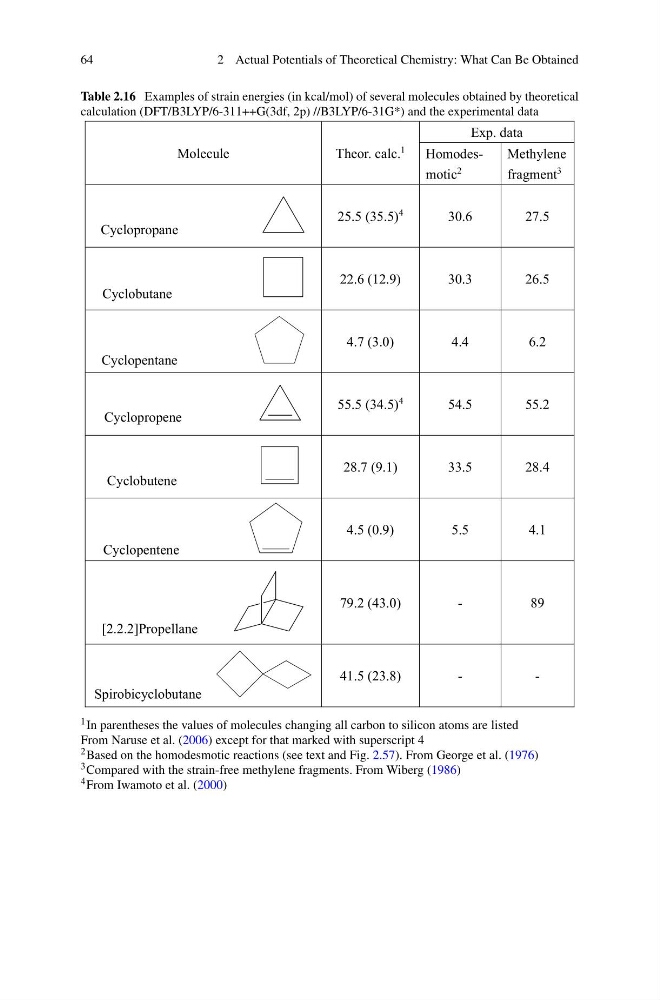
Table 2.16 Examples of strain energies (in kcal/mol) of several molecules obtained by theoretical
calculation (DFT/B3LYP/6-311++G(3df, 2p) //B3LYP/6-31G*) and the experimental data
Molecule
Theor. calc.
1
Exp. data
Homodesmotic
2
Methylene
fragment
3
Cyclopropane
25.5 (35.5)
4
30.6
27.5
Cyclobutane
22.6 (12.9)
30.3
26.5
Cyclopentane
4.7 (3.0)
4.4
6.2
Cyclopropene
55.5 (34.5)
4
54.5
55.2
Cyclobutene
28.7 (9.1)
33.5
28.4
Cyclopentene
4.5 (0.9)
5.5
4.1
[2.2.2]Propellane
79.2 (43.0)
-
89
Spirobicyclobutane
41.5 (23.8)
-
-
1 In parentheses the values of molecules changing all carbon to silicon atoms are listed
From Naruse et al. (2006) except for that marked with superscript 4
2 Based on the homodesmotic reactions (see text and Fig. 2.57). From George et al. (1976)
3 Compared with the strain-free methylene fragments. From Wiberg (1986)
4 From Iwamoto et al. (2000)
2 Actual Potentials of Theoretical Chemistry: What Can Be Obtained
Table 2.16 Examples of strain energies (in kcal/mol) of several molecules obtained by theoretical
calculation (DFT/B3LYP/6-311++G(3df, 2p) //B3LYP/6-31G*) and the experimental data
Molecule
Theor. calc.
1
Exp. data
Homodesmotic
2
Methylene
fragment
3
Cyclopropane
25.5 (35.5)
4
30.6
27.5
Cyclobutane
22.6 (12.9)
30.3
26.5
Cyclopentane
4.7 (3.0)
4.4
6.2
Cyclopropene
55.5 (34.5)
4
54.5
55.2
Cyclobutene
28.7 (9.1)
33.5
28.4
Cyclopentene
4.5 (0.9)
5.5
4.1
[2.2.2]Propellane
79.2 (43.0)
-
89
Spirobicyclobutane
41.5 (23.8)
-
-
1 In parentheses the values of molecules changing all carbon to silicon atoms are listed
From Naruse et al. (2006) except for that marked with superscript 4
2 Based on the homodesmotic reactions (see text and Fig. 2.57). From George et al. (1976)
3 Compared with the strain-free methylene fragments. From Wiberg (1986)
4 From Iwamoto et al. (2000)