

2.6 Mechanical Properties
63
(a)
0.22
0.20
0.08
(b)
0.08
0.20
0.22
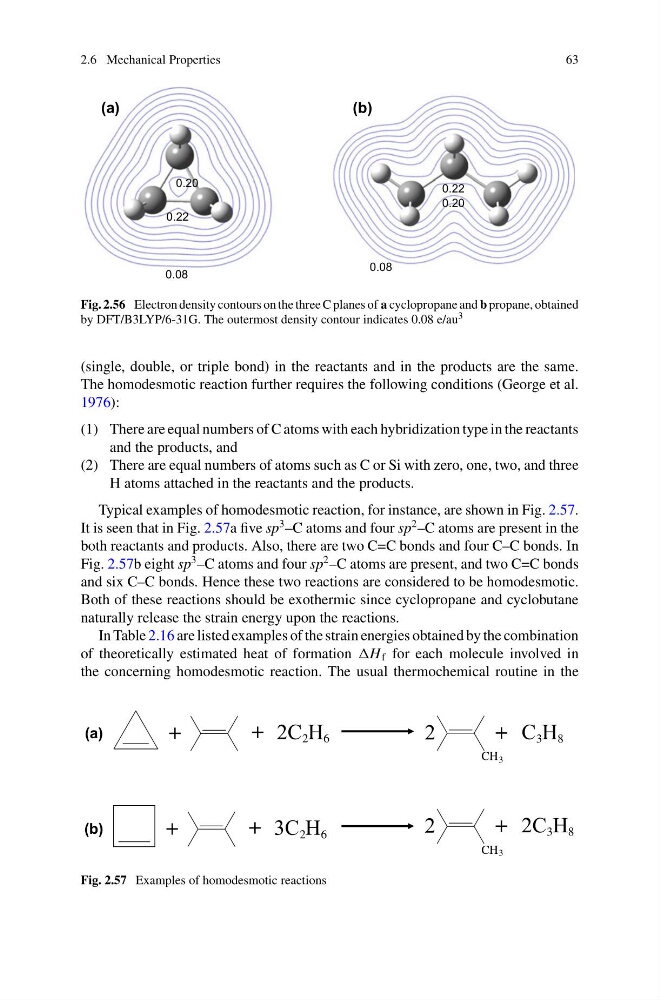
Fig. 2.56 Electron density contours on the three C planes of a cyclopropane and b propane, obtained
by DFT/B3LYP/6-31G. The outermost density contour indicates 0.08 e/au 3
(single, double, or triple bond) in the reactants and in the products are the same.
The homodesmotic reaction further requires the following conditions (George et al.
1976):
(1) There are equal numbers of C atoms with each hybridization type in the reactants
and the products, and
(2) There are equal numbers of atoms such as C or Si with zero, one, two, and three
H atoms attached in the reactants and the products.
Typical examples of homodesmotic reaction, for instance, are shown in Fig. 2.57.
It is seen that in Fig. 2.57a five sp
3 –C atoms and four sp
2 –C atoms are present in the
both reactants and products. Also, there are two C=C bonds and four C–C bonds. In
Fig. 2.57b eight sp
3 –C atoms and four sp
2 –C atoms are present, and two C=C bonds
and six C–C bonds. Hence these two reactions are considered to be homodesmotic.
Both of these reactions should be exothermic since cyclopropane and cyclobutane
naturally release the strain energy upon the reactions.
In Table 2.16 are listed examples of the strain energies obtained by the combination
of theoretically estimated heat of formation f for each molecule involved in
the concerning homodesmotic reaction. The usual thermochemical routine in the
(a)
(b)
2 6
2 6
3 8
3
3
3
8
CH
CH
Fig. 2.57 Examples of homodesmotic reactions
63
(a)
0.22
0.20
0.08
(b)
0.08
0.20
0.22
Fig. 2.56 Electron density contours on the three C planes of a cyclopropane and b propane, obtained
by DFT/B3LYP/6-31G. The outermost density contour indicates 0.08 e/au 3
(single, double, or triple bond) in the reactants and in the products are the same.
The homodesmotic reaction further requires the following conditions (George et al.
1976):
(1) There are equal numbers of C atoms with each hybridization type in the reactants
and the products, and
(2) There are equal numbers of atoms such as C or Si with zero, one, two, and three
H atoms attached in the reactants and the products.
Typical examples of homodesmotic reaction, for instance, are shown in Fig. 2.57.
It is seen that in Fig. 2.57a five sp
3 –C atoms and four sp
2 –C atoms are present in the
both reactants and products. Also, there are two C=C bonds and four C–C bonds. In
Fig. 2.57b eight sp
3 –C atoms and four sp
2 –C atoms are present, and two C=C bonds
and six C–C bonds. Hence these two reactions are considered to be homodesmotic.
Both of these reactions should be exothermic since cyclopropane and cyclobutane
naturally release the strain energy upon the reactions.
In Table 2.16 are listed examples of the strain energies obtained by the combination
of theoretically estimated heat of formation f for each molecule involved in
the concerning homodesmotic reaction. The usual thermochemical routine in the
(a)
(b)
2 6
2 6
3 8
3
3
3
8
CH
CH
Fig. 2.57 Examples of homodesmotic reactions