

28
2 Actual Potentials of Theoretical Chemistry: What Can Be Obtained
HOMO
-6.719 eV
LUMO
0.073 eV
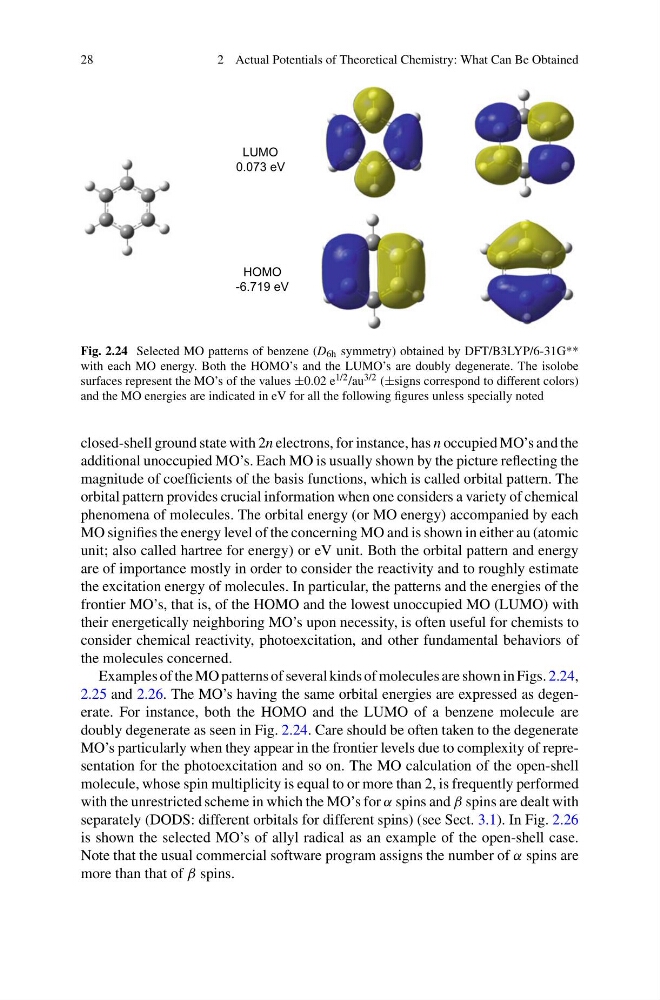
Fig. 2.24 Selected MO patterns of benzene (D 6h symmetry) obtained by DFT/B3LYP/6-31G**
with each MO energy. Both the HOMO’s and the LUMO’s are doubly degenerate. The isolobe
surfaces represent the MO’s of the values ±0.02 e 1/2 /au 3/2 (±signs correspond to different colors)
and the MO energies are indicated in eV for all the following figures unless specially noted
closed-shell ground state with 2n electrons, for instance, has n occupied MO’s and the
additional unoccupied MO’s. Each MO is usually shown by the picture reflecting the
magnitude of coefficients of the basis functions, which is called orbital pattern. The
orbital pattern provides crucial information when one considers a variety of chemical
phenomena of molecules. The orbital energy (or MO energy) accompanied by each
MO signifies the energy level of the concerning MO and is shown in either au (atomic
unit; also called hartree for energy) or eV unit. Both the orbital pattern and energy
are of importance mostly in order to consider the reactivity and to roughly estimate
the excitation energy of molecules. In particular, the patterns and the energies of the
frontier MO’s, that is, of the HOMO and the lowest unoccupied MO (LUMO) with
their energetically neighboring MO’s upon necessity, is often useful for chemists to
consider chemical reactivity, photoexcitation, and other fundamental behaviors of
the molecules concerned.
Examples of the MO patterns of several kinds of molecules are shown in Figs. 2.24,
2.25 and 2.26. The MO’s having the same orbital energies are expressed as degenerate. For instance, both the HOMO and the LUMO of a benzene molecule are
doubly degenerate as seen in Fig. 2.24. Care should be often taken to the degenerate
MO’s particularly when they appear in the frontier levels due to complexity of representation for the photoexcitation and so on. The MO calculation of the open-shell
molecule, whose spin multiplicity is equal to or more than 2, is frequently performed
with the unrestricted scheme in which the MO’s for α spins and β spins are dealt with
separately (DODS: different orbitals for different spins) (see Sect. 3.1). In Fig. 2.26
is shown the selected MO’s of allyl radical as an example of the open-shell case.
Note that the usual commercial software program assigns the number of α spins are
more than that of β spins.
2 Actual Potentials of Theoretical Chemistry: What Can Be Obtained
HOMO
-6.719 eV
LUMO
0.073 eV
Fig. 2.24 Selected MO patterns of benzene (D 6h symmetry) obtained by DFT/B3LYP/6-31G**
with each MO energy. Both the HOMO’s and the LUMO’s are doubly degenerate. The isolobe
surfaces represent the MO’s of the values ±0.02 e 1/2 /au 3/2 (±signs correspond to different colors)
and the MO energies are indicated in eV for all the following figures unless specially noted
closed-shell ground state with 2n electrons, for instance, has n occupied MO’s and the
additional unoccupied MO’s. Each MO is usually shown by the picture reflecting the
magnitude of coefficients of the basis functions, which is called orbital pattern. The
orbital pattern provides crucial information when one considers a variety of chemical
phenomena of molecules. The orbital energy (or MO energy) accompanied by each
MO signifies the energy level of the concerning MO and is shown in either au (atomic
unit; also called hartree for energy) or eV unit. Both the orbital pattern and energy
are of importance mostly in order to consider the reactivity and to roughly estimate
the excitation energy of molecules. In particular, the patterns and the energies of the
frontier MO’s, that is, of the HOMO and the lowest unoccupied MO (LUMO) with
their energetically neighboring MO’s upon necessity, is often useful for chemists to
consider chemical reactivity, photoexcitation, and other fundamental behaviors of
the molecules concerned.
Examples of the MO patterns of several kinds of molecules are shown in Figs. 2.24,
2.25 and 2.26. The MO’s having the same orbital energies are expressed as degenerate. For instance, both the HOMO and the LUMO of a benzene molecule are
doubly degenerate as seen in Fig. 2.24. Care should be often taken to the degenerate
MO’s particularly when they appear in the frontier levels due to complexity of representation for the photoexcitation and so on. The MO calculation of the open-shell
molecule, whose spin multiplicity is equal to or more than 2, is frequently performed
with the unrestricted scheme in which the MO’s for α spins and β spins are dealt with
separately (DODS: different orbitals for different spins) (see Sect. 3.1). In Fig. 2.26
is shown the selected MO’s of allyl radical as an example of the open-shell case.
Note that the usual commercial software program assigns the number of α spins are
more than that of β spins.