

2.2 Chemical Bonds
27
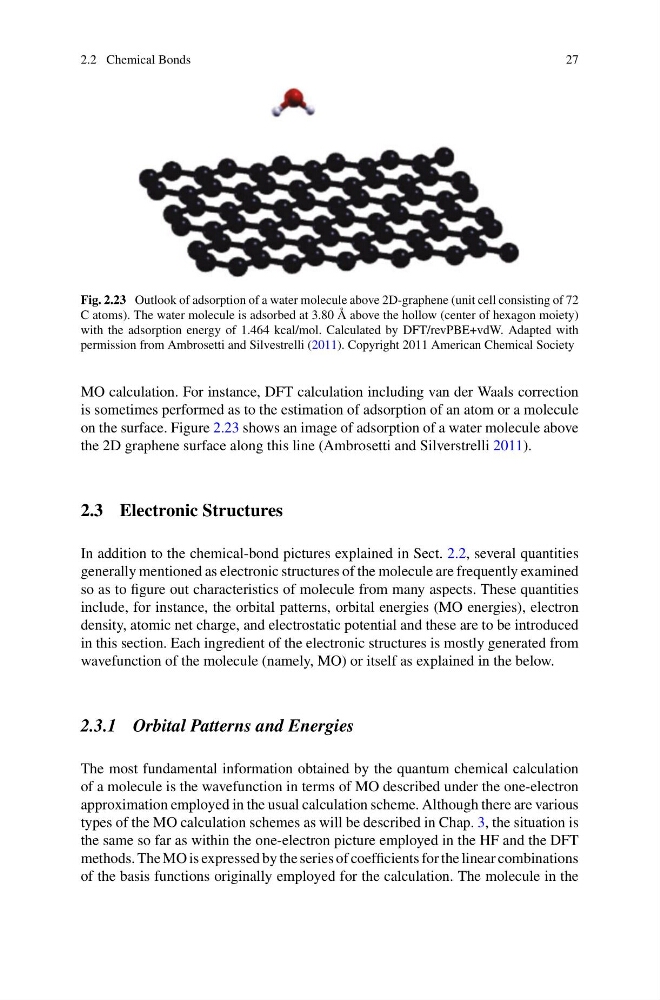
Fig. 2.23 Outlook of adsorption of a water molecule above 2D-graphene (unit cell consisting of 72
C atoms). The water molecule is adsorbed at 3.80 Å above the hollow (center of hexagon moiety)
with the adsorption energy of 1.464 kcal/mol. Calculated by DFT/revPBE+vdW. Adapted with
permission from Ambrosetti and Silvestrelli (2011). Copyright 2011 American Chemical Society
MO calculation. For instance, DFT calculation including van der Waals correction
is sometimes performed as to the estimation of adsorption of an atom or a molecule
on the surface. Figure 2.23 shows an image of adsorption of a water molecule above
the 2D graphene surface along this line (Ambrosetti and Silverstrelli 2011).
2.3 Electronic Structures
In addition to the chemical-bond pictures explained in Sect. 2.2, several quantities
generally mentioned as electronic structures of the molecule are frequently examined
so as to figure out characteristics of molecule from many aspects. These quantities
include, for instance, the orbital patterns, orbital energies (MO energies), electron
density, atomic net charge, and electrostatic potential and these are to be introduced
in this section. Each ingredient of the electronic structures is mostly generated from
wavefunction of the molecule (namely, MO) or itself as explained in the below.
2.3.1 Orbital Patterns and Energies
The most fundamental information obtained by the quantum chemical calculation
of a molecule is the wavefunction in terms of MO described under the one-electron
approximation employed in the usual calculation scheme. Although there are various
types of the MO calculation schemes as will be described in Chap. 3, the situation is
the same so far as within the one-electron picture employed in the HF and the DFT
methods. The MO is expressed by the series of coefficients for the linear combinations
of the basis functions originally employed for the calculation. The molecule in the
27
Fig. 2.23 Outlook of adsorption of a water molecule above 2D-graphene (unit cell consisting of 72
C atoms). The water molecule is adsorbed at 3.80 Å above the hollow (center of hexagon moiety)
with the adsorption energy of 1.464 kcal/mol. Calculated by DFT/revPBE+vdW. Adapted with
permission from Ambrosetti and Silvestrelli (2011). Copyright 2011 American Chemical Society
MO calculation. For instance, DFT calculation including van der Waals correction
is sometimes performed as to the estimation of adsorption of an atom or a molecule
on the surface. Figure 2.23 shows an image of adsorption of a water molecule above
the 2D graphene surface along this line (Ambrosetti and Silverstrelli 2011).
2.3 Electronic Structures
In addition to the chemical-bond pictures explained in Sect. 2.2, several quantities
generally mentioned as electronic structures of the molecule are frequently examined
so as to figure out characteristics of molecule from many aspects. These quantities
include, for instance, the orbital patterns, orbital energies (MO energies), electron
density, atomic net charge, and electrostatic potential and these are to be introduced
in this section. Each ingredient of the electronic structures is mostly generated from
wavefunction of the molecule (namely, MO) or itself as explained in the below.
2.3.1 Orbital Patterns and Energies
The most fundamental information obtained by the quantum chemical calculation
of a molecule is the wavefunction in terms of MO described under the one-electron
approximation employed in the usual calculation scheme. Although there are various
types of the MO calculation schemes as will be described in Chap. 3, the situation is
the same so far as within the one-electron picture employed in the HF and the DFT
methods. The MO is expressed by the series of coefficients for the linear combinations
of the basis functions originally employed for the calculation. The molecule in the