

2.2 Chemical Bonds
23
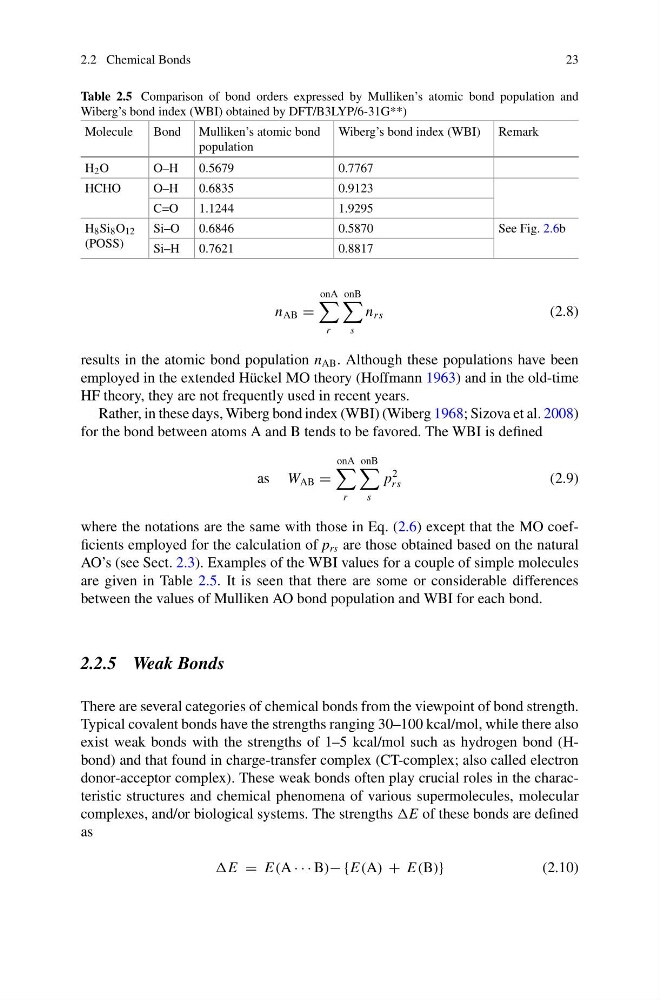
Table 2.5 Comparison of bond orders expressed by Mulliken’s atomic bond population and
Wiberg’s bond index (WBI) obtained by DFT/B3LYP/6-31G**)
Molecule
Bond Mulliken’s atomic bond
population
Wiberg’s bond index (WBI) Remark
H 2 O
O–H
0.5679
0.7767
HCHO
O–H
0.6835
0.9123
C=O
1.1244
1.9295
H 8 Si 8 O 12
(POSS)
Si–O
0.6846
0.5870
See Fig. 2.6b
Si–H
0.7621
0.8817
n AB =
onA
r
onB
s
n rs
(2.8)
results in the atomic bond population n AB . Although these populations have been
employed in the extended Hückel MO theory (Hoffmann 1963) and in the old-time
HF theory, they are not frequently used in recent years.
Rather, in these days, Wiberg bond index (WBI) (Wiberg 1968; Sizova et al. 2008)
for the bond between atoms A and B tends to be favored. The WBI is defined
as W AB =
onA
r
onB
s
p
2
rs
(2.9)
where the notations are the same with those in Eq. (2.6) except that the MO coefficients employed for the calculation of p rs are those obtained based on the natural
AO’s (see Sect. 2.3). Examples of the WBI values for a couple of simple molecules
are given in Table 2.5. It is seen that there are some or considerable differences
between the values of Mulliken AO bond population and WBI for each bond.
2.2.5 Weak Bonds
There are several categories of chemical bonds from the viewpoint of bond strength.
Typical covalent bonds have the strengths ranging 30–100 kcal/mol, while there also
exist weak bonds with the strengths of 1–5 kcal/mol such as hydrogen bond (Hbond) and that found in charge-transfer complex (CT-complex; also called electron
donor-acceptor complex). These weak bonds often play crucial roles in the characteristic structures and chemical phenomena of various supermolecules, molecular
complexes, and/or biological systems. The strengths E of these bonds are defined
as
E = E(A · · · B)− {E(A) + E(B)}
(2.10)
23
Table 2.5 Comparison of bond orders expressed by Mulliken’s atomic bond population and
Wiberg’s bond index (WBI) obtained by DFT/B3LYP/6-31G**)
Molecule
Bond Mulliken’s atomic bond
population
Wiberg’s bond index (WBI) Remark
H 2 O
O–H
0.5679
0.7767
HCHO
O–H
0.6835
0.9123
C=O
1.1244
1.9295
H 8 Si 8 O 12
(POSS)
Si–O
0.6846
0.5870
See Fig. 2.6b
Si–H
0.7621
0.8817
n AB =
onA
r
onB
s
n rs
(2.8)
results in the atomic bond population n AB . Although these populations have been
employed in the extended Hückel MO theory (Hoffmann 1963) and in the old-time
HF theory, they are not frequently used in recent years.
Rather, in these days, Wiberg bond index (WBI) (Wiberg 1968; Sizova et al. 2008)
for the bond between atoms A and B tends to be favored. The WBI is defined
as W AB =
onA
r
onB
s
p
2
rs
(2.9)
where the notations are the same with those in Eq. (2.6) except that the MO coefficients employed for the calculation of p rs are those obtained based on the natural
AO’s (see Sect. 2.3). Examples of the WBI values for a couple of simple molecules
are given in Table 2.5. It is seen that there are some or considerable differences
between the values of Mulliken AO bond population and WBI for each bond.
2.2.5 Weak Bonds
There are several categories of chemical bonds from the viewpoint of bond strength.
Typical covalent bonds have the strengths ranging 30–100 kcal/mol, while there also
exist weak bonds with the strengths of 1–5 kcal/mol such as hydrogen bond (Hbond) and that found in charge-transfer complex (CT-complex; also called electron
donor-acceptor complex). These weak bonds often play crucial roles in the characteristic structures and chemical phenomena of various supermolecules, molecular
complexes, and/or biological systems. The strengths E of these bonds are defined
as
E = E(A · · · B)− {E(A) + E(B)}
(2.10)