

156
4 Toward More Sophisticated Problems
Au
Si
R
Au -SiR
-SR
Fig. 4.1 Schematic drawings of connection of molecular wire R via various anchors (S, Si, and C)
to the external bulk electrode (Au or Si)
bound to the Si electrode gives another possibility. The molecular wire R is further
connected to the core molecule of nanodevices through a certain chemical bond.
Among those, the most popular connection has been established by –SH anchor
to the Au electrode (Lindstrom et al. 2005). The valence electrons of Au atom are
in the 5d
10 6s
1 configuration and the Fermi level of Au bulk consists of 6s band.
The chemical bond picture for –S–Au linkage has not necessarily become clear. For
instance, it is still controversial which of 6s or 5d AO’s mainly contributes to the
Au–S bond (Tachibana et al. 2002; Di Felice et al. 2003).
In this section, a theoretical attempt to clarify this point using the concept of
natural bond orbital (NBO) is to be introduced. To represent the Au electrode, a
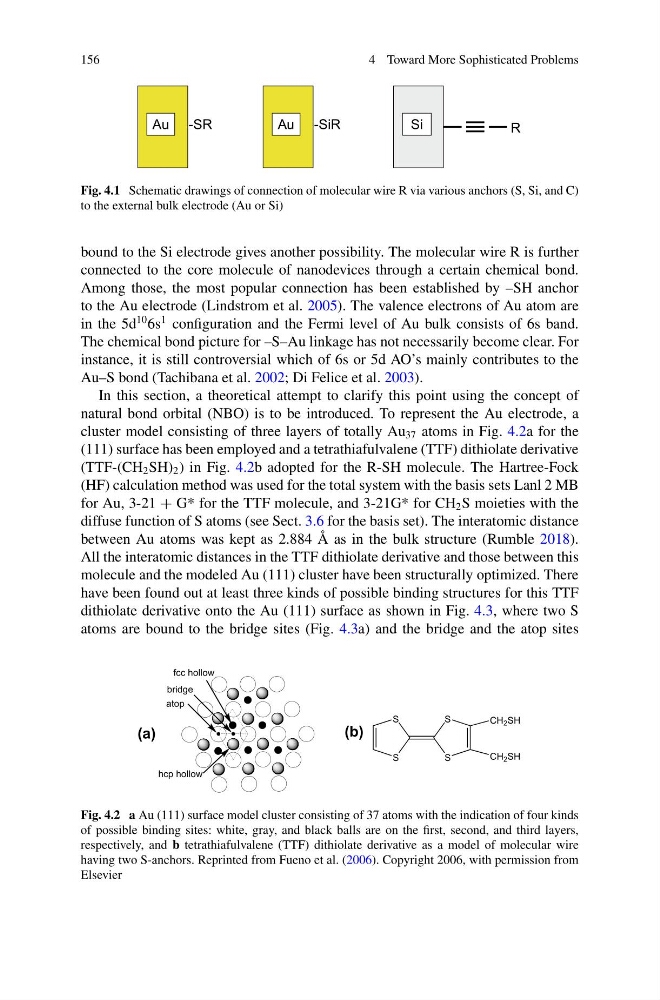
cluster model consisting of three layers of totally Au 37 atoms in Fig. 4.2a for the
(111) surface has been employed and a tetrathiafulvalene (TTF) dithiolate derivative
(TTF-(CH 2 SH) 2 ) in Fig. 4.2b adopted for the R-SH molecule. The Hartree-Fock
(HF) calculation method was used for the total system with the basis sets Lanl 2 MB
for Au, 3-21 + G* for the TTF molecule, and 3-21G* for CH 2 S moieties with the
diffuse function of S atoms (see Sect. 3.6 for the basis set). The interatomic distance
between Au atoms was kept as 2.884 Å as in the bulk structure (Rumble 2018).
All the interatomic distances in the TTF dithiolate derivative and those between this
molecule and the modeled Au (111) cluster have been structurally optimized. There
have been found out at least three kinds of possible binding structures for this TTF
dithiolate derivative onto the Au (111) surface as shown in Fig. 4.3, where two S
atoms are bound to the bridge sites (Fig. 4.3a) and the bridge and the atop sites
S
S
S
S
CH 2 SH
CH 2 SH
fcc hollow
bridge
atop
hcp hollow
(a)
(b)
Fig. 4.2 a Au (111) surface model cluster consisting of 37 atoms with the indication of four kinds
of possible binding sites: white, gray, and black balls are on the first, second, and third layers,
respectively, and b tetrathiafulvalene (TTF) dithiolate derivative as a model of molecular wire
having two S-anchors. Reprinted from Fueno et al. (2006). Copyright 2006, with permission from
Elsevier
4 Toward More Sophisticated Problems
Au
Si
R
Au -SiR
-SR
Fig. 4.1 Schematic drawings of connection of molecular wire R via various anchors (S, Si, and C)
to the external bulk electrode (Au or Si)
bound to the Si electrode gives another possibility. The molecular wire R is further
connected to the core molecule of nanodevices through a certain chemical bond.
Among those, the most popular connection has been established by –SH anchor
to the Au electrode (Lindstrom et al. 2005). The valence electrons of Au atom are
in the 5d
10 6s
1 configuration and the Fermi level of Au bulk consists of 6s band.
The chemical bond picture for –S–Au linkage has not necessarily become clear. For
instance, it is still controversial which of 6s or 5d AO’s mainly contributes to the
Au–S bond (Tachibana et al. 2002; Di Felice et al. 2003).
In this section, a theoretical attempt to clarify this point using the concept of
natural bond orbital (NBO) is to be introduced. To represent the Au electrode, a
cluster model consisting of three layers of totally Au 37 atoms in Fig. 4.2a for the
(111) surface has been employed and a tetrathiafulvalene (TTF) dithiolate derivative
(TTF-(CH 2 SH) 2 ) in Fig. 4.2b adopted for the R-SH molecule. The Hartree-Fock
(HF) calculation method was used for the total system with the basis sets Lanl 2 MB
for Au, 3-21 + G* for the TTF molecule, and 3-21G* for CH 2 S moieties with the
diffuse function of S atoms (see Sect. 3.6 for the basis set). The interatomic distance
between Au atoms was kept as 2.884 Å as in the bulk structure (Rumble 2018).
All the interatomic distances in the TTF dithiolate derivative and those between this
molecule and the modeled Au (111) cluster have been structurally optimized. There
have been found out at least three kinds of possible binding structures for this TTF
dithiolate derivative onto the Au (111) surface as shown in Fig. 4.3, where two S
atoms are bound to the bridge sites (Fig. 4.3a) and the bridge and the atop sites
S
S
S
S
CH 2 SH
CH 2 SH
fcc hollow
bridge
atop
hcp hollow
(a)
(b)
Fig. 4.2 a Au (111) surface model cluster consisting of 37 atoms with the indication of four kinds
of possible binding sites: white, gray, and black balls are on the first, second, and third layers,
respectively, and b tetrathiafulvalene (TTF) dithiolate derivative as a model of molecular wire
having two S-anchors. Reprinted from Fueno et al. (2006). Copyright 2006, with permission from
Elsevier