

138
3 Fundamentals of the Analysis Tools
3.5 ONIOM Method
3.5.1 Concept of the ONIOM
For large or huge molecules such as polypeptides or nucleic acids, the orthodox MO
calculation would be too much time consuming and may not be practical. In such
a case, it is sometimes convenient to partition the whole molecule into a couple of
“layers” and choose the degree of precision of MO calculation for each layer.
One of such and popular frameworks is ONIOM (Our own n-layered integrated
molecular orbital and molecular mechanics) method (Svensson et al. 1999), in which
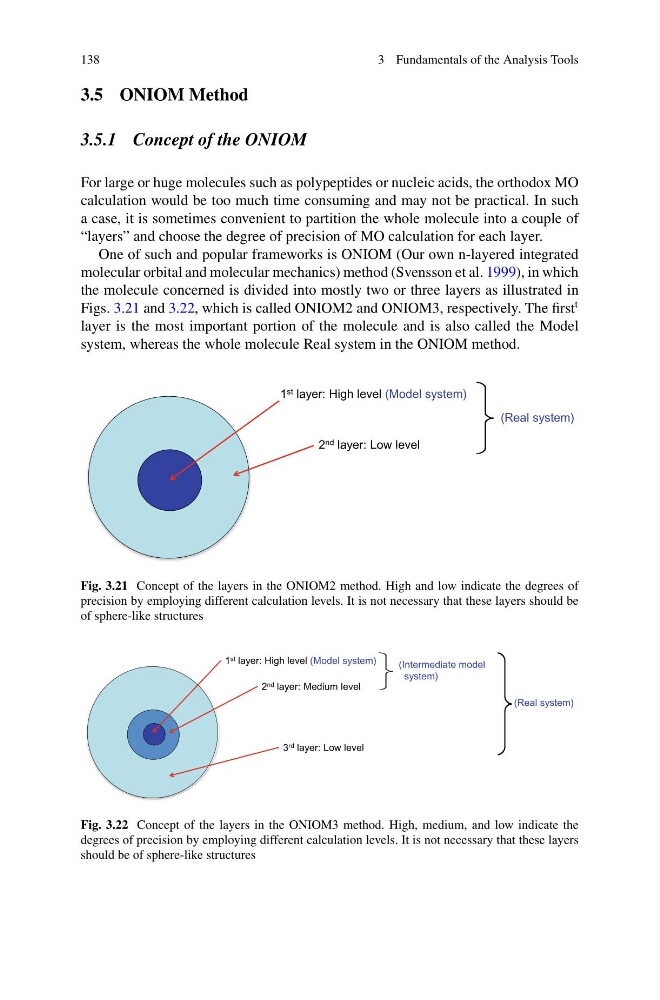
the molecule concerned is divided into mostly two or three layers as illustrated in
Figs. 3.21 and 3.22, which is called ONIOM2 and ONIOM3, respectively. The first
t
layer is the most important portion of the molecule and is also called the Model
system, whereas the whole molecule Real system in the ONIOM method.
1 st layer: High level (Model system)
2 nd layer: Low level
(Real system)
Fig. 3.21 Concept of the layers in the ONIOM2 method. High and low indicate the degrees of
precision by employing different calculation levels. It is not necessary that these layers should be
of sphere-like structures
1 st layer: High level (Model system)
2 nd layer: Medium level
3 rd layer: Low level
(Real system)
(Intermediate model
system)
Fig. 3.22 Concept of the layers in the ONIOM3 method. High, medium, and low indicate the
degrees of precision by employing different calculation levels. It is not necessary that these layers
should be of sphere-like structures
3 Fundamentals of the Analysis Tools
3.5 ONIOM Method
3.5.1 Concept of the ONIOM
For large or huge molecules such as polypeptides or nucleic acids, the orthodox MO
calculation would be too much time consuming and may not be practical. In such
a case, it is sometimes convenient to partition the whole molecule into a couple of
“layers” and choose the degree of precision of MO calculation for each layer.
One of such and popular frameworks is ONIOM (Our own n-layered integrated
molecular orbital and molecular mechanics) method (Svensson et al. 1999), in which
the molecule concerned is divided into mostly two or three layers as illustrated in
Figs. 3.21 and 3.22, which is called ONIOM2 and ONIOM3, respectively. The first
t
layer is the most important portion of the molecule and is also called the Model
system, whereas the whole molecule Real system in the ONIOM method.
1 st layer: High level (Model system)
2 nd layer: Low level
(Real system)
Fig. 3.21 Concept of the layers in the ONIOM2 method. High and low indicate the degrees of
precision by employing different calculation levels. It is not necessary that these layers should be
of sphere-like structures
1 st layer: High level (Model system)
2 nd layer: Medium level
3 rd layer: Low level
(Real system)
(Intermediate model
system)
Fig. 3.22 Concept of the layers in the ONIOM3 method. High, medium, and low indicate the
degrees of precision by employing different calculation levels. It is not necessary that these layers
should be of sphere-like structures