

3.3 Crystal Orbital (CO) Calculations
127
Energy (eV)
LU
HO
Density of states (DOS)
(arbitrary units)
-10
-8
-6
-4
-2
0
2
4
Wave vector k
0
/a
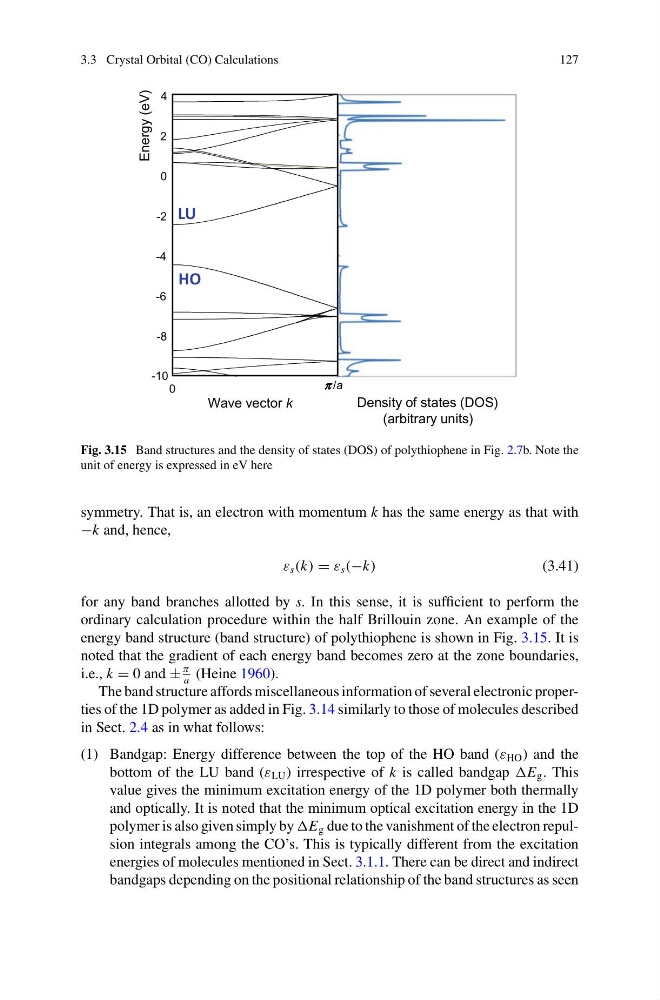
Fig. 3.15 Band structures and the density of states (DOS) of polythiophene in Fig. 2.7b. Note the
unit of energy is expressed in eV here
symmetry. That is, an electron with momentum k has the same energy as that with
−k and, hence,
ε s (k) = ε s (−k)
(3.41)
for any band branches allotted by s. In this sense, it is sufficient to perform the
ordinary calculation procedure within the half Brillouin zone. An example of the
energy band structure (band structure) of polythiophene is shown in Fig. 3.15. It is
noted that the gradient of each energy band becomes zero at the zone boundaries,
i.e., k = 0 and ±
π
a
(Heine 1960).
The band structure affords miscellaneous information of several electronic properties of the 1D polymer as added in Fig. 3.14 similarly to those of molecules described
in Sect. 2.4 as in what follows:
(1) Bandgap: Energy difference between the top of the HO band (ε HO ) and the
bottom of the LU band (ε LU ) irrespective of k is called bandgap g . This
value gives the minimum excitation energy of the 1D polymer both thermally
and optically. It is noted that the minimum optical excitation energy in the 1D
polymer is also given simply by g due to the vanishment of the electron repulsion integrals among the CO’s. This is typically different from the excitation
energies of molecules mentioned in Sect. 3.1.1. There can be direct and indirect
bandgaps depending on the positional relationship of the band structures as seen
127
Energy (eV)
LU
HO
Density of states (DOS)
(arbitrary units)
-10
-8
-6
-4
-2
0
2
4
Wave vector k
0
/a
Fig. 3.15 Band structures and the density of states (DOS) of polythiophene in Fig. 2.7b. Note the
unit of energy is expressed in eV here
symmetry. That is, an electron with momentum k has the same energy as that with
−k and, hence,
ε s (k) = ε s (−k)
(3.41)
for any band branches allotted by s. In this sense, it is sufficient to perform the
ordinary calculation procedure within the half Brillouin zone. An example of the
energy band structure (band structure) of polythiophene is shown in Fig. 3.15. It is
noted that the gradient of each energy band becomes zero at the zone boundaries,
i.e., k = 0 and ±
π
a
(Heine 1960).
The band structure affords miscellaneous information of several electronic properties of the 1D polymer as added in Fig. 3.14 similarly to those of molecules described
in Sect. 2.4 as in what follows:
(1) Bandgap: Energy difference between the top of the HO band (ε HO ) and the
bottom of the LU band (ε LU ) irrespective of k is called bandgap g . This
value gives the minimum excitation energy of the 1D polymer both thermally
and optically. It is noted that the minimum optical excitation energy in the 1D
polymer is also given simply by g due to the vanishment of the electron repulsion integrals among the CO’s. This is typically different from the excitation
energies of molecules mentioned in Sect. 3.1.1. There can be direct and indirect
bandgaps depending on the positional relationship of the band structures as seen