

122
3 Fundamentals of the Analysis Tools
0 ≤ k <
2π
a
or −
π
a
≤ k <
π
a
(3.38)
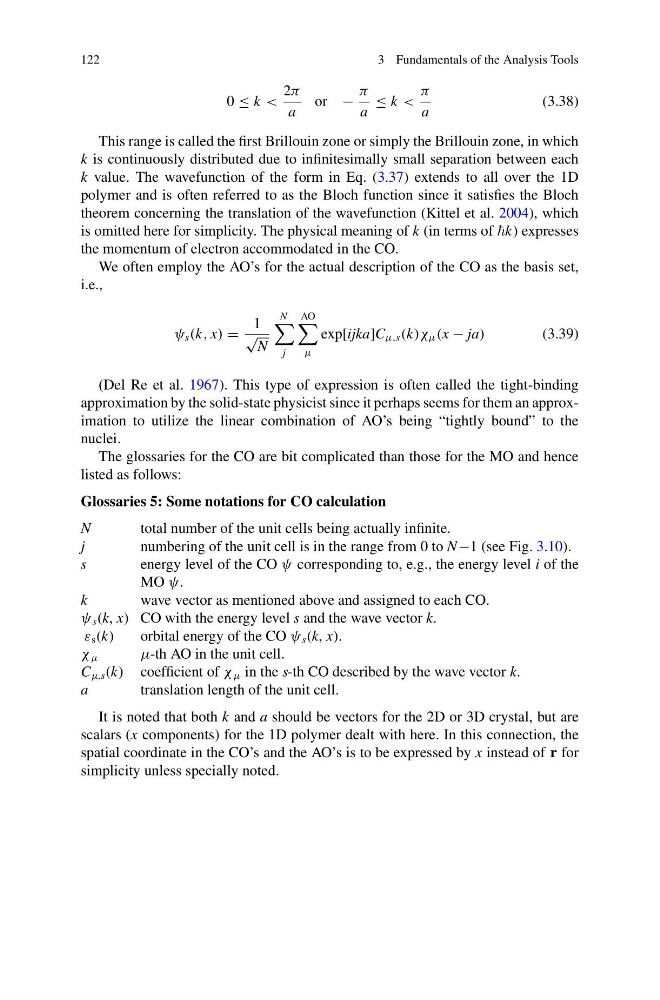
This range is called the first Brillouin zone or simply the Brillouin zone, in which
k is continuously distributed due to infinitesimally small separation between each
k value. The wavefunction of the form in Eq. (3.37) extends to all over the 1D
polymer and is often referred to as the Bloch function since it satisfies the Bloch
theorem concerning the translation of the wavefunction (Kittel et al. 2004), which
is omitted here for simplicity. The physical meaning of k (in terms of k) expresses
the momentum of electron accommodated in the CO.
We often employ the AO’s for the actual description of the CO as the basis set,
i.e.,
ψ s (k, x) =
1
√
N
N
j
AO
μ
exp[ijka]C μ,s (k)χ μ (x − ja)
(3.39)
(Del Re et al. 1967). This type of expression is often called the tight-binding
approximation by the solid-state physicist since it perhaps seems for them an approximation to utilize the linear combination of AO’s being “tightly bound” to the
nuclei.
The glossaries for the CO are bit complicated than those for the MO and hence
listed as follows:
Glossaries 5: Some notations for CO calculation
N
total number of the unit cells being actually infinite.
j
numbering of the unit cell is in the range from 0 to N−1 (see Fig. 3.10).
s
energy level of the CO ψ corresponding to, e.g., the energy level i of the
MO ψ.
k
wave vector as mentioned above and assigned to each CO.
ψ s (k, x) CO with the energy level s and the wave vector k.
ε s (k)
orbital energy of the CO ψ s (k, x).
χ μ
μ-th AO in the unit cell.
C μ,s (k) coefficient of χ μ in the s-th CO described by the wave vector k.
a
translation length of the unit cell.
It is noted that both k and a should be vectors for the 2D or 3D crystal, but are
scalars (x components) for the 1D polymer dealt with here. In this connection, the
spatial coordinate in the CO’s and the AO’s is to be expressed by x instead of r for
simplicity unless specially noted.
3 Fundamentals of the Analysis Tools
0 ≤ k <
2π
a
or −
π
a
≤ k <
π
a
(3.38)
This range is called the first Brillouin zone or simply the Brillouin zone, in which
k is continuously distributed due to infinitesimally small separation between each
k value. The wavefunction of the form in Eq. (3.37) extends to all over the 1D
polymer and is often referred to as the Bloch function since it satisfies the Bloch
theorem concerning the translation of the wavefunction (Kittel et al. 2004), which
is omitted here for simplicity. The physical meaning of k (in terms of k) expresses
the momentum of electron accommodated in the CO.
We often employ the AO’s for the actual description of the CO as the basis set,
i.e.,
ψ s (k, x) =
1
√
N
N
j
AO
μ
exp[ijka]C μ,s (k)χ μ (x − ja)
(3.39)
(Del Re et al. 1967). This type of expression is often called the tight-binding
approximation by the solid-state physicist since it perhaps seems for them an approximation to utilize the linear combination of AO’s being “tightly bound” to the
nuclei.
The glossaries for the CO are bit complicated than those for the MO and hence
listed as follows:
Glossaries 5: Some notations for CO calculation
N
total number of the unit cells being actually infinite.
j
numbering of the unit cell is in the range from 0 to N−1 (see Fig. 3.10).
s
energy level of the CO ψ corresponding to, e.g., the energy level i of the
MO ψ.
k
wave vector as mentioned above and assigned to each CO.
ψ s (k, x) CO with the energy level s and the wave vector k.
ε s (k)
orbital energy of the CO ψ s (k, x).
χ μ
μ-th AO in the unit cell.
C μ,s (k) coefficient of χ μ in the s-th CO described by the wave vector k.
a
translation length of the unit cell.
It is noted that both k and a should be vectors for the 2D or 3D crystal, but are
scalars (x components) for the 1D polymer dealt with here. In this connection, the
spatial coordinate in the CO’s and the AO’s is to be expressed by x instead of r for
simplicity unless specially noted.