

The index superposition method has the advantages of simple operation, easy
acquisition of indicator data, and low cost. However, the dominant use of linear
models increases subjectivity in indicator selection, rating, and final risk determination. The results are too general to reflect the specific migration and attenuation
process of external pollutants, so the method is not suitable for risk assessment of
single-point source pollution. In the process of indicator selection, the causal
connection between indicators should be considered to avoid the repeatability of
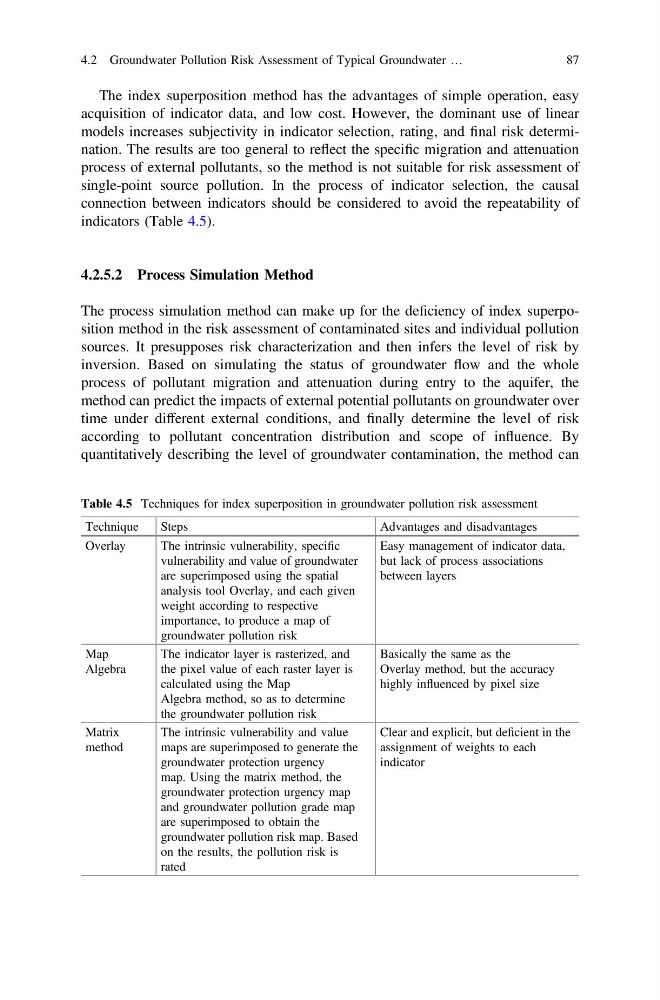
indicators (Table 4.5).
4.2.5.2 Process Simulation Method
The process simulation method can make up for the deficiency of index superposition method in the risk assessment of contaminated sites and individual pollution
sources. It presupposes risk characterization and then infers the level of risk by
inversion. Based on simulating the status of groundwater flow and the whole
process of pollutant migration and attenuation during entry to the aquifer, the
method can predict the impacts of external potential pollutants on groundwater over
time under different external conditions, and finally determine the level of risk
according to pollutant concentration distribution and scope of influence. By
quantitatively describing the level of groundwater contamination, the method can
Table 4.5 Techniques for index superposition in groundwater pollution risk assessment
Technique
Steps
Advantages and disadvantages
Overlay
The intrinsic vulnerability, specific
vulnerability and value of groundwater
are superimposed using the spatial
analysis tool Overlay, and each given
weight according to respective
importance, to produce a map of
groundwater pollution risk
Easy management of indicator data,
but lack of process associations
between layers
Map
Algebra
The indicator layer is rasterized, and
the pixel value of each raster layer is
calculated using the Map
Algebra method, so as to determine
the groundwater pollution risk
Basically the same as the
Overlay method, but the accuracy
highly influenced by pixel size
Matrix
method
The intrinsic vulnerability and value
maps are superimposed to generate the
groundwater protection urgency
map. Using the matrix method, the
groundwater protection urgency map
and groundwater pollution grade map
are superimposed to obtain the
groundwater pollution risk map. Based
on the results, the pollution risk is
rated
Clear and explicit, but deficient in the
assignment of weights to each
indicator
4.2 Groundwater Pollution Risk Assessment of Typical Groundwater …
87
acquisition of indicator data, and low cost. However, the dominant use of linear
models increases subjectivity in indicator selection, rating, and final risk determination. The results are too general to reflect the specific migration and attenuation
process of external pollutants, so the method is not suitable for risk assessment of
single-point source pollution. In the process of indicator selection, the causal
connection between indicators should be considered to avoid the repeatability of
indicators (Table 4.5).
4.2.5.2 Process Simulation Method
The process simulation method can make up for the deficiency of index superposition method in the risk assessment of contaminated sites and individual pollution
sources. It presupposes risk characterization and then infers the level of risk by
inversion. Based on simulating the status of groundwater flow and the whole
process of pollutant migration and attenuation during entry to the aquifer, the
method can predict the impacts of external potential pollutants on groundwater over
time under different external conditions, and finally determine the level of risk
according to pollutant concentration distribution and scope of influence. By
quantitatively describing the level of groundwater contamination, the method can
Table 4.5 Techniques for index superposition in groundwater pollution risk assessment
Technique
Steps
Advantages and disadvantages
Overlay
The intrinsic vulnerability, specific
vulnerability and value of groundwater
are superimposed using the spatial
analysis tool Overlay, and each given
weight according to respective
importance, to produce a map of
groundwater pollution risk
Easy management of indicator data,
but lack of process associations
between layers
Map
Algebra
The indicator layer is rasterized, and
the pixel value of each raster layer is
calculated using the Map
Algebra method, so as to determine
the groundwater pollution risk
Basically the same as the
Overlay method, but the accuracy
highly influenced by pixel size
Matrix
method
The intrinsic vulnerability and value
maps are superimposed to generate the
groundwater protection urgency
map. Using the matrix method, the
groundwater protection urgency map
and groundwater pollution grade map
are superimposed to obtain the
groundwater pollution risk map. Based
on the results, the pollution risk is
rated
Clear and explicit, but deficient in the
assignment of weights to each
indicator
4.2 Groundwater Pollution Risk Assessment of Typical Groundwater …
87