

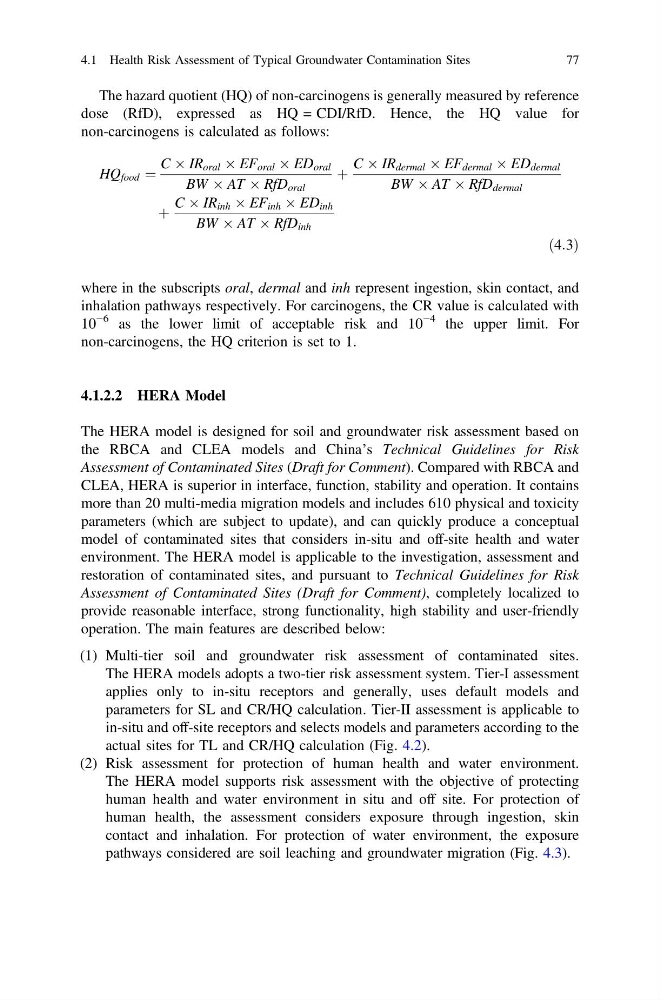
The hazard quotient (HQ) of non-carcinogens is generally measured by reference
dose (RfD), expressed as HQ = CDI/RfD. Hence, the HQ value for
non-carcinogens is calculated as follows:
HQ food ¼
C  IR oral  EF oral  ED oral
BW Â AT Â RfD oral
þ
C  IR dermal  EF dermal  ED dermal
BW Â AT Â RfD dermal
þ
C  IR inh  EF inh  ED inh
BW Â AT Â RfD inh
ð4:3Þ
where in the subscripts oral, dermal and inh represent ingestion, skin contact, and
inhalation pathways respectively. For carcinogens, the CR value is calculated with
10
−6 as the lower limit of acceptable risk and 10
−4 the upper limit. For
non-carcinogens, the HQ criterion is set to 1.
4.1.2.2 HERA Model
The HERA model is designed for soil and groundwater risk assessment based on
the RBCA and CLEA models and China’s Technical Guidelines for Risk
Assessment of Contaminated Sites (Draft for Comment). Compared with RBCA and
CLEA, HERA is superior in interface, function, stability and operation. It contains
more than 20 multi-media migration models and includes 610 physical and toxicity
parameters (which are subject to update), and can quickly produce a conceptual
model of contaminated sites that considers in-situ and off-site health and water
environment. The HERA model is applicable to the investigation, assessment and
restoration of contaminated sites, and pursuant to Technical Guidelines for Risk
Assessment of Contaminated Sites (Draft for Comment), completely localized to
provide reasonable interface, strong functionality, high stability and user-friendly
operation. The main features are described below:
(1) Multi-tier soil and groundwater risk assessment of contaminated sites.
The HERA models adopts a two-tier risk assessment system. Tier-I assessment
applies only to in-situ receptors and generally, uses default models and
parameters for SL and CR/HQ calculation. Tier-II assessment is applicable to
in-situ and off-site receptors and selects models and parameters according to the
actual sites for TL and CR/HQ calculation (Fig. 4.2).
(2) Risk assessment for protection of human health and water environment.
The HERA model supports risk assessment with the objective of protecting
human health and water environment in situ and off site. For protection of
human health, the assessment considers exposure through ingestion, skin
contact and inhalation. For protection of water environment, the exposure
pathways considered are soil leaching and groundwater migration (Fig. 4.3).
4.1 Health Risk Assessment of Typical Groundwater Contamination Sites
77
dose (RfD), expressed as HQ = CDI/RfD. Hence, the HQ value for
non-carcinogens is calculated as follows:
HQ food ¼
C  IR oral  EF oral  ED oral
BW Â AT Â RfD oral
þ
C  IR dermal  EF dermal  ED dermal
BW Â AT Â RfD dermal
þ
C  IR inh  EF inh  ED inh
BW Â AT Â RfD inh
ð4:3Þ
where in the subscripts oral, dermal and inh represent ingestion, skin contact, and
inhalation pathways respectively. For carcinogens, the CR value is calculated with
10
−6 as the lower limit of acceptable risk and 10
−4 the upper limit. For
non-carcinogens, the HQ criterion is set to 1.
4.1.2.2 HERA Model
The HERA model is designed for soil and groundwater risk assessment based on
the RBCA and CLEA models and China’s Technical Guidelines for Risk
Assessment of Contaminated Sites (Draft for Comment). Compared with RBCA and
CLEA, HERA is superior in interface, function, stability and operation. It contains
more than 20 multi-media migration models and includes 610 physical and toxicity
parameters (which are subject to update), and can quickly produce a conceptual
model of contaminated sites that considers in-situ and off-site health and water
environment. The HERA model is applicable to the investigation, assessment and
restoration of contaminated sites, and pursuant to Technical Guidelines for Risk
Assessment of Contaminated Sites (Draft for Comment), completely localized to
provide reasonable interface, strong functionality, high stability and user-friendly
operation. The main features are described below:
(1) Multi-tier soil and groundwater risk assessment of contaminated sites.
The HERA models adopts a two-tier risk assessment system. Tier-I assessment
applies only to in-situ receptors and generally, uses default models and
parameters for SL and CR/HQ calculation. Tier-II assessment is applicable to
in-situ and off-site receptors and selects models and parameters according to the
actual sites for TL and CR/HQ calculation (Fig. 4.2).
(2) Risk assessment for protection of human health and water environment.
The HERA model supports risk assessment with the objective of protecting
human health and water environment in situ and off site. For protection of
human health, the assessment considers exposure through ingestion, skin
contact and inhalation. For protection of water environment, the exposure
pathways considered are soil leaching and groundwater migration (Fig. 4.3).
4.1 Health Risk Assessment of Typical Groundwater Contamination Sites
77