

exposure differs from the point of pollution source, it needs to consider the change
in pollutant concentrations in the lateral distance, i.e. the attenuation of pollutant
concentrations caused by horizontal movement. In contrast, Tier I only considers
the vertical migration of pollutants since only the point of in-situ exposure is
analyzed. Generally, simple analytical modelling is conducted in Tier I and Tier II
to measure the migration and attenuation of pollutants in the environment, and the
predicted concentrations at the point of exposure are higher than the actual concentrations, so TLs determined thereof will also be safe. In Tier III, a more complex
numerical simulation model is used to simulate the migration and attenuation of
pollutants in the environment. Therefore, more thorough site investigation is needed
to obtain a large amount of required hydrogeological and natural degradation
parameters for contaminated sites. In this book, the RBCA model is simplified to
assess health risks in the following steps:
(1) Establish a conceptual model for health risk assessment that takes into account
the excess pollutants from sources, the receptors in the pollution-affected zone,
and the exposure pathways identified through preliminary assessment;
(2) Determine the concentrations of pollutants in the soil based on observational
and experimental data;
(3) Estimate exposure;
(4) Estimate health risks. Based on health assessment results, the urgency of hazard
posed by pollutants to human health are estimated, so that where necessary,
emergency measures are taken at the point of pollution to reduce such hazard.
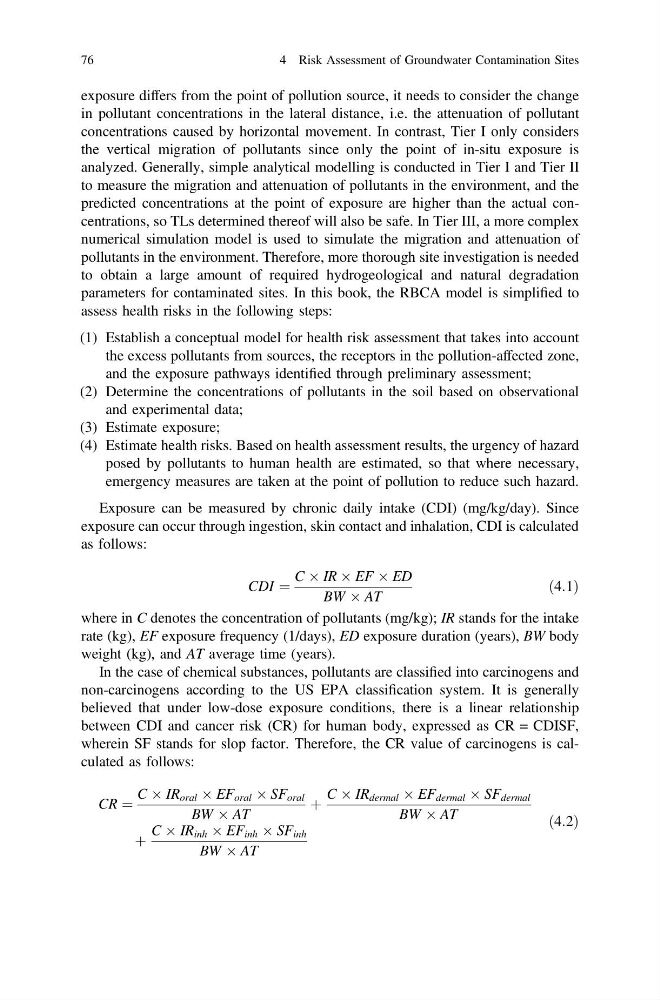
Exposure can be measured by chronic daily intake (CDI) (mg/kg/day). Since
exposure can occur through ingestion, skin contact and inhalation, CDI is calculated
as follows:
CDI ¼
C Â IR Â EF Â ED
BW Â AT
ð4:1Þ
where in C denotes the concentration of pollutants (mg/kg); IR stands for the intake
rate (kg), EF exposure frequency (1/days), ED exposure duration (years), BW body
weight (kg), and AT average time (years).
In the case of chemical substances, pollutants are classified into carcinogens and
non-carcinogens according to the US EPA classification system. It is generally
believed that under low-dose exposure conditions, there is a linear relationship
between CDI and cancer risk (CR) for human body, expressed as CR = CDISF,
wherein SF stands for slop factor. Therefore, the CR value of carcinogens is calculated as follows:
CR ¼
C  IR oral  EF oral  SF oral
BW Â AT
þ
C  IR dermal  EF dermal  SF dermal
BW Â AT
þ
C  IR inh  EF inh  SF inh
BW Â AT
ð4:2Þ
76
4 Risk Assessment of Groundwater Contamination Sites
in pollutant concentrations in the lateral distance, i.e. the attenuation of pollutant
concentrations caused by horizontal movement. In contrast, Tier I only considers
the vertical migration of pollutants since only the point of in-situ exposure is
analyzed. Generally, simple analytical modelling is conducted in Tier I and Tier II
to measure the migration and attenuation of pollutants in the environment, and the
predicted concentrations at the point of exposure are higher than the actual concentrations, so TLs determined thereof will also be safe. In Tier III, a more complex
numerical simulation model is used to simulate the migration and attenuation of
pollutants in the environment. Therefore, more thorough site investigation is needed
to obtain a large amount of required hydrogeological and natural degradation
parameters for contaminated sites. In this book, the RBCA model is simplified to
assess health risks in the following steps:
(1) Establish a conceptual model for health risk assessment that takes into account
the excess pollutants from sources, the receptors in the pollution-affected zone,
and the exposure pathways identified through preliminary assessment;
(2) Determine the concentrations of pollutants in the soil based on observational
and experimental data;
(3) Estimate exposure;
(4) Estimate health risks. Based on health assessment results, the urgency of hazard
posed by pollutants to human health are estimated, so that where necessary,
emergency measures are taken at the point of pollution to reduce such hazard.
Exposure can be measured by chronic daily intake (CDI) (mg/kg/day). Since
exposure can occur through ingestion, skin contact and inhalation, CDI is calculated
as follows:
CDI ¼
C Â IR Â EF Â ED
BW Â AT
ð4:1Þ
where in C denotes the concentration of pollutants (mg/kg); IR stands for the intake
rate (kg), EF exposure frequency (1/days), ED exposure duration (years), BW body
weight (kg), and AT average time (years).
In the case of chemical substances, pollutants are classified into carcinogens and
non-carcinogens according to the US EPA classification system. It is generally
believed that under low-dose exposure conditions, there is a linear relationship
between CDI and cancer risk (CR) for human body, expressed as CR = CDISF,
wherein SF stands for slop factor. Therefore, the CR value of carcinogens is calculated as follows:
CR ¼
C  IR oral  EF oral  SF oral
BW Â AT
þ
C  IR dermal  EF dermal  SF dermal
BW Â AT
þ
C  IR inh  EF inh  SF inh
BW Â AT
ð4:2Þ
76
4 Risk Assessment of Groundwater Contamination Sites