

pollution prevention (V) is integrated as a factor in the calculation, which is
determined according to Table 3.10. In the case of weak pollution prevention, the
comprehensive rating and evaluation of vadose zone will not be conducted. The
mitigation index (DI′) of vadose zone is calculated using Eq. (3.10), and the DI′
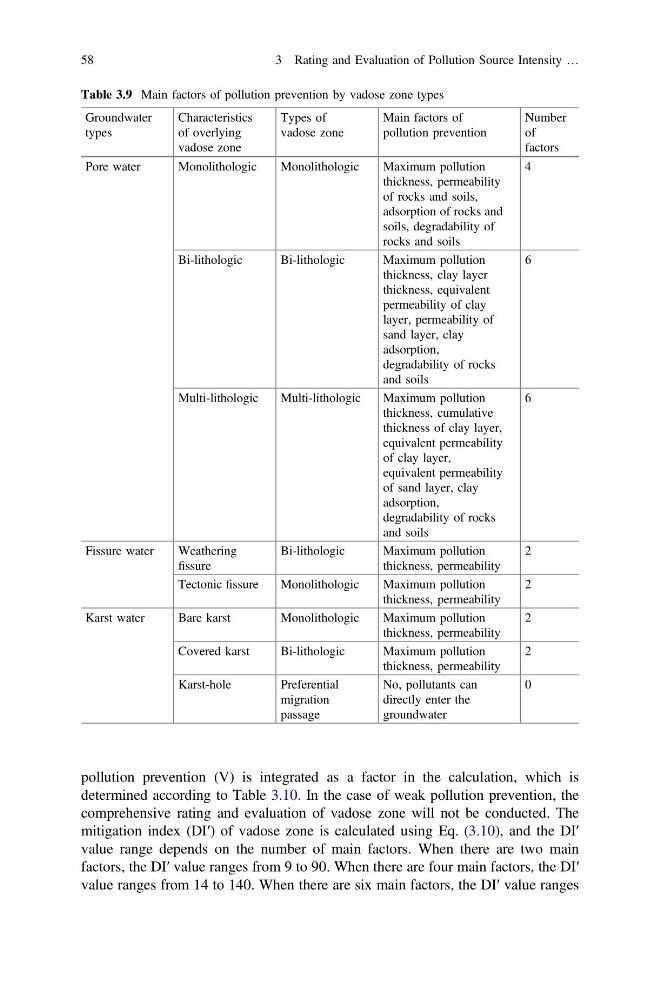
value range depends on the number of main factors. When there are two main
factors, the DI′ value ranges from 9 to 90. When there are four main factors, the DI′
value ranges from 14 to 140. When there are six main factors, the DI′ value ranges
Table 3.9 Main factors of pollution prevention by vadose zone types
Groundwater
types
Characteristics
of overlying
vadose zone
Types of
vadose zone
Main factors of
pollution prevention
Number
of
factors
Pore water
Monolithologic
Monolithologic
Maximum pollution
thickness, permeability
of rocks and soils,
adsorption of rocks and
soils, degradability of
rocks and soils
4
Bi-lithologic
Bi-lithologic
Maximum pollution
thickness, clay layer
thickness, equivalent
permeability of clay
layer, permeability of
sand layer, clay
adsorption,
degradability of rocks
and soils
6
Multi-lithologic
Multi-lithologic
Maximum pollution
thickness, cumulative
thickness of clay layer,
equivalent permeability
of clay layer,
equivalent permeability
of sand layer, clay
adsorption,
degradability of rocks
and soils
6
Fissure water
Weathering
fissure
Bi-lithologic
Maximum pollution
thickness, permeability
2
Tectonic fissure
Monolithologic
Maximum pollution
thickness, permeability
2
Karst water
Bare karst
Monolithologic
Maximum pollution
thickness, permeability
2
Covered karst
Bi-lithologic
Maximum pollution
thickness, permeability
2
Karst-hole
Preferential
migration
passage
No, pollutants can
directly enter the
groundwater
0
58
3 Rating and Evaluation of Pollution Source Intensity …
determined according to Table 3.10. In the case of weak pollution prevention, the
comprehensive rating and evaluation of vadose zone will not be conducted. The
mitigation index (DI′) of vadose zone is calculated using Eq. (3.10), and the DI′
value range depends on the number of main factors. When there are two main
factors, the DI′ value ranges from 9 to 90. When there are four main factors, the DI′
value ranges from 14 to 140. When there are six main factors, the DI′ value ranges
Table 3.9 Main factors of pollution prevention by vadose zone types
Groundwater
types
Characteristics
of overlying
vadose zone
Types of
vadose zone
Main factors of
pollution prevention
Number
of
factors
Pore water
Monolithologic
Monolithologic
Maximum pollution
thickness, permeability
of rocks and soils,
adsorption of rocks and
soils, degradability of
rocks and soils
4
Bi-lithologic
Bi-lithologic
Maximum pollution
thickness, clay layer
thickness, equivalent
permeability of clay
layer, permeability of
sand layer, clay
adsorption,
degradability of rocks
and soils
6
Multi-lithologic
Multi-lithologic
Maximum pollution
thickness, cumulative
thickness of clay layer,
equivalent permeability
of clay layer,
equivalent permeability
of sand layer, clay
adsorption,
degradability of rocks
and soils
6
Fissure water
Weathering
fissure
Bi-lithologic
Maximum pollution
thickness, permeability
2
Tectonic fissure
Monolithologic
Maximum pollution
thickness, permeability
2
Karst water
Bare karst
Monolithologic
Maximum pollution
thickness, permeability
2
Covered karst
Bi-lithologic
Maximum pollution
thickness, permeability
2
Karst-hole
Preferential
migration
passage
No, pollutants can
directly enter the
groundwater
0
58
3 Rating and Evaluation of Pollution Source Intensity …