

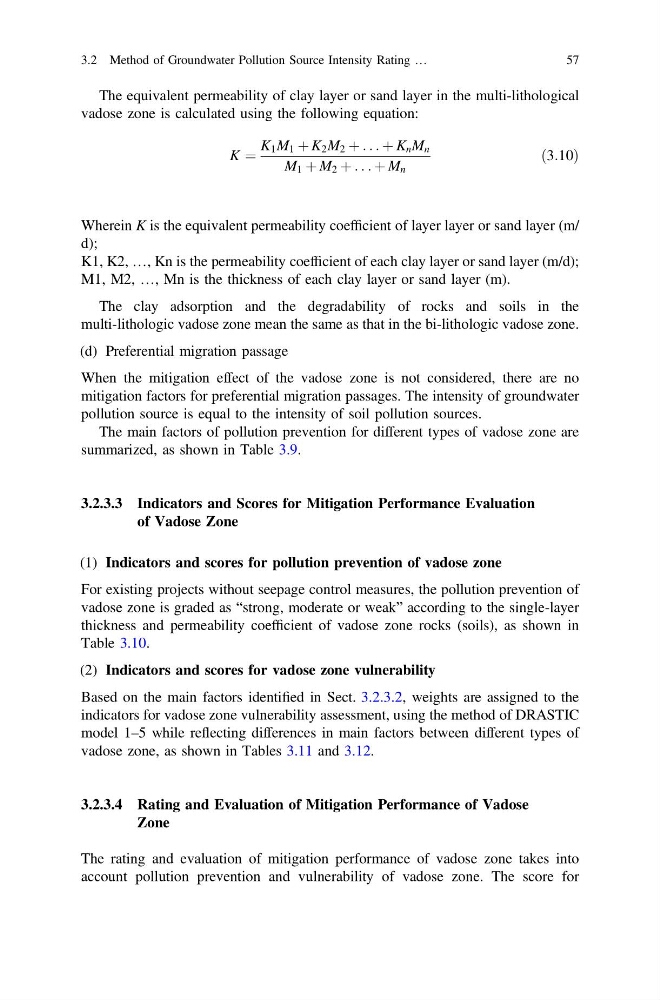
The equivalent permeability of clay layer or sand layer in the multi-lithological
vadose zone is calculated using the following equation:
K ¼
K 1 M 1 þ K 2 M 2 þ . . . þ K n M n
M 1 þ M 2 þ . . . þ M n
ð3:10Þ
Wherein K is the equivalent permeability coefficient of layer layer or sand layer (m/
d);
K1, K2, …, Kn is the permeability coefficient of each clay layer or sand layer (m/d);
M1, M2, …, Mn is the thickness of each clay layer or sand layer (m).
The clay adsorption and the degradability of rocks and soils in the
multi-lithologic vadose zone mean the same as that in the bi-lithologic vadose zone.
(d) Preferential migration passage
When the mitigation effect of the vadose zone is not considered, there are no
mitigation factors for preferential migration passages. The intensity of groundwater
pollution source is equal to the intensity of soil pollution sources.
The main factors of pollution prevention for different types of vadose zone are
summarized, as shown in Table 3.9.
3.2.3.3 Indicators and Scores for Mitigation Performance Evaluation
of Vadose Zone
(1) Indicators and scores for pollution prevention of vadose zone
For existing projects without seepage control measures, the pollution prevention of
vadose zone is graded as “strong, moderate or weak” according to the single-layer
thickness and permeability coefficient of vadose zone rocks (soils), as shown in
Table 3.10.
(2) Indicators and scores for vadose zone vulnerability
Based on the main factors identified in Sect. 3.2.3.2, weights are assigned to the
indicators for vadose zone vulnerability assessment, using the method of DRASTIC
model 1–5 while reflecting differences in main factors between different types of
vadose zone, as shown in Tables 3.11 and 3.12.
3.2.3.4 Rating and Evaluation of Mitigation Performance of Vadose
Zone
The rating and evaluation of mitigation performance of vadose zone takes into
account pollution prevention and vulnerability of vadose zone. The score for
3.2 Method of Groundwater Pollution Source Intensity Rating …
57
vadose zone is calculated using the following equation:
K ¼
K 1 M 1 þ K 2 M 2 þ . . . þ K n M n
M 1 þ M 2 þ . . . þ M n
ð3:10Þ
Wherein K is the equivalent permeability coefficient of layer layer or sand layer (m/
d);
K1, K2, …, Kn is the permeability coefficient of each clay layer or sand layer (m/d);
M1, M2, …, Mn is the thickness of each clay layer or sand layer (m).
The clay adsorption and the degradability of rocks and soils in the
multi-lithologic vadose zone mean the same as that in the bi-lithologic vadose zone.
(d) Preferential migration passage
When the mitigation effect of the vadose zone is not considered, there are no
mitigation factors for preferential migration passages. The intensity of groundwater
pollution source is equal to the intensity of soil pollution sources.
The main factors of pollution prevention for different types of vadose zone are
summarized, as shown in Table 3.9.
3.2.3.3 Indicators and Scores for Mitigation Performance Evaluation
of Vadose Zone
(1) Indicators and scores for pollution prevention of vadose zone
For existing projects without seepage control measures, the pollution prevention of
vadose zone is graded as “strong, moderate or weak” according to the single-layer
thickness and permeability coefficient of vadose zone rocks (soils), as shown in
Table 3.10.
(2) Indicators and scores for vadose zone vulnerability
Based on the main factors identified in Sect. 3.2.3.2, weights are assigned to the
indicators for vadose zone vulnerability assessment, using the method of DRASTIC
model 1–5 while reflecting differences in main factors between different types of
vadose zone, as shown in Tables 3.11 and 3.12.
3.2.3.4 Rating and Evaluation of Mitigation Performance of Vadose
Zone
The rating and evaluation of mitigation performance of vadose zone takes into
account pollution prevention and vulnerability of vadose zone. The score for
3.2 Method of Groundwater Pollution Source Intensity Rating …
57